
Non-FictionMental WealthRemote Work
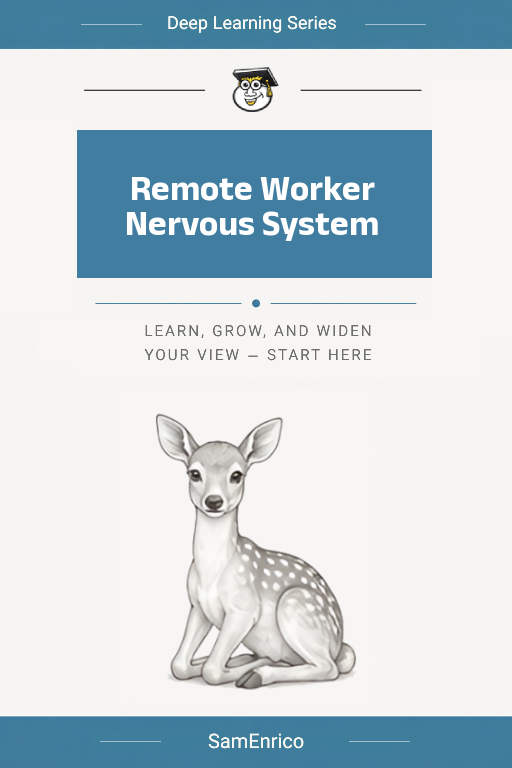
Remote Worker Nervous System eBook
Addresses unique nervous system challenges of remo
Addresses unique nervous system challenges of remote work including isolation, blurred boundaries, and screen fatigue through targeted micro-breaks.
Formats
Free sample
Chapter 1: The Polyvagal Cubicle--–- You are not broken. Your home office is.Before we fix anything, before we talk about micro-breaks or boundaries or breathing, I need you to hear that sentence again. Let it land. Your nervous system – that ancient, brilliant, overprotective machinery inside you – is not malfunctioning. It is not lazy.
It is not weak. It is doing exactly what evolution designed it to do: scanning for threats, mobilizing for action, and shutting down when the danger feels unsurvivable.The problem is that evolution never anticipated Slack notifications.Your brain evolved on the savannas of East Africa, in small tribal bands where threats were physical (a lion, a rival tribe, a snake) and social (expulsion from the group meant death). Every sensory cue had a clear meaning. A rustle in the grass meant predator. A raised eyebrow from a tribe member meant social danger.
A period of silence meant safety – because if no one was shouting, there was probably no lion.Now, you sit in a spare bedroom, a kitchen corner, or a leased desk in a We Work. Your screen lights up with a direct message from your manager. Three dots appear – someone is typing. Your calendar pings: back-to-back Zoom calls for the next four hours. The Slack channel for your project has 147 unread messages.
Your email inbox says 42. Your phone, sitting three inches from your keyboard, buzzes with a news alert.Your brain, still running savanna software, has no category for any of this. So it does the only thing it knows how to do: it guesses.A terse email from your manager? That could be abandonment by the tribe. A blinking Slack icon?
Could be a predator. Four hours of staring at faces on a screen while being watched yourself? That is social threat multiplied by social threat, with no escape route. Hours of silence with no colleagues nearby? That is isolation – and in the ancestral environment, isolation meant death.Your brain, trying to keep you alive, turns on every alarm system it has.This is the polyvagal cubicle.
It is not a physical place. It is a neurological condition created by the collision of ancient survival circuitry with modern work technology. And until you understand it – until you can name what is happening inside your body – you will keep trying productivity hacks, time management systems, and willpower-based solutions that fail because they are aimed at the wrong target.You cannot plan your way out of a physiological state.You can only regulate it.The Three Ghosts of Remote Work Let me introduce you to the three neurological states that dominate remote work. I call them ghosts because they are invisible, they haunt you without warning, and they feel like they come from inside you – when in fact they are summoned by your environment.Ghost One: The Watcher The Watcher is sympathetic overdrive – the classic fight-or-flight response. Your heart rate increases.
Your breathing becomes shallow. Your pupils dilate. Blood moves away from your digestive system and toward your large muscles. Your prefrontal cortex – the part of your brain responsible for executive function, planning, and impulse control – begins to downregulate because in a true survival situation, you do not need to plan a quarterly report. You need to run.What summons The Watcher in remote work?Unpredictable notifications.
Every time your phone buzzes or your Slack icon turns orange, your brain releases a small spike of cortisol and dopamine. The dopamine keeps you coming back. The cortisol keeps you vigilant. When notifications are unpredictable (random, frequent, varied in importance), your brain enters a state of continuous partial attention – always scanning, never resting.Zoom cameras. When your camera is on, you are being watched.
Your brain knows this. But worse, you are also watching yourself. That small video feed of your own face triggers mirror anxiety – the exhausting process of monitoring your own expression, background, lighting, and angle. In a physical meeting, you glance at colleagues. On Zoom, you glance at yourself.
That is not trivial. That is a second full-time job for your brain.Lack of safety cues. In a physical office, you have peripheral vision. You can see the person next to you. You can hear ambient conversation.
You can smell coffee. These sensory cues signal to your ancient brain: "There are other humans nearby. They are not running or screaming. Therefore, this environment is probably safe." In your home office, the sensory field is narrow. A screen.
A wall. A window if you are lucky. Your brain interprets this narrow sensory input as vigilance – like an animal in a burrow, ears pricked, waiting.The Watcher feels like: racing thoughts, inability to sit still, checking your phone every 90 seconds, feeling "on edge" for no reason, snapping at your partner or pet, jaw clenching, shoulders up toward your ears.Ghost Two: The Cage The Cage is a state that most people mistake for laziness or procrastination. It is neither. The Cage is sympathetic activation with no escape route – the neurological experience of being trapped.In the ancestral environment, when a threat appeared, you had three options: fight, flee, or freeze.
Fight and flee are active sympathetic states. Freeze is dorsal vagal collapse (we will get to that). But what happens when you want to fight or flee, and you cannot?You sit in front of your computer. You have a deadline in three hours. Your brain says: "We need to fight this task.
Let's go." But the task is abstract – a spreadsheet, a deck, an email draft. There is nothing to punch, nowhere to run. Your brain, confused, tries to flee anyway. It opens a new tab. Then another tab.
Then Instagram. Then email. Then back to the task. Then the dishes. Then back to the task.You are not procrastinating because you are lazy.
You are stuck in The Cage because your sympathetic nervous system is fully activated, has no physical outlet, and therefore defaults to frantic, directionless activity that looks like avoidance but is actually trapped energy.What summons The Cage?Back-to-back meetings. When you have no gap between obligations, your brain never gets the signal that the previous threat has ended. Cortisol accumulates. Adrenaline spikes. But you cannot leave – you have another Zoom call starting in 30 seconds.
So you sit there, wired, trapped, watching the clock.Open loops. Unfinished tasks, unanswered emails, unresolved Slack threads. Each open loop is a cognitive burden that your brain holds in working memory, waiting for closure. When you have dozens of open loops, your brain enters a state of continuous sympathetic activation – but because you cannot close all the loops at once, you are stuck in The Cage.Impossible demands. A task that is too large, too vague, or too high-stakes can trigger The Cage instantly.
Your brain knows it cannot fight this task (too big), cannot flee (deadline is real), and cannot freeze (you will be fired). So it does the only thing left: it runs in place, opening tabs, checking email, doing anything except the impossible task.The Cage feels like: staring at a blinking cursor for 20 minutes, opening and closing the same three tabs, feeling physically agitated but unable to start or stop…
This is the end of the free sample. Get the eBook to keep going. Buy now
About this book
Details
- Author
- Etheridge Jonah
- Publisher
- SamEnrico
- Language
- English
- Genre
- Non-Fiction, Mental Wealth, Remote Work
- Released
- 2026-05-30
- Pages (approx.)
- 140
- Available as
- eBook, Audiobook

Read better in the ZLOADR app
Your eBooks on your phone or tablet. Sign in with your SamEnrico account and start reading.
More by Etheridge Jonah
 IBS Low FODMAP SolutionEtheridge Jonah$11.99
 Silent Hunter Game HistoryEtheridge Jonah$11.99
 Workaholism in Retail ManagementEtheridge Jonah$11.99
 Anger for DriversEtheridge Jonah$11.99
 The Habit Stacking Method GuideEtheridge Jonah$11.99
 The Iron Duke and the Bridge: Brunel’s Legacy of EmpireEtheridge Jonah$11.99
 Cooperative Export GuideEtheridge Jonah$12.99
 Understanding Spondyloperipheral Dysplasia Short UlnaEtheridge Jonah$17.99
 Athletic TrainingEtheridge Jonah$11.99
 How to Become a Drop-wire HangerEtheridge Jonah$11.99
You may also like
 Hong Kong Handover 1997Dunn Johnnie$11.99
 Zumba For Postnatal Recovery CourseNeal Christian$11.99
 Zumba for BeginnersLadner Nikia$11.99
 YouTube Comment Mining GuideHumes Pandora$12.99
 Worry Box MeditationCarlin Rudy$11.99
 Workplace Stress MeditationNguyen Lynn$11.99
 Workplace Stress and Sleep RepairHawley Ivory$11.99
 Workplace Perfectionism CureDelaney Jeffry$11.99
 Workplace Injustice Anger GuideWallen Isabelle$11.99
 Work Addiction and Burnout LinkGreenwood Ester$11.99
 Women in Yoga and WellnessBeattie Galina$11.99
 Women in Stand Up ComedyChun Evangeline$11.99