
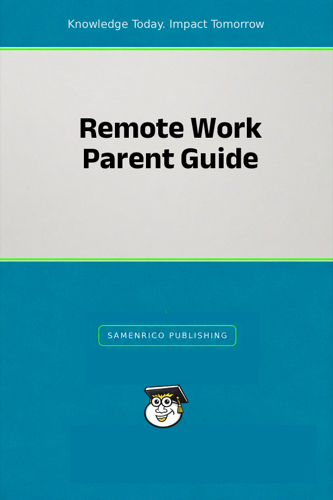
Free sample
Chapter 1: The Integration Leap--–- The Zoom camera was on. My three-year-old had just discovered that the family cat could be draped across his shoulders like a living scarf. The cat was not pleased. The client was mid-sentence about Q3 deliverables. And somewhere behind me, a smoke alarm began its thin, insistent shriek because I had forgotten the frozen pizza in the oven.That was the moment I stopped believing in balance.Not because I was failing at it.
Because I finally understood that balance had never existed. It was a word we sold to parents, especially mothers, to keep us striving for something impossible while feeling perpetually inadequate. Balance implies equilibrium: two sides of a scale holding equal weight. But when one side of the scale holds a crying child and the other holds a quarterly earnings report, they will never weigh the same on any given Tuesday at 2 PM. The only way to achieve perfect balance would be to care less about one or the other.
And you don't. You can't.What you need instead is what this book will teach you: integration. The messy, glorious, imperfect overlap of work and family life under the same roof. Not a 50/50 split. Not a rigid schedule that crumbles at the first sneeze or snow day.
But a sustainable, flexible, psychologically realistic way of living where you stop apologizing for the noise and start designing systems that work with your actual life, not against it.This chapter will dismantle the myth of balance, introduce the framework of integration, and give you your first and most important tool: the Good Enough Audit. By the time you finish these pages, you will have permission to drop specific balls intentionally—and the relief that comes from finally stopping the juggling act.The Myth of Balance: A Brief History of an Unhelpful Ideal The word "balance" as applied to working parents is surprisingly young. It surged into popular culture in the 1980s as women flooded the workforce but remained solely responsible for domestic labor. The message was insidious but well-intentioned: You can have it all. You just need to balance it.
Implicit in that promise was the assumption that failure to balance was a personal failing, not a structural impossibility.By the 2010s, "work-life balance" had become a multibillion-dollar industry of planners, apps, and motivational speakers. Sheryl Sandberg's Lean In (2013) urged women to sit at the table while simultaneously managing bedtime. But what happened when the table was your dining table and your toddler was climbing your leg during a video call? The advice hadn't caught up to the reality of remote work.Then the pandemic hit. Suddenly, millions of parents who had never worked from home were thrust into an impossible situation.
The phrase "balance" became a cruel joke. A viral tweet from 2020 captured the sentiment perfectly: "I don't want work-life balance. I want work-life cease-fire." We had entered the era of remote parenting without a map.Now, years later, remote and hybrid work are permanent for millions. But the advice has not caught up. Most productivity books still assume you can close a door to an office.
Most parenting books assume you are not also managing a Slack channel. And most self-help books tell you to "set boundaries" as if boundaries alone could stop a child from needing you.This book exists because those assumptions are broken. You need a new framework.Why "Leaning In" Fails at the Kitchen Table Let me be specific about why the old advice doesn't work for remote parents. Understanding this will save you years of guilt.First, traditional "balance" advice assumes you can compartmentalize. It says: work at work, home at home.
But when your office is fifteen feet from your child's bedroom, compartmentalization is impossible. You can hear the crying. You can smell the burning toast. You know that the babysitter just texted that she's running late. Your brain cannot simply "switch off" one role and activate another when the physical environment remains constant.Second, traditional advice focuses on time management over energy management.
It asks you to schedule every hour of your day as if your energy were a flat, predictable resource. But parenting drains you in ways that office work does not. Emotional labor—tracking your child's mood, managing transitions, anticipating needs—is exhausting. A three-hour meeting after a two-hour tantrum is not the same as a three-hour meeting after a peaceful morning. Remote parents need energy-aware scheduling, not just time-blocking.Third, traditional advice ignores the psychological weight of visibility.
When you worked in an office, no one saw you scroll your phone for ten minutes or step out for a coffee break. When you work from home with children, every interruption feels magnified. You are acutely aware that your colleague might hear a scream. Your boss might see a child appear behind you. The constant self-monitoring creates a low-grade stress that office workers never experience.Fourth, and most importantly, traditional advice assumes you have a partner who is not also working from home with their own set of demands.
Many remote parents are solo parents. Many are in dual-career households where both partners are on Zoom calls simultaneously. The "divide and conquer" advice—you take morning, I take afternoon—only works if both jobs permit flexible schedules. Many do not.This is why "balance" is not just unhelpful but actively harmful. It sets an impossible standard, then blames you for failing to meet it.
The only way out is to abandon the framework entirely.The Integration Framework: A New Operating System Integration is not balance. Balance is a scale. Integration is a river.In an integration framework, you accept that work and family life will overlap, conflict, and compromise each other. You stop trying to prevent the overlap and start designing systems that make the overlap manageable. You stop apologizing for the conflict and start communicating about it professionally.
You stop seeing compromise as failure and start seeing it as the only realistic path forward.Integration operates on three core principles:Principle 1: Strategic Underperformance. You cannot do everything well. The secret of every successful remote parent you admire is not that they are a superhuman multitasker. It is that they have quietly, deliberately chosen specific areas to do "good enough" so they can pour energy into what matters most. This might mean frozen pizza instead of homemade.
It might mean a messy living room. It might mean responding to non-urgent emails within 24 hours instead of 2. Strategic underperformance is not laziness; it is resource allocation.Principle 2: Environmental Design Over Willpower. Every time you rely on willpower to keep working while a child begs for attention, you lose. Willpower is a finite resource that depletes over the day.
Instead, successful remote parents design their environment to make good choices easier and bad choices harder. This means physical barriers (doors, visual cues), sound management (white noise, headphones), and activity stations (the Busy Book approach you will learn in Chapter 5). You are not weak for needing these tools. You are smart for building them.Principle 3: Psychological Flexibility Over Rigid Schedules. The parent who schedules every minute of their day and panics when a nap is skipped…
This is the end of the free sample. Get the eBook to keep going. Buy now
About this book
Details
- Author
- Law Claudette
- Publisher
- SamEnrico
- Language
- English
- Genre
- Non-Fiction, Self-Help / Parenting
- Released
- 2026-06-06
- Pages (approx.)
- 150
- Available as
- eBook, Audiobook

Read better in the ZLOADR app
Your eBooks on your phone or tablet. Sign in with your SamEnrico account and start reading.
More by Law Claudette
 Nervous Laughter NonverbalLaw Claudette$11.99
 Reddit Rabbit Hole Escape PlanLaw Claudette$11.99
 Guilt Of Not Having ChildrenLaw Claudette$11.99
 Doe Network Volunteer GuideLaw Claudette$11.99
 Atomic Habits For PatienceLaw Claudette$11.99
 Non 24 Hour RhythmLaw Claudette$11.99
 The Invisible Hand: How a Brazilian Genius Redefined the Premier LeagueLaw Claudette$11.99
 The Navigators of the Red Sea: Carthage’s African Seafarers and the Birth of Global TradeLaw Claudette$11.99
 Growing BryaLaw Claudette$11.99
 How to Start a Meteorological Instruments (electronic) Business (Beginners Guide)Law Claudette$11.99
 How to Produce Musical Instrument Amplifier FootswitchesLaw Claudette$11.99
 How to Produce 100% Bamboo Fiber YarnLaw Claudette$11.99
You may also like
 Hong Kong Handover 1997Dunn Johnnie$11.99
 Zumba For Postnatal Recovery CourseNeal Christian$11.99
 Zumba for BeginnersLadner Nikia$11.99
 YouTube Comment Mining GuideHumes Pandora$12.99
 Worry Box MeditationCarlin Rudy$11.99
 Workplace Stress MeditationNguyen Lynn$11.99
 Workplace Stress and Sleep RepairHawley Ivory$11.99
 Workplace Perfectionism CureDelaney Jeffry$11.99
 Workplace Injustice Anger GuideWallen Isabelle$11.99
 Work Addiction and Burnout LinkGreenwood Ester$11.99
 Women in Yoga and WellnessBeattie Galina$11.99
 Women in Stand Up ComedyChun Evangeline$11.99