
Remote Work Overwhelm Solutions eBook
Manage too many tasks and unclear priorities when
Manage too many tasks and unclear priorities when working alone.
Formats
Free sample
Chapter 1: The Visibility Trap--You are not lazy. You are not disorganized. You are not failing at remote work.Let me say that again, because you probably don't believe it yet: You are not the problem.If you picked up this book, chances are you have spent the last several months—or years—feeling like you are running on a treadmill that keeps getting faster. You wake up tired. You check Slack before you have brushed your teeth.
You answer emails while pretending to listen to your child tell you about their dream. You eat lunch over your keyboard, if you eat lunch at all. At 6 PM, you close your laptop, but your brain does not close with it. You think about the thirteen unfinished tasks still lurking in your inbox. You worry about the vague request your manager sent at 4:58 PM.
You rehearse tomorrow's to-do list while you are supposed to be present at dinner.And at the end of the week, when you look back at what you actually accomplished, you feel a strange hollowness. You were busy. You were so busy. But what did you do?This is the remote work paradox: you have never worked harder, and you have never felt less productive.The problem is not your work ethic. The problem is not your intelligence or your capability or your commitment to your job.
The problem is something much deeper and much more insidious—something that every remote worker faces but almost no one talks about. The problem is the Visibility Trap.The Day I Realized I Was Doing Fake Work I remember the exact moment I understood that something was profoundly wrong with how I was working.It was a Tuesday afternoon in March. I had been working from home for fourteen months. Like many remote workers, I had started with enthusiasm—no commute, flexible hours, the freedom to wear sweatpants to "work." But somewhere along the way, that freedom had curdled into something else. Something heavier.On that particular Tuesday, I had spent three hours reformatting a spreadsheet.
Three hours. I had adjusted column widths, changed fonts, added color coding, created pivot tables that no one had asked for, and written detailed comments on cells that were already perfectly clear. When I finally sent the spreadsheet to my manager, his response was three words: "Looks good, thanks."That was it. Three hours of my life. Three hours I would never get back.
For three words.I sat back in my chair and stared at the ceiling. Why had I done that? No one had asked for a beautiful spreadsheet. The raw data had been perfectly usable. My manager did not care about the fonts or the color coding.
So why had I spent three hours on it?The answer, I realized, was uncomfortable: I had done it because I was afraid.I was afraid that if I did not produce something visible, my manager might think I was not working. I was afraid that if I sent a plain, functional spreadsheet, I would look lazy or careless. I was afraid that in the absence of physical presence, my work needed to be more impressive, more polished, more everything—just to prove that I was actually at my desk.That spreadsheet was not business-driven. It was anxiety-driven. And it was not alone.That week, I started tracking my tasks with two simple columns: "Why am I doing this?" and "Who is this for?" The results were shocking.
Nearly forty percent of my tasks—four out of every ten things I did—were not actually needed by anyone. They were performative. They existed only to make me look busy in an environment where no one could see me being busy.This is the Visibility Trap. And if you are a remote worker, you are almost certainly caught in it.The Psychology of Performative Work To understand why remote workers generate so much fake work, you need to understand something fundamental about the human brain: we are social mammals.For hundreds of thousands of years, human survival depended on being seen by the tribe. If the tribe could see you gathering berries or building shelter or keeping watch, you were valuable.
If the tribe could not see you, you were assumed to be lazy—or worse, a threat. Visibility equaled safety. Invisibility equaled danger.That ancient wiring is still running your brain today.When you work in an office, your manager can see you. They can see you typing. They can see you in meetings.
They can see you at your desk. That visual presence provides a constant, low-level reassurance: "They are working." You do not have to prove your productivity because your productivity is visible by default.But when you work from home, that visibility disappears. Your manager cannot see you. Your colleagues cannot see you. The only evidence that you are working is the work you produce and the digital traces you leave behind.
And your ancient, tribal brain interprets this invisibility as a threat. "They cannot see me," your brain whispers. "They might think I am not working. I need to prove myself. I need to be busier.
I need to be visible."This is not a character flaw. It is not a lack of discipline. It is a biological response to a novel environment. Your brain is doing exactly what evolution designed it to do: it is trying to keep you safe by making you look valuable.The problem is that in the modern workplace, "looking valuable" and "being valuable" are no longer the same thing.The Forty Percent Rule Brigid Schulte, in her groundbreaking book Over Work, documented something extraordinary. She found that remote workers consistently report spending approximately forty percent of their time on tasks that have no business value.
Forty percent. That is nearly half of every workweek.Let me put that in concrete terms. If you work forty hours per week, you are spending sixteen hours—two full days—on work that literally does not matter. Work that no one asked for. Work that no one will use.
Work that exists only to soothe your anxiety about being invisible.Sixteen hours. Every week. For no reason except fear.Think about what you could do with an extra sixteen hours per week. You could learn a new skill. You could spend time with your family.
You could exercise. You could sleep. You could do the deep, focused work that actually advances your career. Instead, you are reformatting spreadsheets. Rewriting emails.
Reorganizing folders. Creating status updates about status updates.This is not a small inefficiency. This is a catastrophic waste of human potential. And it is happening to millions of remote workers right now.Business-Driven vs. Anxiety-Driven Tasks The first step out of the Visibility Trap is learning to distinguish between two fundamentally different kinds of tasks: business-driven tasks and anxiety-driven tasks.Business-driven tasks are the work that actually matters.
They are directly tied to revenue, customer needs, contractual obligations, strategic priorities, or explicit requests from your manager. If you stopped doing business-driven tasks, someone would notice—not because they were watching you, but because the results would disappear. The report would…
This is the end of the free sample. Get the eBook to keep going. Buy now
About this book
Details
- Author
- Broyles Deangelo
- Publisher
- SamEnrico
- Language
- English
- Genre
- Non-Fiction, Self-Help, Overwhelm
- Released
- 2026-06-08
- Pages (approx.)
- 135
- Available as
- eBook, Audiobook

Read better in the ZLOADR app
Your eBooks on your phone or tablet. Sign in with your SamEnrico account and start reading.
More by Broyles Deangelo
 Dryer Sheet Chemical LoadBroyles Deangelo$11.99
 The Resilient WorkplaceBroyles Deangelo$11.99
 Major Depressive Disorder Explained for BeginnersBroyles Deangelo$11.99
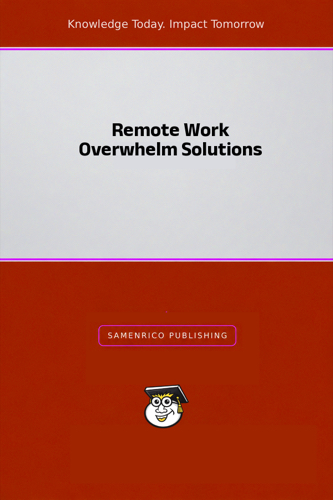 Remote Work Overwhelm SolutionsBroyles Deangelo$11.99
 Community Garden FounderBroyles Deangelo$11.99
 Metta for Phlebotomy AnxietyBroyles Deangelo$11.99
 Middle Passage Disease OutbreaksBroyles Deangelo$11.99
 Success Without Burnout for FreelancersBroyles Deangelo$11.99
 The Vanishing Fortunes: The Great London Bank Heist of 1873Broyles Deangelo$11.99
 A Collector's Handbook to the Mg BBroyles Deangelo$11.99
 Service Providers Guide to New-mom CareBroyles Deangelo$11.99
 How to Produce Water SkisBroyles Deangelo$11.99
You may also like
 Hong Kong Handover 1997Dunn Johnnie$11.99
 Zumba For Postnatal Recovery CourseNeal Christian$11.99
 Zumba for BeginnersLadner Nikia$11.99
 YouTube Comment Mining GuideHumes Pandora$12.99
 Worry Box MeditationCarlin Rudy$11.99
 Workplace Stress MeditationNguyen Lynn$11.99
 Workplace Stress and Sleep RepairHawley Ivory$11.99
 Workplace Perfectionism CureDelaney Jeffry$11.99
 Workplace Injustice Anger GuideWallen Isabelle$11.99
 Work Addiction and Burnout LinkGreenwood Ester$11.99
 Women in Yoga and WellnessBeattie Galina$11.99
 Women in Stand Up ComedyChun Evangeline$11.99