
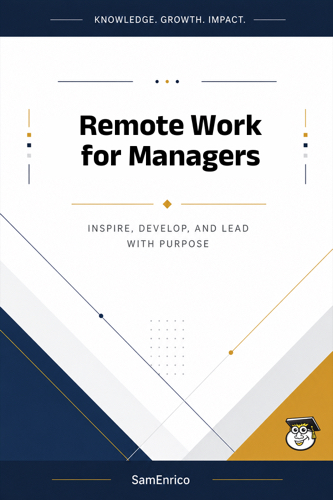
Remote Work for Managers eBook
Leads team time and productivity from afar.
by Dunn Clyde
Leads team time and productivity from afar.
Formats
Free sample
Chapter 1: The Trust Fall--–- Let me tell you about the worst week of my management career.I was leading a team of fourteen software engineers spread across three time zones. We had recently gone fully remote after a mandatory office closure. My director pulled me aside on a Monday morning and said something I will never forget: “How do you know they’re actually working?”I didn’t have a good answer. So I did what anxious managers do. I installed activity tracking software.
I mandated cameras on for all eight hours of the workday. I moved from one daily standup to two—morning and afternoon. I started sending Slack messages at random times just to see who would respond within five minutes.By Friday, three people had updated their Linked In profiles to “open for work.” One engineer, my best performer, submitted a resignation letter that contained this sentence: “I don’t feel trusted. I feel watched. And I can’t do my best work when I’m afraid of being judged for taking a bathroom break.”I had lost a top employee in five days.
Not because of pay, not because of career growth, not because of a toxic culture in any traditional sense. I lost her because I confused surveillance with leadership. I thought that if I could see people, I could manage them. I was catastrophically wrong.That week cost me my best engineer, the trust of my team, and three months of rebuilding. But it also taught me the single most important lesson of remote leadership: You cannot manage what you cannot measure.
So stop trying to measure what you cannot see. Measure what actually matters.This chapter is about unlearning the most dangerous habit in management—the belief that presence equals productivity. If you take nothing else from this book, take this: your anxiety about remote work is not a sign that your team is failing. It is a sign that you were trained to manage a different era. That era is over.The Surveillance Trap: Why Your Anxiety Is Ruining Your Team Let me be direct about something most leadership books dance around: You don’t actually care about productivity.
You care about control. And control is a drug that remote work just cut off.In an office, control feels effortless. You walk by someone’s desk and see them typing. You hear the hum of collaboration. You feel the ambient reassurance of bodies in chairs.
None of this measures productivity—but it feels like it does. It soothes your managerial anxiety without requiring you to do the hard work of defining what “good” actually looks like.Remote work removes that pacifier. Suddenly, you can’t see anyone. Your brain, trained for years to equate visibility with value, panics. And panic leads to what I call the Surveillance Trap: the instinctive, counterproductive rush to install more check-ins, more tools, more rules—all of which destroy the very trust and autonomy your team needs to thrive.The Surveillance Trap has four predictable stages:Stage 1: The Anxiety Spike.
You notice silence. No one is messaging you. You can’t see anyone working. Your brain interprets silence as slacking, even though research shows remote workers often put in longer hours than office workers.Stage 2: The Reactive Intervention. You add a check-in.
Then another. You ask for daily updates. You install a tool that tracks mouse movements or screenshots. You tell yourself this is temporary, just until you “feel comfortable.”Stage 3: The Trust Collapse. Your team notices.
They feel watched, not supported. They begin performing for the camera instead of producing real work. Deep work plummets. Resentment builds. Your best employees—the ones with the most options—start looking for exits.Stage 4: The Death Spiral.
You lose your top performers. You interpret this as proof that remote work “doesn’t work.” You tighten surveillance further. The remaining employees disengage. Productivity drops. Turnover spikes.
And you blame the model instead of your management.I have watched this play out in dozens of organizations. It is predictable, avoidable, and heartbreaking—because it is driven by fear, not malice.The antidote is not more surveillance. The antidote is better measurement.The Three Myths of Remote Productivity (And Why They’re Destroying Your Team)Before we can build a better system, we have to demolish the false beliefs that keep managers trapped in the Surveillance Trap. These three myths are the pillars of bad remote management. Tear them down.Myth #1: “If I Can’t See Them, They Aren’t Working”This is the grandfather of all remote management errors.
It feels intuitive because it’s how most of us were managed. But intuition is not evidence.The Research: A Stanford study of 16,000 workers found that remote employees worked 9% longer hours than their office-based counterparts, took fewer sick days, and reported higher focus levels. A separate analysis by Prodoscore found that remote workers’ productivity increased by 47% after transitioning from office to home.The Reality: When you can’t see someone, you don’t see them taking coffee breaks, chatting by the water cooler, or scrolling their phone in the bathroom. You also don’t see them answering emails at 10 PM, working through lunch, or skipping breaks because they have no commute. The visibility bias cuts both ways.The Fix: Replace “Can I see them?” with “Can I see their results?” If you can answer that second question, the first one becomes irrelevant.Myth #2: “More Check-Ins Mean More Control”This myth is seductive because it feels like action.
When you’re anxious, doing something—anything—feels better than doing nothing. But most check-ins are not management. They are performance theater.The Research: A study of 500 remote managers found that teams with daily check-ins reported 32% lower psychological safety than teams with weekly check-ins. More contact did not mean more alignment. It meant more anxiety.The Reality: Every unnecessary check-in sends an implicit message: “I don’t trust you to work without me watching.” Over time, that message erodes intrinsic motivation.
Your team stops working for the mission and starts working to appease you.The Fix: Audit every recurring meeting and check-in. Ask: “Does this exist because of a real need or because of my anxiety?” If the answer is anxiety, cancel it.⚠️ EXCEPTION: Daily check-ins are toxic for established team members. However, they are essential during the first 30 days of onboarding a new hire. New employees need structure, frequent feedback, and relationship-building. See Chapter 8 for the onboarding exception.Myth #3: “Activity Equals Progress”This is the most dangerous myth because it’s woven into the fabric of office culture.
We reward the visible: the person who answers emails fastest, the team that holds the most meetings, the employee who is always “on.”The Research: A study of software developers found that the most productive engineers spent 70% of their day in uninterrupted deep work—during which they appeared completely inactive to outside observers. Their Slack response times were slow. Their status icons often showed “away.” But their code output was triple the team average.The Reality: Deep work looks like nothing. It looks like staring at a wall. It looks like being away from the keyboard.…
This is the end of the free sample. Get the eBook to keep going. Buy now
About this book
Details
- Author
- Dunn Clyde
- Publisher
- SamEnrico
- Language
- English
- Genre
- Non-Fiction, Self-Help, Leadership
- Released
- 2026-06-06
- Pages (approx.)
- 150
- Available as
- eBook, Audiobook

Read better in the ZLOADR app
Your eBooks on your phone or tablet. Sign in with your SamEnrico account and start reading.
More by Dunn Clyde
 Muscle Relaxation SleepDunn Clyde$11.99
 ABCDE For OverwhelmDunn Clyde$11.99
 Detox Medication Error PreventionDunn Clyde$11.99
 After Action Creativity ReviewDunn Clyde$11.99
 Napoleon s Exile to ElbaDunn Clyde$11.99
 Empathy for NeurodivergentDunn Clyde$11.99
 Child CPR GuideDunn Clyde$11.99
 The Siege of Rhodes: Suleiman the Magnificent's Unstoppable ForceDunn Clyde$11.99
 Leiden's Starvation: The Siege That Ignited a Nation (1573-1574)Dunn Clyde$11.99
 Ultimate Handbook Guide to Essen : (Germany) Travel GuideDunn Clyde$11.99
 How to Produce ICE PacksDunn Clyde$11.99
 Environmental Science GuideDunn Clyde$12.99
You may also like
 Managerial Stress Reduction WorkbookHolden Heike$11.99
 Emotional Regulation For LeadersWolf Chantel$11.99
 CEO Flow StatesFinnegan Jonah$11.99
 Validation for LeadersLackey Debi$11.99
 The Calm Leader GuideStrand Alverta$11.99
 The Assertiveness for New ManagersThomson Margit$11.99
 Pomodoro for Managers GuideLoftin Page$11.99
 Nonverbal Cues In Leadership CourseTRUE Betsey$11.99
 Navigating Workplace ConflictNoyes Sherly$11.99
 Legacy for LeadersSadler Rusty$11.99
 Improv for LeadershipSkaggs Lura$11.99
 Fear Of Failure In LeadershipHendrickson Lavern$11.99