
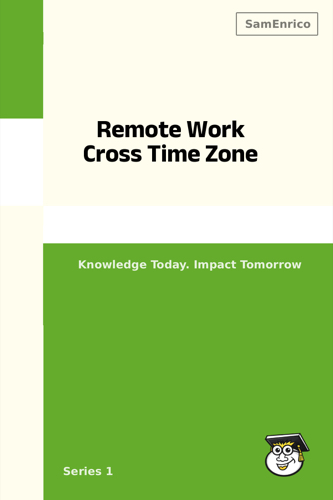
Non-FictionSelf-HelpGlobal Teams
Remote Work Cross Time Zone eBook
Schedule overlapping hours and handoffs across glo
by Crane Wen
Schedule overlapping hours and handoffs across global team members.
Formats
Free sample
Chapter 1: The 9-to-5 Lie--–- In March 2021, a senior product manager named Sarah Jensen sat alone in her Chicago apartment at 4:47 PM, staring at a Slack message she had just sent to her lead engineer in Bangalore. The message read: “Hey Vikram – quick question, is the payment gateway fix ready for deploy? Let me know. Thanks!” She watched the message land. She saw the little eye icon appear, indicating that Vikram had seen it.
Then nothing. For the next fourteen hours, Sarah checked her phone eleven times. She woke up twice during the night to see if Vikram had replied. He hadn’t. At 7:00 AM Chicago time, Vikram’s message finally arrived: “Hi Sarah – I was asleep.
The fix has been ready since yesterday morning. I assumed you knew. Deploying now.”The fix deployed at 7:15 AM Chicago time. The bug had been reported at 2:00 PM the previous day. Total time from report to resolution: seventeen hours.
Actual development time required: forty-five minutes. The remaining sixteen hours and fifteen minutes were pure latency—the structural friction of a global team operating with a local mindset.Two weeks later, Sarah’s company lost a fifty-thousand-dollar deal because a different bug, which should have taken two hours to fix, took three days to coordinate. The client wrote in their cancellation email: “Your response times make it feel like you’re not even in the same century, let alone the same timezone.”Sarah’s story is not unusual. It is not a cautionary tale about a bad manager or a lazy engineer. It is the default state of most global teams today.
And it is the reason this book exists.The Industrial Revolution Never Ended for Your Team Most of us believe we have left the factory floor behind. We work from home. We use Slack and Zoom and Notion. We call ourselves “distributed,” “agile,” and “asynchronous.” But underneath these modern labels, our default operating system remains stubbornly, destructively, rooted in the nineteenth century.The 9-to-5 workday is not a law of nature. It is not even a particularly old invention.
It emerged from the factory system of the Industrial Revolution, where physical machines required physical bodies to be present simultaneously. The assembly line demanded that everyone pull the lever at the same time. That logic made sense for steam engines and conveyor belts. It makes no sense for knowledge work. And yet, we have carried it with us like a ghost in the machine.Consider what happens when you send a “quick question” to a teammate in a different timezone.
You are not actually asking a question. You are exporting your own urgency onto their calendar. You are assuming that your need for an answer right now trumps their need for sleep, focus, or family time. You are treating time as a shared, infinite resource—when in fact, for global teams, time is the scarcest, most expensive, and most poorly managed asset on the balance sheet.The central argument of this book is simple and, for many managers, uncomfortable: The 9-to-5 workday is a bug, not a feature. It was designed for an era when work happened in one place, at one time, under one roof.
That era is over. Most of us know this intellectually. But our habits, our tools, our promotion systems, and our meeting cultures have not caught up.This chapter will dismantle the three core assumptions of the 9-to-5 mindset that are silently destroying your global team. Then it will introduce a new framework—the 24-Hour Development Cycle—that turns time zones from your biggest liability into your only true competitive advantage.Assumption One: Work Happens in a Single, Continuous Block The first and most damaging assumption of the 9-to-5 mindset is that work is a continuous river. You start at 9 AM, you work steadily until 5 PM, and then you stop.
The next day, you pick up exactly where you left off. This assumption is so deeply embedded in our culture that we rarely even notice it. But it is catastrophically wrong for global teams.Let us examine what actually happens when a team in New York hands off work to a team in London, who then hands off to a team in Sydney. In a perfect world, the New York team finishes their day by documenting their progress, leaving clear next steps, and handing off a baton. The London team picks it up eight hours later, advances the work, and hands it off again.
The Sydney team finishes the job. Twenty-four hours after the first keystroke, the work is done.In the real world, this almost never happens. Why? Because the New York team treats their 5 PM as an ending, not a handoff. They do not document their progress because they assume they will pick it up again tomorrow.
They leave tickets in a “hanging state”—half-written code, unresolved threads, uncommitted changes. The London team arrives to find not a baton, but a puzzle. They spend the first hour of their day reverse-engineering what New York was thinking. By the time they figure it out, it is already their own afternoon. They rush to make progress but run out of time before they can hand off cleanly.
Sydney arrives to find chaos. The cycle repeats.This is not a failure of effort or talent. It is a failure of assumption. The New York team is acting as if work stops when they log off. It does not.
The river keeps flowing. The only question is whether you hand off a clear stream or a muddy puddle.The 9-to-5 mindset treats time as a linear, homogeneous resource. In reality, for a global team, time is a relay race. There are moments when you are holding the baton, moments when you are passing it, and moments when you are resting while another runner sprints. The most successful global teams understand that their calendar is not a schedule of working hours—it is a map of handoffs.Assumption Two: Synchronous Communication Is the Default The second assumption is even more pervasive: that real communication happens in real time.
We have built an entire ecosystem of tools—Slack, Teams, Zoom, Webex—around the idea that the best way to solve a problem is to get everyone in a room (virtual or physical) and talk it out.This assumption made sense when teams were collocated. When you can walk to someone’s desk, the cost of a live conversation is low. But when your teammate is nine hours ahead, the cost is enormous. A five-minute “quick sync” requires them to stay awake until 10 PM, or to wake up at 6 AM. It fragments their day, disrupts their focus, and—over time—erodes their trust in you.The irony is that most synchronous communication is completely unnecessary.
Researchers have found that in knowledge work, less than five percent of messages require an immediate response. The other ninety-five percent are requests for information that could have been found in a document, a ticket, or a well-written handoff. But because those documents do not exist, or because they are poorly written, we default to the path of least resistance: we ask.This is what the author Cal Newport…
This is the end of the free sample. Get the eBook to keep going. Buy now
About this book
Details
- Author
- Crane Wen
- Publisher
- SamEnrico
- Language
- English
- Genre
- Non-Fiction, Self-Help, Global Teams
- Released
- 2026-06-06
- Pages (approx.)
- 152
- Available as
- eBook, Audiobook

Read better in the ZLOADR app
Your eBooks on your phone or tablet. Sign in with your SamEnrico account and start reading.
More by Crane Wen
 Resilience For LGBTQ+ YouthCrane Wen$11.99
 Carbohydrate Quality PrimerCrane Wen$11.99
 Loving Kindness for Equine TherapyCrane Wen$11.99
 Cocaine Sobriety Daily Action WorkbookCrane Wen$11.99
 Period Product DistributorCrane Wen$11.99
 Weekly Review Productivity SystemCrane Wen$11.99
 Building a Lasting LegacyCrane Wen$11.99
 The Silk Road’s Shadow: How a Lost Chinese Diplomat Outwitted the MongolsCrane Wen$11.99
 The Iron Shark: How Steam and Steel Broke the Pirate Kingdoms (1840s)Crane Wen$11.99
 Service Providers Guide to Plant NurseriesCrane Wen$11.99
 A Collector's Handbook to the Minerva Ab 12cvCrane Wen$11.99
 First Email Test and Preview GuideCrane Wen$12.99
You may also like
 Hong Kong Handover 1997Dunn Johnnie$11.99
 Zumba For Postnatal Recovery CourseNeal Christian$11.99
 Zumba for BeginnersLadner Nikia$11.99
 YouTube Comment Mining GuideHumes Pandora$12.99
 Worry Box MeditationCarlin Rudy$11.99
 Workplace Stress MeditationNguyen Lynn$11.99
 Workplace Stress and Sleep RepairHawley Ivory$11.99
 Workplace Perfectionism CureDelaney Jeffry$11.99
 Workplace Injustice Anger GuideWallen Isabelle$11.99
 Work Addiction and Burnout LinkGreenwood Ester$11.99
 Women in Yoga and WellnessBeattie Galina$11.99
 Women in Stand Up ComedyChun Evangeline$11.99