
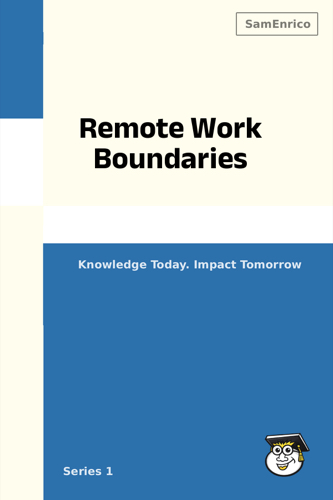
Free sample
Chapter 1: The Broken Commute--The average American worker spends 54 minutes commuting each day. That is 225 hours per year. Over a forty-year career, it amounts to 9,000 hours—or 375 full days—sitting in traffic, standing on train platforms, or staring at the back of someone else’s head.And we miss it.Not the traffic, obviously. Not the crowded trains or the delayed flights or the smell of stale coffee in a shared elevator. What we miss is what the commute did for us without our permission or awareness.
The commute was not dead time. It was a psychological bridge. It was a liminal space—a threshold between “Home Self” and “Work Self” that our brains relied upon to navigate the most fundamental transition of our lives.When remote work erased the commute, it did not erase boundaries. It exploded them.This chapter is about understanding that explosion. It is about seeing clearly why your work thoughts now invade your dinner table, why your family stress interrupts your deep work, and why you feel like you are never fully at home or fully at work.
Most importantly, this chapter introduces the central framework of this book: the four types of boundaries you must build to replace the commute you didn’t know you needed.The Commute You Never Thanked Let us start with a simple experiment. Close your eyes for ten seconds and remember your old commute—the one you had before remote work, or the one you have on the days you still go into an office.What do you remember?For most people, the memories are not pleasant. The frustration of a red light. The annoyance of a slow walker on the sidewalk. The tedium of the same buildings, the same turns, the same announcements on the same train.
But here is what else was happening in those unpleasant moments: your brain was transitioning.Neuroscientists have studied what happens to the brain during routine transitions. When you leave your home, your brain begins a process called “context shifting.” It downregulates the neural networks associated with family, rest, and personal identity. It upregulates the networks associated with vigilance, task-switching, and professional role performance. By the time you walked through the office door, you were not the same person who had poured cereal twenty minutes earlier. You were someone else—someone ready to work.The commute was the bridge.
It did not matter if the bridge was ugly. It did not matter if it was long. What mattered was that it existed.Now consider what happens without that bridge. You close your laptop at 5:01 PM. You walk twelve feet to your couch.
You sit down for dinner. But your brain is still in “work mode.” The neural networks that were activated for your 4:30 PM meeting have not had time to downregulate. They are still firing. So when your child asks about their homework, you hear it through the filter of a project manager. When your partner tells you about their day, you process it like a status update.
When you try to relax, your brain keeps generating solutions to problems you are no longer being paid to solve.This is not a failure of willpower. It is a failure of architecture.Work-Home Interference: The Science of Permeability Researchers have a name for what happens when the boundaries between work and home break down. They call it “work-home interference” or, more precisely, “work-to-home conflict.” It is one of the most studied phenomena in occupational health psychology, and the findings are sobering.Work-home interference occurs when the demands, stresses, or cognitive patterns of work intrude into the home domain. It manifests as:Thinking about a deadline while helping with homework Checking email during family dinner Feeling irritable with loved ones because of a frustrating work interaction Lying awake at night mentally rehearsing a presentation Saying “just one more thing” and then realizing two hours have passed The data from Out of Office and the broader remote work literature is unambiguous: remote workers report significantly higher levels of work-home interference than office workers, even when they work fewer hours. The problem is not the amount of work.
The problem is the permeability of the boundary between work and life.Here is the metaphor I want you to hold in your mind. Imagine you live in a house with a front door. When you leave for work, you close the door behind you. That door is the commute. It is imperfect—sometimes you forget things, sometimes you come back early—but it is a door.
You know when you are inside and when you are outside.Now imagine someone removes the front door. Your house now opens directly onto the street. You can still live there. You can still work there. But the distinction between “inside” and “outside” has become meaningless.
You are always both. You are never fully one or the other.That is remote work without boundaries. That is the experience of millions of workers right now.The 9-to-5 Was Never About Efficiency Before we go further, we need to understand something important about the office-based work model that remote work has disrupted. The 9-to-5 office was not designed for efficiency. It was designed for control and visibility.Frederick Winslow Taylor, the father of scientific management, developed his principles in the late nineteenth century.
His goal was to eliminate the “systematic soldiering” that he believed workers engaged in when left to their own devices. Taylor wanted managers to see what workers were doing at all times. He wanted time studies, motion studies, and standardized processes. The office layout—open floors, centralized management, fixed hours—was not an accident. It was a surveillance architecture.The commute served this system perfectly.
It ensured that workers arrived at the same time, left at the same time, and could be observed during the hours in between. It also created a clean boundary: work happened in the office; life happened everywhere else.Remote work has not destroyed the desire for control and visibility. It has merely made those desires harder to satisfy. Many managers now substitute “availability” for “visibility.” If they cannot see you working, they want to know that you are available—responding to messages, joining calls, clicking things. This is the origin of the “always on” culture we will explore in depth in Chapter 2.But here is what you need to understand right now: the old boundaries were not better because they were natural.
They were better because they were physical. You did not have to decide to have a boundary. The boundary was a building. It was a train. It was a door.Now the boundary is a choice.
And choices require architecture.The Four Walls: Introducing the Boundary Framework This book is built around a simple framework: there are four types of boundaries you need to build, maintain, and repair. I call them the Four Walls because, like the walls of a house, each serves a different purpose, and all are necessary for shelter.Spatial Boundaries The first wall is physical. It is the distinction between the place where you work and the place where you live. Spatial boundaries are the most intuitive, which is why many people…
This is the end of the free sample. Get the eBook to keep going. Buy now
About this book
Details
- Author
- Self Kemberly
- Publisher
- SamEnrico
- Language
- English
- Genre
- Non-Fiction, Self-Help / Boundaries
- Released
- 2026-06-06
- Pages (approx.)
- 136
- Available as
- eBook, Audiobook

Read better in the ZLOADR app
Your eBooks on your phone or tablet. Sign in with your SamEnrico account and start reading.
More by Self Kemberly
 SMART History GuideSelf Kemberly$11.99
 Teamster Boss Hoffa Biography Complete ManualSelf Kemberly$11.99
 Post Cheating Guilt RecoverySelf Kemberly$11.99
 Burnout Recovery For Flight AttendantsSelf Kemberly$11.99
 Sleep Restriction GuideSelf Kemberly$11.99
 Atomic Habits For ParentingSelf Kemberly$11.99
 The Lampkeeper's Bargain: A Djinn's Last WishSelf Kemberly$11.99
 Headspace Meditation Minute RivalrySelf Kemberly$11.99
 The Last Stand of 'Iron Mike': Tyson’s Unbreakable ComebackSelf Kemberly$11.99
 How to Start a Coach Hire With Driver Business (Beginners Guide)Self Kemberly$11.99
 How to Produce a Music CentreSelf Kemberly$11.99
 Growing BrodiaeaSelf Kemberly$11.99
You may also like
 Saying No at Work GuideEmanuel Christiane$11.99
 Stress Boundary Setting GuideMallen Theda$11.99
 Mindfulness for People PleasersSterling Lonnie$11.99
 Self Talk for BoundariesMahoney Evalyn$11.99
 Stress and Boundary SettingJett Charlsie$11.99
 Caregiver Boundary SettingChristy Devorah$11.99
 Boundary Setting TalkDo Dalene$11.99
 Saying No With ConfidencePenny Eleonora$11.99
 Open Door Policy BalanceRose Christian$11.99
 Empathy Boundaries GuideParedes Myrta$11.99
 Body Language ManipulationEllsworth Angle$11.99