
Non-FictionBusiness BriefTime Off
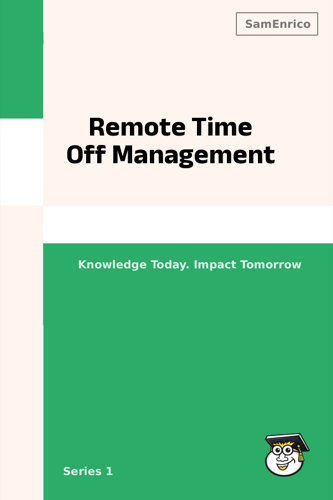
Remote Time Off Management eBook
Handle vacation requests and coverage when everyon
by Knapp Ara
Handle vacation requests and coverage when everyone works asynchronously.
Formats
Free sample
Chapter 1: The Ghost Period...–- The Sydney employee had already left for a long weekend by the time their manager in New York clicked “Approve.” The coverage notes were never written. The team in London woke up to an empty inbox and a Slack status that simply said “OOO.” No one knew who was supposed to handle the client escalation. The deadline passed. The client emailed the VP. The VP called the manager.
The manager called the employee—who was hiking without cell service. By Monday morning, three people had worked overtime, one relationship was damaged, and the employee returned to 147 messages asking “Where is the X file?” and “Who covers for Y?” None of this would have happened in an office. But no one works in an office anymore.This is not a story about bad employees or lazy managers. This is a story about a system designed for a world that no longer exists. The traditional paid time off (PTO) approval process—email your manager, wait for a reply, then notify the team—was built for a synchronous workplace.
That workplace assumed everyone worked roughly the same hours, sat in roughly the same time zone, and could hand off responsibilities in a five-minute conversation at someone’s desk. That workplace is dead. Yet 94 percent of remote teams still use some variation of the email-and-approval model, according to a 2024 survey of distributed companies. The result is not just frustration. It is a quiet, compounding operational crisis that burns out managers, punishes honest employees, and creates invisible debt that no one pays until something breaks.The Sync Fallacy: Why We Keep Designing for a World That Doesn’t Exist Let us name the enemy.
Call it the Assumption of Synchronicity. It is the hidden belief that everyone is working at the same time, in the same place, on the same schedule. It lives in every “Can you hop on a quick call?” It lives in every “I’ll approve this by EOD.” It lives in every out-of-office message that assumes someone else is watching the screen. The Assumption of Synchronicity is the gravitational pull of the old world, and it is the single greatest threat to effective async time off management.Here is what the Assumption of Synchronicity looks like in practice. An employee in Berlin wants to take the last week of August off.
They send an email to their manager in Seattle at 3 PM on a Friday, Berlin time. The manager receives it at 6 AM Friday, Seattle time. The manager is still asleep. By the time the manager wakes up, has coffee, and reads the email, it is 9 AM Seattle time—which is 6 PM in Berlin. The Berlin employee is already shutting down for the weekend.
The manager approves the request at 10 AM Seattle time, but the Berlin employee has already left. The coverage handoff window has closed. The team will spend Monday morning scrambling to figure out who covers what. The employee returns from vacation to a messy inbox and a passive-aggressive Slack thread. Everyone feels bad.
No one knows why.This is not a failure of individual discipline. It is a failure of process design. The email-approval model has three embedded assumptions that break completely in asynchronous environments. First, it assumes instantaneous awareness—that the manager will see the request within minutes of it being sent. In a global team, that is impossible.
Second, it assumes back-and-forth clarification can happen in real time. In an async team, clarifying questions might take 24 hours to get answered. Third, it assumes the handoff can happen verbally in a meeting. In an async team, there is no meeting. The result is what this chapter calls the Ghost Period: the gap between when an employee initiates time off and when the team actually knows how to cover for them.The Ghost Period is the most dangerous and least understood variable in remote PTO management.
During the Ghost Period, the employee has mentally checked out, the manager is unaware of the gap, and the team is operating on incomplete information. The Ghost Period can last hours or days. In extreme cases, it lasts an entire weekend, as in the Berlin example. The longer the Ghost Period, the more coverage debt accumulates. And because no one is sitting in the same room, no one feels the debt until something falls over.The Always-On Trap: When Flexibility Becomes a Prison There is a cruel irony at the heart of async time off.
The same flexibility that makes remote work desirable also makes disconnecting nearly impossible. This is the Always-On Trap, and it operates through three psychological mechanisms.The first mechanism is approval anxiety. When an employee submits a time off request, they are not just asking for permission. They are waiting for confirmation that their absence will be covered. In a synchronous office, that confirmation comes quickly—often within minutes.
In an async environment, confirmation might take 24 hours. During those 24 hours, the employee checks their email compulsively. They check Slack. They check their phone while making dinner. They are not working, but they are not resting either.
They are in limbo. Research on workplace stress shows that anticipation is often more draining than the event itself. Waiting for approval is not neutral. It is active cognitive load.The second mechanism is reciprocity pressure. When an employee knows that their manager approves requests outside of normal hours, they feel pressure to do the same.
If the manager in Seattle approves a Berlin request at 10 PM their time, the Berlin employee notices. They think, “If my manager is working late to approve my time off, I should be available late to respond to coverage questions.” This pressure is rarely explicit. No one says “You must check email at midnight.” But the implicit norm spreads through the team like a virus. Soon everyone is checking email during off-hours, and no one is truly on vacation.The third mechanism is notification fatigue. Most teams use multiple channels for PTO communication: email for the request, Slack for the team notification, a calendar tool for the actual block, and possibly an HR system for formal tracking.
Each channel generates notifications. The employee’s out-of-office reply generates more notifications. By the time the employee actually leaves, they have been pinged a dozen times about their own vacation. The cognitive overhead of managing these notifications eats into the mental wind-down that should happen before time off.The Always-On Trap is not a conspiracy. It is an emergent property of poorly designed systems.
When the system does not provide clear answers, humans fill the gap with anxiety. When the system does not enforce boundaries, humans invent their own—usually worse—boundaries. The solution is not to tell people to relax. The solution is to redesign the system so that the anxiety never appears.The Visibility Gap: Why Your Out-of-Office Message Is Not Enough Let us talk about the humble out-of-office message. It is the most overused and underpowered tool in the async PTO toolkit.
An employee sets their automatic reply, goes on vacation, and assumes the world knows they are gone. But here is the problem: out-of-office messages only fire when someone emails…
This is the end of the free sample. Get the eBook to keep going. Buy now
About this book
Details
- Author
- Knapp Ara
- Publisher
- SamEnrico
- Language
- English
- Genre
- Non-Fiction, Business Brief, Time Off
- Released
- 2026-06-07
- Pages (approx.)
- 138
- Available as
- eBook, Audiobook

Read better in the ZLOADR app
Your eBooks on your phone or tablet. Sign in with your SamEnrico account and start reading.
More by Knapp Ara
 Reverse Mortgage Housing StrategyKnapp Ara$11.99
 Shift Work Sleep MedicationsKnapp Ara$11.99
 Body Image After Burn Injury GuideKnapp Ara$11.99
 Advanced Method of Loci CourseKnapp Ara$11.99
 The Silk Road of the South: Medieval Explorers and the Lost Kingdoms of the AndesKnapp Ara$11.99
 The Last Pharaoh: Cleopatra’s Unseen LegacyKnapp Ara$11.99
 Magento Business Solutions ArchitectKnapp Ara$11.99
 Understanding Erythrokeratodermia Progressive Symmetrica IchthyosisKnapp Ara$17.99
 Mentoring Junior Introverts Across CulturesKnapp Ara$12.99
 CV Writer Testimonial GuideKnapp Ara$12.99
 How to Become a Mortgage-loan-computation ClerkKnapp Ara$11.99
You may also like
 Hong Kong Handover 1997Dunn Johnnie$11.99
 Zumba For Postnatal Recovery CourseNeal Christian$11.99
 Zumba for BeginnersLadner Nikia$11.99
 YouTube Comment Mining GuideHumes Pandora$12.99
 Worry Box MeditationCarlin Rudy$11.99
 Workplace Stress MeditationNguyen Lynn$11.99
 Workplace Stress and Sleep RepairHawley Ivory$11.99
 Workplace Perfectionism CureDelaney Jeffry$11.99
 Workplace Injustice Anger GuideWallen Isabelle$11.99
 Work Addiction and Burnout LinkGreenwood Ester$11.99
 Women in Yoga and WellnessBeattie Galina$11.99
 Women in Stand Up ComedyChun Evangeline$11.99