
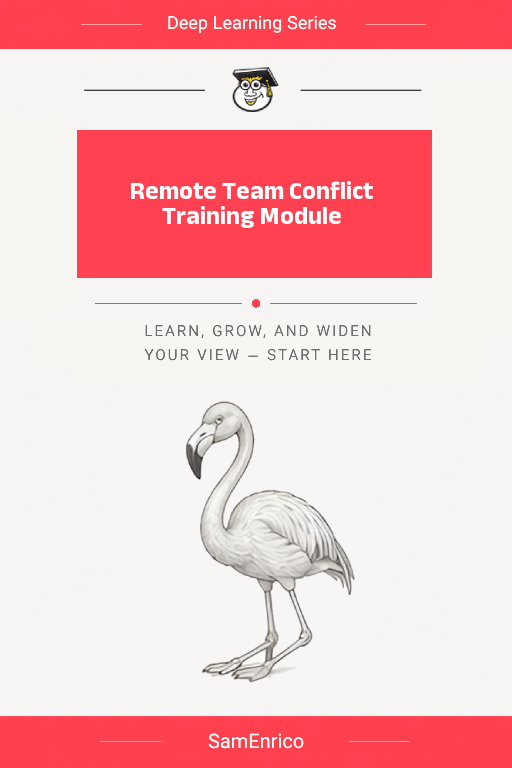
Non-FictionProfessional's Cheat SheetTraining Design
Remote Team Conflict Training Module Audiobook
Structures a 60-minute training session on remote
by Camp Efrain
Structures a 60-minute training session on remote conflict resolution, including slides, activities, and participant handouts.
Formats
Free sample
Chapter 1: The Context Crisis--–- On a Tuesday morning in March, a senior product manager named Elena received a Slack message from her counterpart in engineering. The message contained four words: “We need to talk.” Elena spent the next three hours cycling through worst-case scenarios—was she being demoted? Was her flagship project being cancelled? Had she offended someone without realizing it? She replayed every interaction from the past two weeks, searched for hidden meanings in old emails, and finally asked a colleague if she “seemed like someone who might be in trouble.” The colleague had no idea what she was talking about.
When Elena finally joined the video call that afternoon, the engineer said: “I just wanted to clarify the timeline for the Q3 release. No crisis. Sorry if that worried you.”This exchange lasted four seconds on the engineer’s side. It consumed four hours on Elena’s. And it happened not because anyone was malicious, incompetent, or even particularly sensitive, but because remote communication strips away nearly every contextual cue that humans evolved to read.
In the absence of tone, posture, facial expression, and the ambient safety of shared physical space, our brains do not register ambiguity. They register threat.This is not a flaw in individual temperament. It is a feature of how the human nervous system processes incomplete information. And it is the single most under-addressed driver of dysfunction in distributed teams.The Hidden Cost of Flat Text Remote work has transformed where and how we do our jobs, but it has not transformed how our brains are wired. For tens of thousands of years, humans resolved disagreements through a rich tapestry of nonverbal signals: a raised eyebrow signaled skepticism, a leaned-in posture signaled engagement, a softening of the jaw signaled readiness to compromise.
These cues evolved precisely because they allowed us to negotiate threats without triggering full fight-or-flight responses.Written text, by contrast, is a relatively new technology for conflict resolution. And it is spectacularly ill-suited to the task.When you send a message in Slack, Teams, or email, you are transmitting only the semantic content of your words. You are not transmitting your tone, your pace, your breathing, or the dozens of micro-expressions that would tell the other person whether you are angry, tired, rushed, or simply thinking out loud. The recipient’s brain, confronted with this vacuum of information, does not remain neutral. It fills…
This is the end of the free sample. Get the Audiobook to keep going. Buy now
About this book
Details
- Author
- Camp Efrain
- Publisher
- SamEnrico
- Language
- English
- Genre
- Non-Fiction, Professional's Cheat Sheet, Training Design
- Released
- 2026-05-30
- Pages (approx.)
- 130
- Available as
- eBook, Audiobook

Listen in the VoxFlicks app
Audiobooks and audio dramas wherever you go. Sign in with your SamEnrico account and press play.
More by Camp Efrain
 Vaccine Hesitancy CommunicationCamp Efrain$11.99
 Senior Purpose Discovery GuideCamp Efrain$11.99
 Wind Chime SerenityCamp Efrain$11.99
 Procrastination Self TalkCamp Efrain$11.99
 John Wayne Gacy's Mental Health HistoryCamp Efrain$11.99
 The Navigator’s Compass: Prince Henry the Navigator’s African ExplorersCamp Efrain$11.99
 AI Audit Trail GenerationCamp Efrain$12.99
 Understanding Multiple Endocrine Neoplasia, Type 2Camp Efrain$17.99
 Stock PhotographyCamp Efrain$11.99
 How to Start a Building Structure Design for Ancillary Service Business (Beginners Guide)Camp Efrain$11.99
You may also like
 Hong Kong Handover 1997Dunn Johnnie$11.99
 Zumba For Postnatal Recovery CourseNeal Christian$11.99
 Zumba for BeginnersLadner Nikia$11.99
 YouTube Comment Mining GuideHumes Pandora$12.99
 Worry Box MeditationCarlin Rudy$11.99
 Workplace Stress MeditationNguyen Lynn$11.99
 Workplace Stress and Sleep RepairHawley Ivory$11.99
 Workplace Perfectionism CureDelaney Jeffry$11.99
 Workplace Injustice Anger GuideWallen Isabelle$11.99
 Work Addiction and Burnout LinkGreenwood Ester$11.99
 Women in Yoga and WellnessBeattie Galina$11.99
 Women in Stand Up ComedyChun Evangeline$11.99