
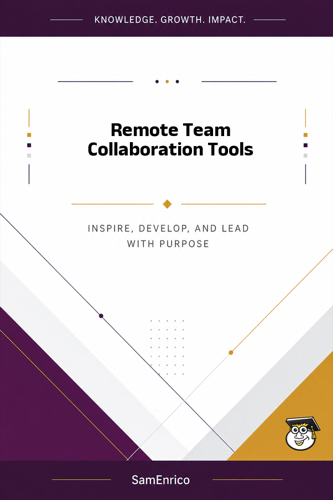
Non-FictionSelf-HelpRemote Work
Remote Team Collaboration Tools eBook
Compare Slack, Teams, Discord, and Asana for creat
by Parish Tad
Compare Slack, Teams, Discord, and Asana for creative work.
Formats
Free sample
Chapter 1: The Non‑Linear Trap--–- Maya stared at her screen. It was 11:47 PM on a Tuesday, and she had just received the eleventh Slack notification in ninety seconds. Her video editor in Manila was asking for clarification on a color grade. Her copywriter in Chicago was waiting for “final final v3” approval. Her client in London had just sent a message that began, “Quick thought…” – a phrase that had never, in Maya’s eight years as a creative director, preceded anything quick.She closed her laptop, walked to her kitchen, and stood in the dark for a full minute.
The silence was disorienting. She could not remember the last time she had gone sixty seconds without a ping, a mention, or a “following up on this.”Maya’s team was not failing. They were delivering award‑winning work for a Fortune 500 client. Their retention rate was 94%. Their Net Promoter Score was the highest in the agency’s history.
By every traditional metric, they were thriving. And yet, every single person on her team was exhausted. Three designers had asked for mental health days in the past month. Her lead producer had started taking calls from her car just to have “ten minutes of quiet.” And Maya herself had not exercised, cooked a proper meal, or read a book for pleasure in over six months.The problem was not her people. The problem was not their talent, their work ethic, or their commitment.
The problem was the invisible architecture of tools and habits that governed how they worked. And that architecture was built on a fundamental lie: that creative work can be managed like an assembly line.The Assembly Line Myth In 1913, Henry Ford introduced the moving assembly line. It reduced the time to build a Model T from twelve hours to ninety‑three minutes. The key insight was linearity: Step A always led to Step B, which always led to Step C. Parts moved forward in a straight line.
There was no looping back, no sudden inspiration that required a rethink of the chassis, no client who called on Friday to say, “Actually, could the car have six wheels?”For a century, virtually every project management methodology – from Gantt charts to Critical Path Method to Waterfall – has borrowed from this linear logic. You break a project into sequential tasks. You assign deadlines. You track progress. If something falls behind, you add resources or cut scope.This works beautifully for manufacturing.
It works reasonably well for software engineering. It fails catastrophically for creative work.Creative work – writing, design, video editing, illustration, campaign development, branding – is inherently non‑linear. A novelist does not write Chapter 1, then Chapter 2, then Chapter 3, and call it done. She writes Chapter 1, then Chapter 2, then realizes Chapter 1 needs to be rewritten based on something she discovered in Chapter 4. A designer does not sketch, then render, then deliver.
She sketches, renders, shows the client, receives feedback, and returns to sketching. A video editor does not cut linearly from start to finish. She jumps between scenes, experiments with transitions, and sometimes throws away hours of work because a different musical track changes the entire emotional tone of the piece.This is not inefficiency. This is the very nature of creativity. And when you force non‑linear work into linear tools, you create friction, burnout, and missed deadlines – not because the team is slow, but because the tool is lying about how work actually happens.The Hidden Rework Problem Let us examine the first of three ways that traditional project management breaks when applied to creative teams.
Call it the Hidden Rework Problem.In manufacturing, rework is expensive but predictable. If a machine stamps a part incorrectly, you know immediately. You can trace the error to a specific step, recalibrate, and resume. The cost of rework is a function of volume: stamping a second part costs the same as stamping the first.In creative work, rework is hidden, unpredictable, and exponentially expensive the later it occurs. Consider a typical branding project.
The copywriter writes tagline options. The designer creates logo variations. The creative director selects a direction. The client approves. The team produces style guides, stationery, social media templates, and website assets.
Then, at the final presentation, the client’s new CMO says, “I love everything except the tagline. Can we go back to option three from the first round?”That single sentence – “go back to option three” – unravels three weeks of work. The designer must revisit color palettes that were chosen to complement the rejected tagline. The social media templates use phrasing tied to the discarded concept. The website copy, already approved by legal, now contradicts the new tagline.A traditional project management tool – say, a Gantt chart in Asana or Microsoft Project – will show this as a disaster.
Every dependent task will turn red. The timeline will balloon. The team will be marked “behind schedule.” But the team was not behind. They were executing exactly as planned. The plan was simply wrong for the nature of creative work.The solution is not better planning.
The solution is tools and workflows that treat rework as a feature, not a bug. That means tools that make it easy to loop back without punishing the team for doing so. It means separate tracking for “creative generation” (which is messy, iterative, and non‑linear) and “creative approval” (which benefits from structure, accountability, and clear handoffs). Most teams today force both into the same linear track, creating exactly the kind of red‑light panic that Maya experienced at 11:47 PM.Feedback Loop Friction The second breakdown is what we will call Feedback Loop Friction. And this is where most creative teams bleed time without even realizing it.Imagine a simple workflow.
A designer creates three homepage mockups. She uploads them to a shared drive and sends a Slack message to her creative director: “Homepage options ready for feedback.” The creative director, who is in back‑to‑back meetings, sees the message four hours later. He replies, “Looking good – I like option two but want to see it with the new photography. Can you update and send to the client by EOD?”The designer, who has moved on to another project, sees this message another two hours later. She spends an hour swapping photography.
She uploads the new version and sends a fresh Slack message to the client. The client, who is in a different time zone, sees the message the next morning. She reviews for twenty minutes, then replies, “Almost there. Can we try the headline from option one on this layout? And make the CTA button green instead of blue.”The designer receives this feedback eight hours after sending the revision.
She makes the changes in thirty minutes. She resends. The client approves two days later.Let us add up the elapsed time: Designer works for one hour. Then she waits four hours for the creative director. Then she works for one hour.
Then she waits overnight for the client. Then she works for thirty minutes. Then she waits two days for final approval. Total elapsed time: nearly four days. Total active work time: two and a half hours.The designer spent 94% of…
This is the end of the free sample. Get the eBook to keep going. Buy now
About this book
Details
- Author
- Parish Tad
- Publisher
- SamEnrico
- Language
- English
- Genre
- Non-Fiction, Self-Help, Remote Work
- Released
- 2026-06-07
- Pages (approx.)
- 128
- Available as
- eBook, Audiobook

Read better in the ZLOADR app
Your eBooks on your phone or tablet. Sign in with your SamEnrico account and start reading.
More by Parish Tad
 Patient Rights During DetoxParish Tad$11.99
 ABCDE Method WorkbookParish Tad$11.99
 Blue Zone Nuts And Seeds GuideParish Tad$11.99
 Parent Social Life SaverParish Tad$11.99
 Validation Statements GuideParish Tad$11.99
 Anger Restructuring For FamiliesParish Tad$11.99
 Virtual Team Time ManagementParish Tad$11.99
 The Carbonari Conspiracy: The Assassination That Shaped a NationParish Tad$11.99
 Silent Code: The Enigma of the Zodiac Killer's Corporate Cover-UpParish Tad$11.99
 How to Produce I/o Cards and AdaptersParish Tad$11.99
 A Collector's Handbook to the Healey 2.4-litre Tickford SaloonParish Tad$11.99
 US Company Registration GuideParish Tad$12.99
You may also like
 Hong Kong Handover 1997Dunn Johnnie$11.99
 Zumba For Postnatal Recovery CourseNeal Christian$11.99
 Zumba for BeginnersLadner Nikia$11.99
 YouTube Comment Mining GuideHumes Pandora$12.99
 Worry Box MeditationCarlin Rudy$11.99
 Workplace Stress MeditationNguyen Lynn$11.99
 Workplace Stress and Sleep RepairHawley Ivory$11.99
 Workplace Perfectionism CureDelaney Jeffry$11.99
 Workplace Injustice Anger GuideWallen Isabelle$11.99
 Work Addiction and Burnout LinkGreenwood Ester$11.99
 Women in Yoga and WellnessBeattie Galina$11.99
 Women in Stand Up ComedyChun Evangeline$11.99