
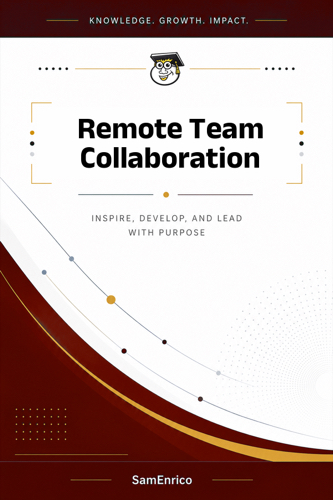
Non-FictionSelf-HelpRemote Work
Remote Team Collaboration eBook
Use digital tools for virtual creativity.
Use digital tools for virtual creativity.
Formats
Free sample
Chapter 1: The Watercooler Lie...--We need to talk about the watercooler. Not the actual object—the ceramic tower of tepid office water that no one drinks. The myth. The golden-tinted memory of spontaneous collision that has become the most expensive nostalgia in modern business.I have sat in over two hundred post-mortem meetings with remote and hybrid teams, and in nearly every single one, someone says the same thing: "This never would have happened if we were in the office. We'd have just bumped into each other by the coffee machine and solved it."It is a beautiful story.
It is also, for the most part, complete fiction.The belief that physical proximity is the mother of creativity has become one of the most stubborn and damaging assumptions in the history of work. We have built entire corporate cultures around it. We have designed billion-dollar office towers to maximize "collision density." We have convinced ourselves that the random hallway chat is the atomic unit of innovation. And now that millions of us work remotely, we are mourning this imaginary golden age as if creativity itself has died.It hasn't. But the way you think about creativity almost certainly has.Here is the uncomfortable truth that the watercooler myth hides: spontaneous creativity is extraordinarily rare, even in physical offices.
What we remember as "magic" was usually the result of careful structural conditions that we never bothered to name. The watercooler didn't create ideas. It was just the only place in an otherwise isolating office environment where people felt safe enough to talk. The problem was never the loss of the watercooler. The problem was that we never learned to build intentional creative spaces anywhere else.This book is built on a single, provocative argument: digital tools are not inferior substitutes for physical whiteboards.
They are new instruments entirely—instruments that, when played correctly, can produce creative breakthroughs that are impossible in any physical room. But to play them, you must first unlearn almost everything you think you know about how creativity happens.Let me start with a confession.The Day I Blamed Zoom for My Own Failure Two years ago, I was leading a creative strategy session for a fintech company with a distributed team across nine time zones. We had fifteen people on a Zoom call, a Miro board that looked like a Jackson Pollock painting, and three hours to solve a product problem that had been stalling for months. I had prepared nothing except a question: "What should we do?"The first twenty minutes were chaos. People talked over each other.
The latency meant that three people would start speaking at once, then all stop, then all start again. Someone's dog barked for forty-five seconds. A senior vice president dominated the conversation with an idea that everyone could see was terrible, but no one said anything because his video square was larger than everyone else's. (It wasn't actually larger. It just felt that way.)After an hour, we had produced exactly two ideas, both of them safe, incremental, and boring.
After two hours, people started turning off their cameras. I could see their faces shrink to gray circles with initials in them. The Miro board had forty-seven sticky notes, but twenty of them said "agree" or "+1." Three people hadn't spoken at all. I ended the meeting early. I told myself it was because we had made "good progress." I was lying.The next day, I blamed Zoom.
I blamed remote work. I wrote an angry Slack message to a colleague about how "creativity requires a room." I was so convincing that I almost believed myself.Six months later, I ran the exact same session with the exact same team. But this time, I had changed everything. We generated eighty-seven ideas in forty-five minutes. The quietest person on the team—a junior product manager who had never spoken on a video call—produced the winning concept.
No one talked over anyone else. The senior vice president who had dominated the first session later told me it was the best creative session of his career. He had barely spoken.What changed? Not the tools. Not the team.
Not the problem. Me. I had stopped blaming the watercooler and started learning how to design for digital creativity.That journey is what this book documents. And it begins with unlearning the most dangerous story we tell ourselves about how ideas are born.The Cues-Filtered-Out Theory: What You Actually Lost Let me be precise about what remote work actually took from you. It is not creativity.
It is not connection. It is not the ability to generate breakthrough ideas. What you lost is something much narrower: a specific set of non-verbal cues that you used to unconsciously regulate conversation.Communication scholars call this the "cues-filtered-out" theory. The idea is simple: every communication medium filters out some of the cues available in face-to-face interaction. A phone call filters out body language.
Email filters out tone of voice. Text messaging filters out pacing. Video conferencing—even at its best—filters out peripheral vision, side glances, the ability to read a room by seeing who is leaning forward, the subtle shift in posture that tells you someone wants to speak, the micro-expression that flashes across a face for a fraction of a second.Here is what the theory does not say: that filtered-out cues are the only way to communicate. That creativity requires them. That without them, collaboration is impossible.
The theory is descriptive, not prescriptive. It tells you what you lost. It does not tell you that you cannot replace it with something else.The watercooler myth relies on a sleight of hand. It takes the genuine loss of non-verbal cues and inflates it into the claim that creativity itself requires physical proximity. That is like saying because you lost a hammer, you cannot build a house.
You can. You just need a different tool.The teams that thrive in remote environments have learned to stop mourning the cues they lost and start reading the cues they still have. And here is the secret that the watercooler nostalgists never mention: digital environments provide information that physical environments cannot. Response latency. Punctuation patterns.
Emoji density. The exact time of day someone posts. The length of their messages. The frequency of their reactions. Whether they type in complete sentences or fragments.
Whether they edit their messages after posting.These are not poor substitutes for body language. They are different data streams entirely. And they can be more reliable than body language, because they are harder to fake. You can train yourself to smile in a meeting when you are miserable. You cannot train yourself to type a period instead of an exclamation point without revealing something true about your energy level.The first step toward digital creativity is accepting this trade-off.
You lost the watercooler. You did not lose the ability to collaborate. You just have to learn a new language.Distributed Work vs. Creative Collaboration: The Critical Distinction Most of what people call "remote work" is actually distributed work. This is an important distinction that almost no one makes, and failing to make it is why so many…
This is the end of the free sample. Get the eBook to keep going. Buy now
About this book
Details
- Author
- Raynor Marine
- Publisher
- SamEnrico
- Language
- English
- Genre
- Non-Fiction, Self-Help, Remote Work
- Released
- 2026-06-07
- Pages (approx.)
- 155
- Available as
- eBook, Audiobook

Read better in the ZLOADR app
Your eBooks on your phone or tablet. Sign in with your SamEnrico account and start reading.
More by Raynor Marine
 Teresas Exclaustration and ReturnRaynor Marine$11.99
 Senior Chronic Pain EsteemRaynor Marine$11.99
 NVC for Police GuideRaynor Marine$11.99
 Heart Disease PreventionRaynor Marine$11.99
 ABCDE For HomemakersRaynor Marine$11.99
 Shift Work Heart HealthRaynor Marine$11.99
 Cleopatra Poison ProtocolRaynor Marine$11.99
 The Raven’s Gambit: A Baba Yaga EspionageRaynor Marine$11.99
 The Phantom Brokers: Europe's Bootleg Empire on the Dark WebRaynor Marine$11.99
 How to Produce Infant and Toddlers ClothingRaynor Marine$11.99
 Slash Career Time ManagementRaynor Marine$12.99
 Undergraduate Length Comparison GuideRaynor Marine$12.99
You may also like
 Hong Kong Handover 1997Dunn Johnnie$11.99
 Zumba For Postnatal Recovery CourseNeal Christian$11.99
 Zumba for BeginnersLadner Nikia$11.99
 YouTube Comment Mining GuideHumes Pandora$12.99
 Worry Box MeditationCarlin Rudy$11.99
 Workplace Stress MeditationNguyen Lynn$11.99
 Workplace Stress and Sleep RepairHawley Ivory$11.99
 Workplace Perfectionism CureDelaney Jeffry$11.99
 Workplace Injustice Anger GuideWallen Isabelle$11.99
 Work Addiction and Burnout LinkGreenwood Ester$11.99
 Women in Yoga and WellnessBeattie Galina$11.99
 Women in Stand Up ComedyChun Evangeline$11.99