
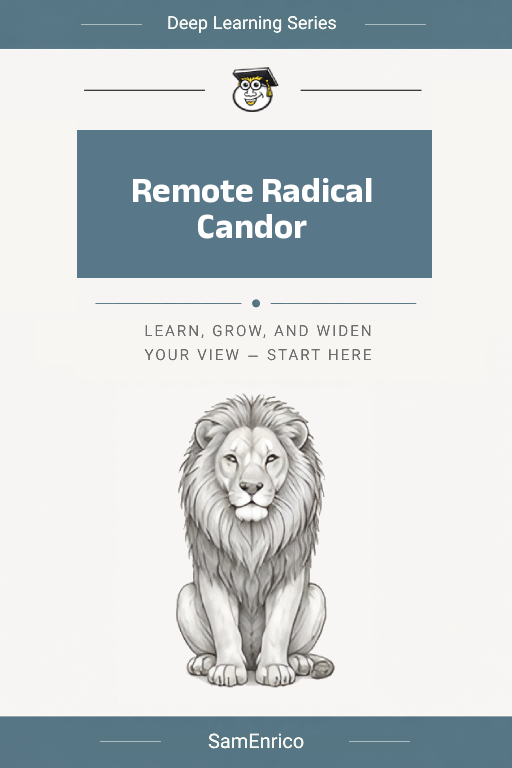
Non-FictionProfessional's Cheat SheetRadical Candor
Remote Radical Candor eBook
Apply radical candor framework to give direct feed
Apply radical candor framework to give direct feedback without causing conflict.
Formats
Free sample
Chapter 1: The Burned Bridge--–- The Slack message arrived at 2:47 PM on a Tuesday. It read: “Can you hop on a quick Zoom?” No context. No emoji. No “no emergency.” Just six words and a period. The recipient, a senior designer named Priya, spent the next forty-five minutes running disaster scenarios through her head: I’m being laid off.
The client complained. That typo from last week is getting me fired. When she finally joined the call, her manager opened with, “Hey, I just wanted to give you some quick feedback on the Figma file.” Priya had already burned through so much emotional energy anticipating catastrophe that she couldn’t hear a single word of the actual feedback. Her amygdala was in control. Her prefrontal cortex—the part of the brain responsible for rational thinking and learning—had logged off.This is the burned bridge.
It is not a single catastrophic event. It is a thousand small, well-intentioned messages that land like grenades because the sender forgot that remote work strips away the ambient humanity of human interaction. In an office, “Can we talk?” comes with a facial expression, a posture, a tone of voice. You can see if your manager is smiling or frowning, relaxed or tense. You have data.
In remote work, you have nothing but words on a screen, and words on a screen are the most dangerous delivery system for feedback ever invented.The thesis of this chapter is simple but painful: remote work makes “caring personally” feel impossible, and without intentional re-humanization, every piece of feedback you give will land colder than you intend. You will become a ghost manager—not because you are cruel, but because you are absent. The watercooler is gone. The coffee chat is gone. The spontaneous “Hey, how are you really doing?” that happens when you walk past someone’s desk is gone.
What remains is the cold architecture of Slack channels, Zoom grids, and email threads. And in that architecture, trust crumbles unless you build it back deliberately, brick by brick.This chapter introduces the concept of Virtual Sociopathy—not a clinical diagnosis, but a behavioral tendency to treat screen-based colleagues as objects or task vectors rather than people. It explains why your feedback lands as harsh even when your intent is kind. And it provides the first three re-humanization protocols that form the foundation of Remote Radical Candor. By the end of this chapter, you will understand why the burned bridge happened, how to prevent the next one, and why the two-minute personal check-in is the most powerful management tool you are probably not using.The Anatomy of a Burned Bridge Let us return to Priya.
Her manager, Marcus, was not a bad person. He was a busy person. He had back-to-back Zoom calls, a deadline looming, and a Slack channel with four hundred unread messages. When he saw the error in Priya’s Figma file—a misaligned button that would break the mobile layout—he wanted to flag it quickly so she could fix it before the client saw. Efficiency was his goal.
He typed “Can you hop on a quick Zoom?” without a second thought. He assumed Priya would understand that “quick” meant “this is small.” He was wrong.What Marcus did not know—because he had not asked in weeks—was that Priya was already on edge. Her partner had lost his job the previous month. She was the sole income earner for the first time in their relationship. Every notification from Marcus felt like a threat because she had no baseline of psychological safety.
In an office, Marcus might have noticed she looked tired. He might have stopped by her desk and said, “Hey, everything okay?” He might have seen the stack of empty coffee cups or the way she flinched when her phone buzzed. But on a screen, she looked exactly like everyone else: a rectangle of pixels in a grid of rectangles.The burned bridge is not the result of a single toxic interaction. It is the cumulative effect of low-context communication delivered into a high-anxiety environment. Remote work creates a perfect storm for misunderstanding because it removes the very cues humans evolved to read.
We are not designed to interpret emotional nuance from twelve-point sans-serif text. We are designed to read faces, hear tones, and feel physical proximity. When those channels disappear, the brain defaults to the worst-case interpretation. It is a survival mechanism. A rustle in the bushes could be the wind or a predator.
Your brain assumes predator. A terse message from your boss could be nothing or a firing. Your brain assumes firing.This is not paranoia. It is neuroscience. The amygdala, the brain’s threat-detection system, cannot distinguish between a literal predator and an ambiguous Slack message.
The same stress response activates: cortisol spikes, heart rate increases, and rational thinking shuts down. In that state, feedback cannot land. The recipient is too busy surviving to learn.Introducing Virtual Sociopathy The term Virtual Sociopathy sounds dramatic. That is intentional. It is meant to jar you out of the comfortable assumption that remote communication is just like in-person communication but with fewer hugs.
It is not.Virtual Sociopathy is the behavioral tendency—encouraged by the design of digital tools—to treat remote colleagues as objects, task vectors, or obstacles rather than as full human beings. It is not malice. It is a side effect of the medium. When you cannot see someone’s face, it is easier to type a blunt message. When you do not have to walk past their desk afterward, it is easier to avoid a difficult conversation.
When the only thing you know about a colleague is their output (tickets closed, reports submitted, code committed), it is easier to reduce them to that output.Consider how you behave in an office versus on Slack. In an office, if you need to tell a colleague that their work missed the mark, you might walk over, ask how their weekend was, and then gently raise the issue. You might use a softer tone, a half-smile, a hand gesture that signals collaboration. On Slack, you type “This needs rework” and hit send. The words are the same, but the impact is radically different.
Without the softening rituals of physical presence, your message lands as a punch.Virtual Sociopathy is amplified by the asynchronous default of remote work. In an office, feedback happens in real time. You see the reaction. You can course-correct immediately: “Wait, that came out harsher than I meant—let me rephrase.” In remote work, feedback is often delivered into a void. You type, you send, and you go back to your other tasks.
The recipient, meanwhile, sits with your words for hours, interpreting and reinterpreting, spiraling without recourse. By the time you realize your message landed badly, the bridge is already burning.The solution is not to abandon remote work or to avoid giving feedback. The solution is to actively, deliberately, and consistently re-humanize your remote interactions. You cannot rely on ambient humanity anymore. You must engineer it.The Three Re-Humanization Protocols The remainder of this chapter presents three protocols for rebuilding the human connection that remote…
This is the end of the free sample. Get the eBook to keep going. Buy now
About this book
Details
- Author
- Maness Mozella
- Publisher
- SamEnrico
- Language
- English
- Genre
- Non-Fiction, Professional's Cheat Sheet, Radical Candor
- Released
- 2026-06-01
- Pages (approx.)
- 146
- Available as
- eBook, Audiobook

Read better in the ZLOADR app
Your eBooks on your phone or tablet. Sign in with your SamEnrico account and start reading.
More by Maness Mozella
 Online Student Isolation GuideManess Mozella$11.99
 Sleep Soundscape GuideManess Mozella$11.99
 The Bering Strait CrossingManess Mozella$11.99
 Hospice Nurse Stress ReliefManess Mozella$11.99
 Antwerp Heist Key Witness ProtectionManess Mozella$11.99
 The Silk Road to the Reef: Zheng He’s Forgotten Marine BiologistsManess Mozella$11.99
 The Silent Treaty: How a 19th-Century Pact Shaped Modern DiplomacyManess Mozella$11.99
 Understanding FibrolipomatosisManess Mozella$17.99
 How to Become a MycologistManess Mozella$11.99
 Strategic Partnership DevelopmentManess Mozella$11.99
 Marc Andreessen Debt WorkbookManess Mozella$12.99
You may also like
 Hong Kong Handover 1997Dunn Johnnie$11.99
 Zumba For Postnatal Recovery CourseNeal Christian$11.99
 Zumba for BeginnersLadner Nikia$11.99
 YouTube Comment Mining GuideHumes Pandora$12.99
 Worry Box MeditationCarlin Rudy$11.99
 Workplace Stress MeditationNguyen Lynn$11.99
 Workplace Stress and Sleep RepairHawley Ivory$11.99
 Workplace Perfectionism CureDelaney Jeffry$11.99
 Workplace Injustice Anger GuideWallen Isabelle$11.99
 Work Addiction and Burnout LinkGreenwood Ester$11.99
 Women in Yoga and WellnessBeattie Galina$11.99
 Women in Stand Up ComedyChun Evangeline$11.99