
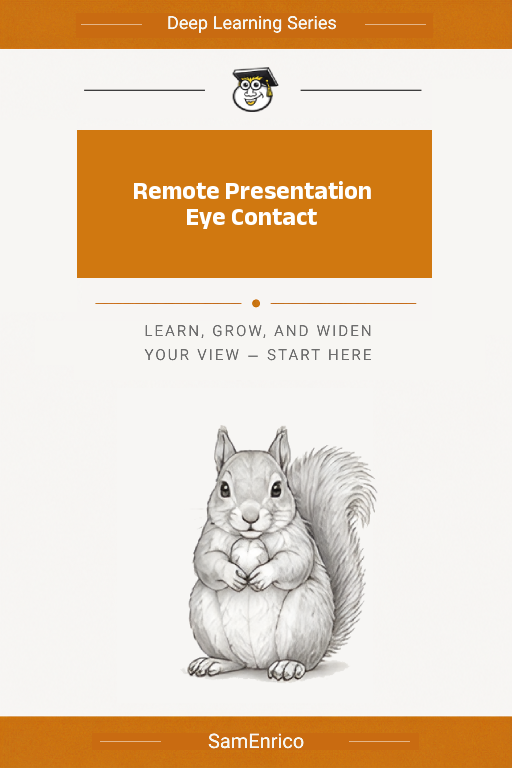
Remote Presentation Eye Contact eBook
Make virtual eye contact by looking at the camera
by Briggs Clint
Make virtual eye contact by looking at the camera lens. Build trust and connection remotely.
Formats
Free sample
Chapter 1: The Broken Mirror--–- Every time you look at a face on your screen, you are lying to the person on the other side. Not intentionally. Not maliciously. But the effect is the same: your gaze says "I am not fully here," and their ancient, hardwired brain believes you.This is the single most destructive force in remote communication today, and almost no one is talking about it. We have spent five years obsessing over Zoom backgrounds, ring lights, and noise-canceling headphones.
We have bought standing desks, upgraded our internet to fiber optic, and memorized the mute button's location. Yet the one thing that determines whether someone trusts you, buys from you, or believes you—the one thing that has separated trustworthy humans from untrustworthy ones for two hundred thousand years—is broken. That thing is eye contact. And in the virtual world, we have accidentally engineered it out of existence.The problem is not that you are bad at presenting remotely. The problem is not that you lack charisma or that your slides are boring.
The problem is structural, architectural, and deeply rooted in human biology. When you look at someone's face on a screen, you are not making eye contact. You are doing the opposite. You are broadcasting disinterest, insecurity, and even deception—whether you feel those things or not. And the people watching you cannot explain why they feel uneasy.
They simply feel it. They trust you less. They remember you less. They choose someone else.This book exists to fix that. But before we get to the solutions—before we adjust your camera height, retrain your gaze, and rewire your habits—you need to understand the depth of the problem.
You need to see the mirror that is broken and why no amount of wishful thinking can repair it without a new set of tools.The Evolutionary Inheritance You Cannot Ignore Let us travel backward in time. Not a hundred years. Not a thousand. Two hundred thousand years. That is roughly how long Homo sapiens have walked the earth.
For the vast majority of that history, humans lived in small tribal groups. There were no smartphones, no written language, no electricity. Survival depended on one thing above all others: accurately reading the intentions of other humans.In that world, eye contact was a life-or-death signal. When another person looked directly at you with a relaxed, steady gaze, your brain registered safety, alliance, and trust. That person was not hiding anything.
They were not preparing to strike. They were with you. But when someone avoided your eyes—when their gaze darted away, dropped to the ground, or seemed to look past you—your ancient threat detection system lit up like a fire alarm. That person could be hiding something. That person could be an enemy.
That person could be preparing to deceive you.This system is not a metaphor. It is a physical network in your brain called the "social brain network," centered in regions like the superior temporal sulcus, the fusiform face area, and the amygdala. These structures work together in milliseconds to detect where another person is looking, whether their gaze is mutual, and whether that mutual gaze signals friend or foe. When you make eye contact with someone in person, your brain releases a small amount of oxytocin—sometimes called the "bonding hormone" or "trust molecule." You feel warmer toward that person. You are more likely to believe them.
You are more likely to cooperate with them.This is not a choice. You do not decide to release oxytocin. Your brain does it automatically because, for two hundred thousand years, mutual gaze was the single most reliable signal of trustworthy intent.Now consider what happens on a video call. You are looking at a screen. The other person's face appears in a rectangle.
You want to connect with them. You want them to trust you. So you do what feels natural: you look at their face. You look them in the eyes. Except you are not looking them in the eyes.
You are looking at a two-dimensional representation of their eyes, and because their camera is mounted somewhere above or beside their screen, they cannot see your eyes at all. From their perspective, you appear to be looking down, looking away, or looking at something just past their shoulder.Your ancient, hardwired social brain does not understand Zoom. It does not understand latency, resolution, or camera placement. It only knows one thing: this person is not looking at me. And when someone does not look at you, your brain whispers: do not trust them.The Paradox of Proximity This brings us to what I call the Paradox of Proximity.
We have never been more connected in a technological sense. A person in Singapore can video call a person in Buenos Aires instantly, for free, with high-definition video. We can see each other's facial expressions, hear each other's voices, and share screens in real time. By any objective measure, we are closer than ever before.And yet, study after study shows that trust in remote interactions is significantly lower than trust in face-to-face interactions. Surveys of remote workers consistently find that they feel less connected to their colleagues, less certain of their managers' intentions, and less confident in their team's cohesion.
Sales professionals report that closing deals remotely is harder. Therapists report that building rapport online takes longer. Even friends and family members report that video calls leave them feeling emotionally drained and strangely unsatisfied.This is the paradox. The technology brings us face-to-face, but the experience drives us apart.The reason is not complicated, but it is profound. Technology has advanced faster than evolution can follow.
Your brain is still running software that was written for the African savanna, not the video grid. And that software interprets the absence of mutual eye contact as a threat. Every remote call triggers a low-grade threat response in your nervous system. You may not feel it consciously. You may not label it as fear.
But you feel it as fatigue, as irritation, as a vague sense that something is off. That feeling has a name: Zoom fatigue. And while many people attribute it to screen time or back-to-back meetings, the real culprit is the constant, unresolved search for mutual gaze that never arrives.The Two Types of Trust To understand why this matters so much, we need to make a critical distinction. In organizational psychology, researchers have identified two fundamentally different types of trust. I have adapted these for our purposes as Cognitive Trust and Affective Trust.Cognitive Trust is the trust of reliability.
It answers the question: "Do I believe this person will do what they say?" You can build cognitive trust through email, through Slack messages, through consistent follow-through on deadlines. If a colleague always submits their reports on time, you develop cognitive trust in them even if you have never met them in person. Cognitive trust is important. It is the foundation of professional reliability. But it is not enough.Affective Trust is the trust of emotional connection.
It answers the question: "Do I feel safe and understood by this person?" Affective trust requires warmth, empathy, and mutual…
This is the end of the free sample. Get the eBook to keep going. Buy now
About this book
Details
- Author
- Briggs Clint
- Publisher
- SamEnrico
- Language
- English
- Genre
- Non-Fiction, Professional's Cheat Sheet, Virtual Communication
- Released
- 2026-06-01
- Pages (approx.)
- 136
- Available as
- eBook, Audiobook

Read better in the ZLOADR app
Your eBooks on your phone or tablet. Sign in with your SamEnrico account and start reading.
More by Briggs Clint
 Cognitive Distortions in Sex AddictionBriggs Clint$11.99
 Customer Discovery For PlanningBriggs Clint$11.99
 Anchoring Persuasion EffectBriggs Clint$11.99
 Age Difference Self EsteemBriggs Clint$11.99
 The Baghdad Bank Heist: A Million-Dollar BetrayalBriggs Clint$11.99
 Manager Assistant StoreBriggs Clint$11.99
 Learn to Play the IgilBriggs Clint$11.99
 How to Start a Picnic Grounds BusinessBriggs Clint$11.99
You may also like
 Remote Public Speaking GuideBelk Valene$12.99
 Remote Presentation Tech ChecklistGist Hunter$12.99
 Remote Presentation Setup GuideSwart Jannette$12.99
 Remote Presentation Nervousness GuideKang Cheri$12.99
 Remote Presentation Vocal TipsBedard Zelda$12.99
 Remote Presentation Slide DesignSwain Tory$12.99
 Remote Presentation Q&A GuideHoover Elidia$12.99
 Engaging Remote Audiences GuideMallen Theda$12.99
 Remote Presentation Body LanguageHowell Rosemarie$12.99