
Non-FictionSelf-HelpHuman Resources
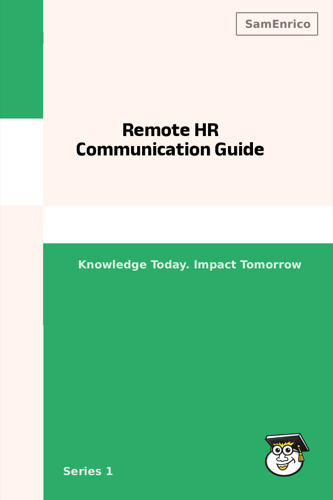
Remote HR Communication Guide eBook
Teaches handling employee relations, benefits, and
Teaches handling employee relations, benefits, and policies digitally.
Formats
Free sample
Chapter 1: The Transposition Trap–- The email arrived at 9:47 AM on a Tuesday. It was seventeen paragraphs long, attached to a PDF that was itself twenty-three pages, and it announced a complete restructuring of the company’s remote work policy. Within ninety minutes, three senior engineers had started a private Slack channel called #wtf-hr, two managers had called in sick to avoid answering questions they couldn’t understand, and one employee had accidentally replied all with a single word: “Unbelievable.” The HR director, baffled by the chaos, asked her team, “But we sent the exact same memo we used for the office restructuring three years ago. Why isn’t this working?”This question—innocent, well-intentioned, and catastrophically wrong—is the single most expensive mistake in remote HR today. The belief that what worked in a physical office will work equally well on a screen has led to failed policy rollouts, undetected harassment complaints, quiet quitting epidemics, and lawsuits that could have been prevented with a different choice of words or a different channel of delivery.
Copy-pasting is not a strategy. Transposition is not translation. And the gap between what you mean to say and what a remote employee actually hears has never been wider.This chapter is not a gentle introduction to remote HR communication. It is a wake-up call. Before we can teach you how to mediate conflict across time zones, explain benefits without putting people to sleep, or write policies that people actually read, we must first confront the fundamental misunderstanding that undermines all of it: the assumption that remote HR is simply “HR on Zoom.” It is not.
It is a completely different discipline, with its own physics, its own pathologies, and its own set of rules. And until you understand why copy-pasting fails, you will keep making the same expensive mistakes.The Anatomy of Transposition Failure Let us define a term that will appear throughout this book: transposition failure. Transposition is the act of moving something from one context to another without changing its form. In music, transposition works because the relationships between notes remain constant. In HR communication, transposition fails catastrophically because the relationships between people do not remain constant when the medium changes.Consider a simple example.
In an office, a manager walks past an employee’s desk and says, “Hey, got a minute?” The employee looks up, reads the manager’s facial expression (relaxed? tense?), hears their tone (casual? urgent?), and within half a second decides whether to feel anxious or curious. The manager then sits down, and the conversation unfolds with real-time feedback loops: nodding, leaning in, crossed arms, a sigh, a smile. Both parties adjust continuously.Now transpose that exact same interaction to Slack.
The manager types: “Got a minute?” The employee sees the message pop up. There is no facial expression. There is no tone of voice. There is no context. The employee’s brain, starved of social information, fills the gap with the worst possible interpretation.
This is called negative bias in text-based communication, and it is well documented in organizational psychology: in the absence of positive cues, humans default to assuming threat. The employee thinks: “Am I in trouble? Did I miss something? Is this about the deadline last week?” Their cortisol spikes. They type back, “Sure, what’s up?” But by now, they are already defensive.The manager, oblivious to this internal spiral, types a perfectly benign request: “Just wanted to check on the Johnson file.” The employee exhales.
But the damage is done. The interaction took twice as long as it would have in person, produced five times more anxiety, and eroded trust slightly—not because anyone did anything wrong, but because the medium itself stripped away the human cues that make workplace communication safe.Now multiply this by a hundred interactions a day, across an entire organization. That is the hidden tax of transposition failure. And it is why the most common phrase in remote HR—“Just put it in Slack”—should be treated with the same suspicion as “What’s the worst that could happen?”The Four Hidden Costs of Transposition Transposition failure is not a single problem but a cluster of related failures, each with its own cost. Let me name them:The Loss of Emotional Containment.
In physical spaces, emotions are shared. When a difficult announcement is made, employees can see that others are also worried, which normalizes their anxiety and prevents it from spiraling into panic. In remote work, each employee experiences news alone, in whatever emotional state they happen to be in—mid-task, tired, distracted, already frustrated about something else. Isolation amplifies fear. Research from the National Institutes of Health shows that individuals receiving bad news in isolation show 40 percent higher cortisol levels than those receiving the same news in a group setting.
The physical office was a shock absorber for emotion. Remote work has no shock absorbers unless you build them.The Loss of Real-Time Clarification. In an office, a policy announcement is followed immediately by questions. The speaker can see confusion on faces and address it before it spreads. The Q&A happens in the same room, at the same time, so everyone hears the same answers.
In remote work, questions trickle in over hours or days, with the same questions being answered repeatedly via different channels, creating a sense of disorganization and incompetence. By the time the third person asks “Does this affect my team?” the answer has been given twice, but no one knows that because the answers are scattered across Slack threads, email chains, and private DMs.The Loss of Sequential Processing. In an office, employees receive information in a controlled sequence: announcement, then Q&A, then small-group discussion, then written follow-up. Each stage builds on the previous one, and employees are never asked to process more than one type of information at a time. In remote work, the entire information dump often arrives simultaneously.
An email contains the announcement, the FAQ, the legal appendix, and the manager talking points all in one message. Employees scroll to the attachment first (panic), then the FAQ (confusion), then the rationale (skepticism), then the summary (too late). The sequence matters enormously. When you scramble the sequence, you scramble comprehension.The Permanence Paradox. A spoken announcement evaporates.
A written announcement is archived, searched, quoted, screenshotted, and weaponized. This is the cruelest paradox of remote communication: the same features that make digital writing useful—searchability, permanence, verifiability—also make it dangerous. One employee excerpts a single ambiguous sentence from a policy update, posts it to a private Slack channel with a skull emoji, and within hours the entire company believes that “the wording suggests layoffs are coming in Q2,” even though the memo said nothing of the sort. Text is evidence. Spoken words are memory.
In conflict, memory is flexible; evidence is not. And in remote work, everything is evidence.The Case Study That Should Scare You Let me tell you the full story of the restructuring memo, because it contains every element of transposition failure in one tidy disaster. The company, let us call it Fin Serve Solutions, had successfully used a detailed written memo for office restructurings for a…
This is the end of the free sample. Get the eBook to keep going. Buy now
About this book
Details
- Author
- Mcclellan Kermit
- Publisher
- SamEnrico
- Language
- English
- Genre
- Non-Fiction, Self-Help, Human Resources
- Released
- 2026-06-07
- Pages (approx.)
- 142
- Available as
- eBook, Audiobook

Read better in the ZLOADR app
Your eBooks on your phone or tablet. Sign in with your SamEnrico account and start reading.
More by Mcclellan Kermit
 Fiverr Buyer Persona GuideMcclellan Kermit$11.99
 Hawking Zero Gravity FlightMcclellan Kermit$11.99
 Twelve Step for Compulsive ExerciseMcclellan Kermit$11.99
 Anticipatory Grief and LegacyMcclellan Kermit$11.99
 The Navy Sailor OverdoseMcclellan Kermit$11.99
 Impossible Standards ChildhoodMcclellan Kermit$11.99
 Hearst Good HousekeepingMcclellan Kermit$11.99
 Dancer Flexibility Maintenance GuideMcclellan Kermit$11.99
 The Forgotten Ecologists of Angkor: Decoding the Khmer Empire's Environmental WisdomMcclellan Kermit$11.99
 The Last Mile: Lance Armstrong's Fall from GraceMcclellan Kermit$11.99
 Steel Behemoths: The Pacific Carrier Duel That Shaped Modern Naval WarfareMcclellan Kermit$11.99
 Understanding Attenuated FapMcclellan Kermit$17.99
You may also like
 Hong Kong Handover 1997Dunn Johnnie$11.99
 Zumba For Postnatal Recovery CourseNeal Christian$11.99
 Zumba for BeginnersLadner Nikia$11.99
 YouTube Comment Mining GuideHumes Pandora$12.99
 Worry Box MeditationCarlin Rudy$11.99
 Workplace Stress MeditationNguyen Lynn$11.99
 Workplace Stress and Sleep RepairHawley Ivory$11.99
 Workplace Perfectionism CureDelaney Jeffry$11.99
 Workplace Injustice Anger GuideWallen Isabelle$11.99
 Work Addiction and Burnout LinkGreenwood Ester$11.99
 Women in Yoga and WellnessBeattie Galina$11.99
 Women in Stand Up ComedyChun Evangeline$11.99