
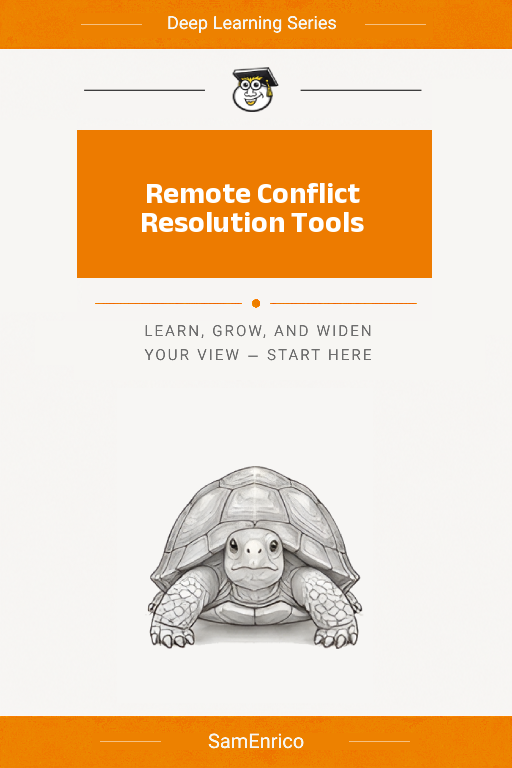
Non-FictionProfessional's Cheat SheetTechnology Tools
Remote Conflict Resolution Tools eBook
Evaluates software platforms for anonymous reporti
Evaluates software platforms for anonymous reporting, mediation scheduling, and conflict tracking specifically designed for distributed teams.
Formats
Free sample
Chapter 1: The Silent Escalation--The first sign of trouble was not a raised voice or a slammed door. It was a Slack message that went unanswered for forty-eight hours. Two software engineers who had once collaborated seamlessly, who had shared inside jokes in the #random channel and tagged each other in pull request comments, had stopped speaking. No one noticed. Their manager was in a different time zone.
Their teammates were focused on their own deadlines. The conflict, whatever it was, festered in silence.Three months later, one of them quit. In the exit interview, she cited “a toxic work environment.” Her manager was baffled. He had seen nothing. He had heard nothing.
The conflict had never appeared in any formal channel, never escalated to HR, never triggered any of the early warning systems that existed in the physical office. It had simply grown in the dark, like mold behind a wall, until it was too late to save.This story is not unusual. It is the new normal of remote work. And it reveals a terrifying truth: the infrastructure that once caught conflicts early—the hallway conversations, the overheard words, the observable body language—has vanished. In its place is a void where small misunderstandings become silent resentments, and silent resentments become attrition, legal claims, and organizational dysfunction.This chapter diagnoses why traditional conflict resolution breaks online.
We will explore the four structural failures of distributed work environments, examine the hidden costs of unresolved conflict, and lay the foundation for the software-based solutions that the rest of this book will evaluate. By the end, you will understand why your current methods are failing and what you must do differently.The Four Broken Pillars of Traditional Conflict Resolution For decades, organizations relied on an invisible architecture of conflict resolution. It was not written in any policy manual. No one trained managers to use it. It simply existed, a byproduct of human proximity.This architecture rested on four pillars.
In distributed teams, every pillar has crumbled.Pillar One: Proximity-Based Observation In a physical office, a manager could walk the floor and sense the temperature of the organization. She could see who ate lunch alone, who avoided eye contact, whose body language suggested tension during meetings. She could notice when two interdependent colleagues stopped collaborating, when a usually talkative employee went quiet, when a team’s energy shifted from engaged to resigned.These observations did not require formal reporting. They were passive, ambient, and constant. They allowed early intervention—a quick check-in, a gentle question, a facilitated conversation—before minor friction became major conflict.In distributed teams, proximity-based observation is impossible.
A manager cannot see who is isolated because everyone is isolated by default. She cannot observe body language through Slack messages. She cannot sense team energy when team members communicate asynchronously across time zones.The result is what one HR leader called “the silent escalation problem.” Conflicts that would have been caught at level one or two in a physical office escalate to level five or six before anyone notices. By the time they become visible—through formal complaints, productivity metrics, or attrition—the damage is done.Pillar Two: Informal Documentation In a physical office, many conflicts resolved through undocumented conversations. A manager might bring two employees together for coffee, mediate a brief discussion, and watch the issue dissolve.
The resolution was never recorded. No case number was created. No audit trail existed. But the conflict was gone.This informality worked because the participants shared physical space. They could read each other’s tone, see each other’s expressions, and trust that the conversation happened.
The absence of documentation was a feature, not a bug. It reduced friction, lowered stakes, and allowed resolution without bureaucracy.In distributed teams, undocumented conversations are dangerous. Without the context of shared physical space and nonverbal cues, employees demand written documentation of every interaction. A manager’s attempt at an informal Zoom check-in is recorded. A casual suggestion is screenshot and shared.
Every word becomes evidence.This creates a paradox. The need for documentation increases precisely when the medium of communication—text-based chat, email, video calls—makes resolution more difficult. Employees become defensive. Managers become cautious. Conflicts that could have been resolved with a five-minute conversation drag on for weeks.Pillar Three: Relationship-Based Trust Conflict resolution requires psychological safety.
An employee must believe that raising a concern will not lead to retaliation, that his perspective will be heard fairly, and that the process will be confidential.In traditional settings, this trust was built through relationships. An employee trusted his manager because they had worked together for years. He trusted HR because he had seen them handle other cases fairly. He trusted the ombuds because they had a reputation for neutrality.In distributed teams, these relationships do not exist. An employee may never meet his HR representative in person.
He may have only occasional video calls with his manager. The trust that once took years to build must now be established through systems, not relationships.This is why anonymous reporting platforms have become essential infrastructure. They do not solve the trust deficit, but they bypass it. An employee does not need to trust a person. He only needs to trust the system.Pillar Four: Spontaneous Coordination In a physical office, scheduling a mediation was trivial.
A manager could walk to two desks, ask “Do you have ten minutes?”, and lead the employees to an empty conference room. Coordination happened in real time, with minimal overhead.In distributed teams, scheduling is a logistical nightmare. A conflict involving employees in New York, London, and Singapore requires finding a meeting time that works across three time zones, coordinating virtual room access, managing document sharing, and tracking follow-up actions. Without dedicated software, these coordination tasks can consume more time than the mediation itself.This is not a minor inconvenience. It is a structural barrier.
When scheduling a mediation takes weeks, conflicts escalate. When follow-up sessions require the same arduous coordination, resolutions unravel. The friction of coordination becomes an obstacle to resolution.The Hidden Costs of Unresolved Conflict Before organizations invest in new tools, they must understand what they are currently losing. The costs of unresolved conflict are not theoretical. They are measurable, substantial, and largely invisible.Direct Costs These are the easy ones.
HR investigative time, legal fees, settlement payments, regulatory fines. In a significant workplace claim, these can easily reach six or seven figures. But they are the tip of the iceberg.Indirect Costs These are larger and harder to measure. Productivity loss is the most obvious. Employees in active conflict spend hours ruminating, avoiding colleagues, and documenting their grievances rather than doing their jobs.
Research suggests the average organization loses two to three hours per week per employee to conflict-related productivity drag. For a 1,000-person organization, that is 2,000 to 3,000 hours per week—the equivalent of 50 to 75 full-time employees doing nothing productive.Voluntary turnover is another major cost. Employees who experience unresolved conflict are far more likely to leave. Each departure costs 50-150% of the employee’s annual salary in recruitment, hiring, and training expenses. A single preventable departure can wipe out the cost savings of a cheap conflict resolution…
This is the end of the free sample. Get the eBook to keep going. Buy now
About this book
Details
- Author
- Comer Krystyna
- Publisher
- SamEnrico
- Language
- English
- Genre
- Non-Fiction, Professional's Cheat Sheet, Technology Tools
- Released
- 2026-06-01
- Pages (approx.)
- 124
- Available as
- eBook, Audiobook

Read better in the ZLOADR app
Your eBooks on your phone or tablet. Sign in with your SamEnrico account and start reading.
More by Comer Krystyna
 Corporate Wellness Program UsersComer Krystyna$11.99
 Tanganyika Nyerere Union GuideComer Krystyna$11.99
 Cabin in the WoodsComer Krystyna$11.99
 The John Wayne Gacy Insanity DefenseComer Krystyna$11.99
 Social Skills EQ EnhancementComer Krystyna$11.99
 The Last Voyage of the Mary Celeste: A Mind Palace MysteryComer Krystyna$11.99
 Payroll SupervisorComer Krystyna$11.99
 Understanding Mucopolysaccharidosis Type 3Comer Krystyna$17.99
 How to Become a Cloth-bale HeaderComer Krystyna$11.99
 AI Video Translation GuideComer Krystyna$12.99
You may also like
 Hong Kong Handover 1997Dunn Johnnie$11.99
 Zumba For Postnatal Recovery CourseNeal Christian$11.99
 Zumba for BeginnersLadner Nikia$11.99
 YouTube Comment Mining GuideHumes Pandora$12.99
 Worry Box MeditationCarlin Rudy$11.99
 Workplace Stress MeditationNguyen Lynn$11.99
 Workplace Stress and Sleep RepairHawley Ivory$11.99
 Workplace Perfectionism CureDelaney Jeffry$11.99
 Workplace Injustice Anger GuideWallen Isabelle$11.99
 Work Addiction and Burnout LinkGreenwood Ester$11.99
 Women in Yoga and WellnessBeattie Galina$11.99
 Women in Stand Up ComedyChun Evangeline$11.99