
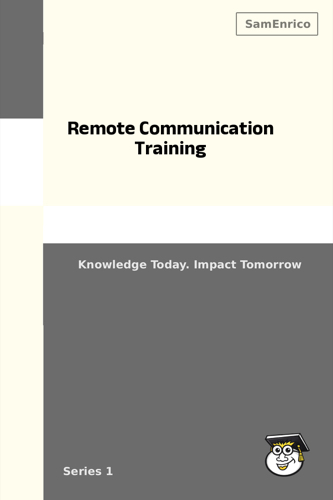
Remote Communication Training eBook
For managers to train teams on digital best practi
by Kurtz Linnea
For managers to train teams on digital best practices.
Formats
Free sample
Chapter 1: The Ping Pandemic--–- It is 3:17 PM on a Tuesday. You have answered forty-seven Slack messages, attended two meetings that could have been emails, switched between six different applications, and you still have not opened the document that is due tomorrow morning. Your Slack status has been green all day. Your team thinks you are busy. You are not busy.
You are noisy. And there is a difference—a difference that separates high-performing remote teams from those that merely survive.This chapter begins with a confession that most leadership books are too polite to make: Most remote teams fail not because people are not working, but because they confuse being "online" with being "productive." The always-on, always-ping culture that has infected organizations over the past five years is not a productivity strategy. It is a coping mechanism for managers who have not learned to distinguish signal from noise. And until you name the problem, you cannot fix it.The problem has a name. I call it the Ping Pandemic.The Ping Pandemic is the widespread, unexamined assumption that digital availability equals professional contribution.
It is the belief that a quick reply is better than a thoughtful one. It is the habit of sending a message just to feel like you are doing something. It is the slow creep of notification badges from "helpful" to "tyrannical." And like any pandemic, it spreads asymptomatically—teams do not realize they are infected until the damage is already done.I have watched this phenomenon destroy good teams. Not bad teams. Not lazy teams.
Good teams with talented people who care about their work. The Ping Pandemic does not discriminate by talent or motivation. It eats both equally.Consider the research from Andrew Brodsky, whose work on digital communication patterns revealed something counterintuitive: The teams that communicate the most are rarely the teams that accomplish the most. In fact, Brodsky found a negative correlation between message volume and project completion rates. The more a team pinged, the less they delivered.
This is not because pings are evil. It is because pings are interruption, and interruption is the enemy of depth.But here is what makes the Ping Pandemic so insidious: It feels productive. When you answer a Slack message, you get a small dopamine hit. When you clear your email inbox, you feel a sense of completion. When you end a day with dozens of "closed loops," you convince yourself that you worked hard.
You did work hard. You just did not do the work that matters.The Ping Pandemic tricks your brain into mistaking motion for progress. And once your team is hooked, the addiction self-reinforces. The more you ping, the more you expect replies. The more replies you expect, the more you check your notifications.
The more you check your notifications, the less deep work you complete. The less deep work you complete, the more behind you fall. The more behind you fall, the more you ping to feel in control.This is the cycle that this book exists to break.The Availability Fallacy Before we can solve the Ping Pandemic, we must understand its underlying belief system. I call this the Availability Fallacy: the mistaken assumption that a person's availability to respond to messages is a valid proxy for their contribution to the team.The Availability Fallacy shows up in dozens of subtle ways. The manager who checks Slack at 10 PM and expects to see activity.
The team member who apologizes for a two-hour email delay. The unspoken rule that green status indicators should be treated as attendance records. The anxiety that rises when you step away from your computer for a lunch break and return to a wall of unread messages.Here is what the research says about availability: It does not predict output. In study after study, the employees who reply fastest are not the employees who produce the highest-quality work. They are the employees who are most anxious, most insecure, or most unoccupied with meaningful tasks.
Fast replies are a sign of availability, not ability.The Availability Fallacy also creates a terrible asymmetry between managers and individual contributors. Managers often believe they need constant updates to feel in control. Individual contributors, sensing this need, begin to perform availability rather than performance. They send messages to be seen. They reply instantly to appear engaged.
They stay logged in after hours to demonstrate loyalty. And all of this performative availability steals time from the work that actually matters.I have worked with teams where the Availability Fallacy cost them over ten hours per person per week. Ten hours. That is an entire workday plus two hours of overtime, every week, wasted on the theater of availability. When I showed one team their audit data, the lead engineer broke down in tears.
She had been working sixty-hour weeks and producing less than she did when she worked forty hours in an office. She was not burning out from work. She was burning out from the constant ping of work.The PING Model: Your Antidote The remainder of this chapter introduces a framework that will serve as the backbone for everything that follows in this book. The PING model is not a theory. It is a practice—a set of four mental habits that transform how your team thinks about every single digital message they send.PING stands for Perspective Taking, Initiative, Nonverbal Cues, and Goals.
Each element builds on the others. And together, they create a complete discipline for intentional communication.P is for Perspective Taking Perspective taking is the single most underrated skill in digital communication. Before you send any message—any email, any Slack message, any voice memo, any meeting invitation—you must stop and ask one question: What does the receiver need right now?This sounds simple. It is not. Most people send messages from their own perspective.
They write what they want to say, when they want to say it, in the format that is most convenient for them. Perspective taking flips this entirely. It demands that you think about the receiver's context, priorities, and constraints before you type a single word.Consider two versions of the same update. Version one: "We need to discuss the Q3 numbers. Let me know when you're free." Version two: "[INFORM] Q3 numbers came in at 112% of target.
No action needed—just sharing the good news. Attached is the breakdown if you want details." The first message forces the receiver to stop, interpret, respond, and schedule. The second message gives the receiver everything they need in five seconds. Same information. Radically different experience.Perspective taking also means recognizing that not every message needs an immediate response.
If you are sending a message to someone in deep work hours, you are interrupting them. Perspective taking asks: Is this interruption worth it? Can this wait two hours? Can this be batched? Can this be sent as a voice memo they can listen to while walking?The best teams practice perspective taking so consistently that it becomes invisible.
They do not congratulate themselves for being considerate. They just are. And the result is a communication culture where messages feel like gifts, not obligations.I is…
This is the end of the free sample. Get the eBook to keep going. Buy now
About this book
Details
- Author
- Kurtz Linnea
- Publisher
- SamEnrico
- Language
- English
- Genre
- Non-Fiction, Self-Help, Training
- Released
- 2026-06-10
- Pages (approx.)
- 140
- Available as
- eBook, Audiobook

Read better in the ZLOADR app
Your eBooks on your phone or tablet. Sign in with your SamEnrico account and start reading.
More by Kurtz Linnea
 Conversation Starters for Hotel LoungesKurtz Linnea$11.99
 Email Out of Office GuideKurtz Linnea$11.99
 Pinterest VA Rich Pins DecodedKurtz Linnea$11.99
 DCIS Diagnosis GuideKurtz Linnea$11.99
 Frozen Alchemy: The Arctic Quest for the Elements of LifeKurtz Linnea$11.99
 The Last Letter: A Family’s Hidden WWII Love StoryKurtz Linnea$11.99
 Meeting Blocking StrategyKurtz Linnea$12.99
 MarketForce YC GuideKurtz Linnea$12.99
 Ultimate Handbook Guide to Shishou : (China) Travel GuideKurtz Linnea$11.99
 Understanding Codesette SyndromeKurtz Linnea$17.99
 BlenderKurtz Linnea$11.99
You may also like
 Hong Kong Handover 1997Dunn Johnnie$11.99
 Zumba For Postnatal Recovery CourseNeal Christian$11.99
 Zumba for BeginnersLadner Nikia$11.99
 YouTube Comment Mining GuideHumes Pandora$12.99
 Worry Box MeditationCarlin Rudy$11.99
 Workplace Stress MeditationNguyen Lynn$11.99
 Workplace Stress and Sleep RepairHawley Ivory$11.99
 Workplace Perfectionism CureDelaney Jeffry$11.99
 Workplace Injustice Anger GuideWallen Isabelle$11.99
 Work Addiction and Burnout LinkGreenwood Ester$11.99
 Women in Yoga and WellnessBeattie Galina$11.99
 Women in Stand Up ComedyChun Evangeline$11.99