
Non-FictionSelf-HelpChatNotifications
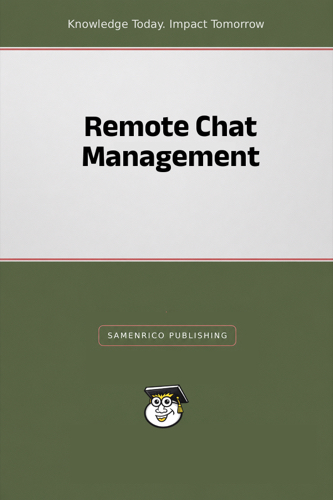
Remote Chat Management eBook
Use Slack, Teams, and Discord without constant dis
Use Slack, Teams, and Discord without constant distraction.
Formats
Free sample
Chapter 1: The Ping Reflex--–- Three times in the last hour, you have looked at your phone while reading this sentence. You didn't mean to. You don't even remember doing it. But somewhere between the second and third paragraph, a notification buzzed, or maybe it didn't, and your thumb drifted toward the screen anyway. That is not a character flaw.
That is a trained physiological response, and it has a name: the Ping Reflex.The Ping Reflex is the automatic, semi-conscious urge to check a chat application whenever a notification appears, might appear, or could theoretically appear at any moment. It is the reason remote workers now check Slack, Teams, or Discord an average of seventy-seven times per workday, according to a 2023 study from the University of California, Irvine. It is the reason you can no longer sit through a ninety-minute movie without picking up your phone. And it is the single greatest threat to deep, meaningful work in the remote era.But here is what almost no one understands: the Ping Reflex is not your fault. It is not a sign of weak willpower, poor discipline, or a scattered mind.
It is the predictable outcome of a digital environment designed by some of the smartest behavioral psychologists in the world, working for companies whose business models depend on your attention. Every sound, every badge, every typing indicator, every little green "active now" dot has been optimized to trigger the same neural pathways as a slot machine. You are not addicted to your chat apps because you are broken. You are reacting exactly as any human would react to a system engineered for compulsive use.This chapter will do three things. First, it will name the enemy: not Slack or Teams or Discord themselves, but the invisible architecture of urgency they have built around us.
Second, it will show you the true cost of that architecture, not just in lost time but in cognitive capacity, creative thinking, and basic sanity. And third, it will introduce the single most important tool you will learn in this entire book: the Batch Clock. By the time you finish this chapter, you will understand why you have been losing the battle against chat, and you will have the first concrete strategy for winning it back.The Invention of Now To understand why chat feels urgent, you have to understand what it replaced. Before Slack launched in 2013, most workplace communication traveled through email. Email has many problems, but it has one critical feature that chat deliberately removed: asynchronous friction.
When you send an email, you have no idea if the recipient has read it. There is no typing indicator. There is no "last seen" timestamp. There is no little green dot next to their name. Email, by design, builds in a natural delay.
You send a message, and then you wait. That waiting teaches patience.Chat applications removed every single one of those friction points. Slack shows you exactly when someone is active. Teams displays a green dot when your colleague is at their computer. Discord tells you when someone is typing a reply.
These features were not added by accident. They were added because they increase engagement. When you see that someone is active, you expect an immediate reply. When you see those three dots indicating typing, you stare at the screen, waiting. Your dopamine system lights up in anticipation, just as it does when a slot machine's reels begin to spin.This is what the book Ping: The Secrets of Successful Virtual Communication calls "the urgency transfer." The tool transfers the urgency of the medium onto the message.
A question that would feel low-pressure in an email suddenly feels high-pressure in a chat because the chat itself signals immediacy. "Got a sec?" is not actually an urgent question. But because it arrives in a container designed for real-time conversation, your brain treats it like a fire alarm.The Ping Reflex is the behavioral outcome of this urgency transfer. Your brain has learned that a chat notification might contain something important, and because it might, you cannot afford to ignore it. This is the logic of intermittent reinforcement, the same psychological principle that makes gambling so addictive.
If a notification were always important, you would check it eagerly. If it were never important, you would ignore it entirely. But because it is sometimes important and sometimes not, you are trapped in a cycle of compulsive checking. You cannot predict which ping matters, so you check them all.The 23-Minute Lie There is a statistic that circulates widely in productivity circles: after an interruption, it takes an average of twenty-three minutes to return to your original task. This statistic is often cited as if it applies to every single ping, and as a result, many people have concluded that any interruption is catastrophic.
That conclusion is wrong, and it has led to precisely the opposite of useful advice.The original study, conducted by Gloria Mark at UC Irvine, found that twenty-three minutes was the average time to return to a task after an interruption, but that average included a wide range of outcomes. A simple interruption, like a quick question about a file location, might cost only a few minutes. A complex interruption, like being pulled into an entirely different project, might cost an hour or more. More importantly, the study measured return to task, not loss of deep focus. The deepest forms of creative work require a state that psychologist Mihaly Csikszentmihalyi called "flow": complete absorption, loss of self-consciousness, and a distorted sense of time.
That state can take thirty minutes or more to achieve. And a single ping can shatter it instantly.Here is the distinction that matters, and it will reappear throughout this book: there is a difference between interruption and distraction. An interruption is external. A notification appears. Someone taps you on the shoulder.
The phone buzzes. You did not choose it. A distraction is internal. Your mind wanders away from your work, either toward a potential interruption or away from the work itself. Most people blame interruptions for their lost productivity.
But in truth, the anticipation of an interruption is often more damaging than the interruption itself.The Ping Reflex is not just the act of checking a notification. It is the low-grade, continuous anxiety that a notification might appear. It is the part of your brain that remains vigilant, scanning for incoming messages, even when you have not heard a sound in twenty minutes. That vigilance is exhausting. It consumes cognitive resources that should be directed toward your work.
And it is the real reason chat tools are so damaging to deep thinking.Sarah's Spreadsheet Let me tell you about Sarah. Sarah is a senior product manager at a mid-sized software company. She is good at her job, well-liked by her team, and consistently exhausted. When she came to me for help, she described her typical workday as "drowning in Slack." She had forty-seven active channels. She received an average of two hundred and thirty direct messages per week.
She estimated that she checked Slack more than one hundred times per day.I asked Sarah to do something simple. For…
This is the end of the free sample. Get the eBook to keep going. Buy now
About this book
Details
- Author
- Sturgeon Lulu
- Publisher
- SamEnrico
- Language
- English
- Genre
- Non-Fiction, Self-Help, Chat, Notifications
- Released
- 2026-06-10
- Pages (approx.)
- 145
- Available as
- eBook, Audiobook

Read better in the ZLOADR app
Your eBooks on your phone or tablet. Sign in with your SamEnrico account and start reading.
More by Sturgeon Lulu
 Mindfulness for Job SeekersSturgeon Lulu$11.99
 Difficult Conversations Made EasySturgeon Lulu$11.99
 Lonely Recovery From AddictionSturgeon Lulu$11.99
 The Walking Creativity RitualSturgeon Lulu$11.99
 The Russian Enlightenment: From Catherine the Great to Tolstoy’s WisdomSturgeon Lulu$11.99
 Learn to Play the BandoneónSturgeon Lulu$11.99
 Express Entry Graduate GuideSturgeon Lulu$12.99
 Pre Launch Paid Ads GuideSturgeon Lulu$12.99
 Assistant UnderwriterSturgeon Lulu$11.99
 How to Become a Steam-conditioner OperatorSturgeon Lulu$11.99
You may also like
 Hong Kong Handover 1997Dunn Johnnie$11.99
 Zumba For Postnatal Recovery CourseNeal Christian$11.99
 Zumba for BeginnersLadner Nikia$11.99
 YouTube Comment Mining GuideHumes Pandora$12.99
 Worry Box MeditationCarlin Rudy$11.99
 Workplace Stress MeditationNguyen Lynn$11.99
 Workplace Stress and Sleep RepairHawley Ivory$11.99
 Workplace Perfectionism CureDelaney Jeffry$11.99
 Workplace Injustice Anger GuideWallen Isabelle$11.99
 Work Addiction and Burnout LinkGreenwood Ester$11.99
 Women in Yoga and WellnessBeattie Galina$11.99
 Women in Stand Up ComedyChun Evangeline$11.99