
Non-FictionSelf-HelpGovernance
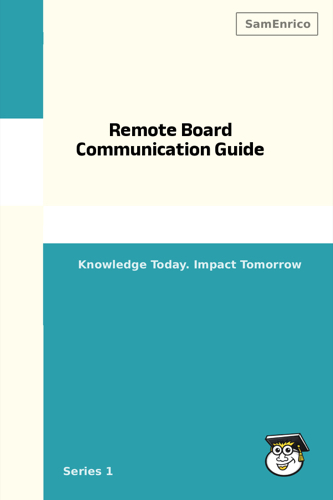
Remote Board Communication Guide eBook
Teaches presenting to and engaging virtual board o
by Ford Jason
Teaches presenting to and engaging virtual board of directors.
Formats
Free sample
Chapter 1: The Silent Scream--The first time a CEO loses a virtual board vote they should have won, they almost never see it coming. The meeting starts with polite hellos. The slides load smoothly. The Chair nods approvingly. And then, somewhere between the third chart and the fifth question, the air changes.
Not dramatically. Not with hostility. With something far worse: nothing.No one asks the hard follow-up. No one challenges the assumption buried on slide twelve. The Audit Committee chair says "interesting" instead of "I approve." The Lead Director asks a question that was answered twice already.
And twenty-four hours later, the decision comes back: "We'd like to see more analysis." Or worse: "We're not comfortable moving forward." The CEO hangs up, baffled. What went wrong? The data was perfect. The deck was polished. The answer, invisible and devastating, is that the board checked out forty-five minutes before the meeting ended, and no one noticed.
Not because they were rude. Because they were silent. And in the remote boardroom, silence is not a pause. It is a verdict.This chapter is about learning to hear that silence before it kills your initiative. It is about reading the room when there is no room.
And it is about mastering the single hardest skill in virtual board communication: assessing engagement when all you have is a two-inch video square and a director who stopped blinking three minutes ago.The problem is not that virtual boards are less engaged. The problem is that engagement looks different on a screen. In person, you have peripheral vision. You can see who is leaning forward, who is flipping through a board book, who is whispering to the person next to them. On Zoom, your brain is starved of context.
You see a grid of faces, each frozen, each slightly delayed, each cropped at the shoulders. The natural rhythms of conversation—the nod, the tilt, the lean—are either missing or so compressed that your subconscious cannot process them. By the time you realize you have lost the room, the room has been gone for fifteen minutes.This chapter will give you a new framework for seeing what is actually happening in your virtual boardroom. You will learn to spot the "Gallery View freeze," the micro-expression that predicts a hostile question, and the difference between a thoughtful pause and a checked-out silence. You will learn when to use synchronous video versus asynchronous updates.
And you will walk away with three practical exercises that will permanently rewire how you read a remote room.The Anatomy of the Silent Scream Every executive who has presented to a virtual board knows the feeling: you finish a slide, pause for questions, and the screen goes dead. No one unmutes. No one types in chat. The directors stare back at you like a Renaissance painting—frozen, composed, and utterly unreadable. Your brain interprets this as either (a) they are deeply thinking, or (b) they have abandoned you.
Most executives panic and fill the silence with more words, more slides, more data. This is exactly wrong.The silent scream has three distinct phases, and learning to identify them is the difference between recovering a meeting and losing it.Phase One: The Attentive Pause (0–3 seconds). After you finish a significant point, the board needs time to process. In person, this processing happens while people look down at their notes, adjust their glasses, or exchange a glance. On video, processing looks like stillness.
No one moves. No one blinks. This is good. This means you have landed a punch. Do not speak.
Do not advance the slide. Wait three full seconds. Count them in your head: one-one-thousand, two-one-thousand, three-one-thousand. If someone speaks in that window, answer them. If no one speaks, move to the next point.
You have not lost them.Phase Two: The Hesitant Silence (4–7 seconds). At four seconds, something shifts. The stillness is no longer processing; it is hesitation. Someone wants to speak but is waiting for someone else to go first. On video, this looks like the same frozen faces, but with a new quality: the slight parting of lips, the eyes moving from the center of the screen to the speaker list, the hand hovering near the mute button.
This is the moment to deploy a directed question. "Susan, as Audit Chair, what is your initial reaction?" You are not filling silence. You are inviting participation. The difference is everything.Phase Three: The Checked-Out Void (8+ seconds). At eight seconds of complete silence after a direct question or a major point, you have lost the room.
They are not thinking. They are not hesitating. They have moved on. Their cameras are still on, but their attention is elsewhere—email, a second monitor, a phone under the desk. This is the silent scream.
And most executives respond by talking faster, showing more data, or apologizing. All three responses make it worse. The correct response is a pattern interrupt: a change of modality, a call to action, or a hard reset.The pattern interrupt might be: "I see I've given you a lot to think about. Let me summarize the two decisions I need from you today, and then we can vote." Or: "Let me pause here. Would it be helpful to see a live demo instead of these slides?" Or, in extreme cases: "I'm sensing we're not aligned.
Should we schedule a follow-up focused only on the risk section?" The key is to acknowledge the silence without apologizing for it. You are not saying "Sorry, I'm being boring." You are saying "I see we need a different approach."Low-Resolution Presence: Seeing Through the Pixelation The term "strategic presence in a low-resolution environment" comes from research on virtual communication and has been adapted from best-selling works on remote presentation. It means: your ability to project authority and read responses when the visual feed is compressed, delayed, and cropped. In practice, it requires you to shift from reading macro body language (crossed arms, leaning back) to reading micro-expressions (tightened jaw, raised eyebrow, sudden stillness).Here is what you can actually see on a standard Zoom or Teams grid, assuming the director's camera is on and their face is reasonably well lit:The Jaw. A director who is engaged and thinking will have a relaxed jaw, often slightly parted.
A director who is skeptical or hostile will tighten the jaw, sometimes visibly clenching the masseter muscle at the back of the cheek. A director who is checked out will have a slack jaw, often with the mouth slightly open and unmoving. Jaw tension is your earliest warning system.The Eyes. Eye contact on video is weird because the camera is not at the center of the screen. A director who is truly looking at you will look slightly above the camera, not directly into it.
A director who is reading something else will have eyes moving left to right at a consistent pace. A director who is watching themselves instead of you will glance down at their own image every few seconds. The worst sign: fixed, unblinking eyes that never move. That is not engagement. That is the Gallery View freeze, and it means they have…
This is the end of the free sample. Get the eBook to keep going. Buy now
About this book
Details
- Author
- Ford Jason
- Publisher
- SamEnrico
- Language
- English
- Genre
- Non-Fiction, Self-Help, Governance
- Released
- 2026-06-09
- Pages (approx.)
- 150
- Available as
- eBook, Audiobook

Read better in the ZLOADR app
Your eBooks on your phone or tablet. Sign in with your SamEnrico account and start reading.
More by Ford Jason
 Einstein God Letter MysteryFord Jason$11.99
 The Warehouse Worker OverdoseFord Jason$11.99
 Sugar Addiction During Pregnancy GuideFord Jason$11.99
 False Allegations ChildhoodFord Jason$11.99
 Cyclist Hip and Knee Stretching HandbookFord Jason$11.99
 Gambling Addiction and Family Repair WorkbookFord Jason$11.99
 Anticipatory Grief ChecklistFord Jason$11.99
 Hearst EsquireFord Jason$11.99
 The Crimson Tide: How the Indian Ocean Spice Trade Revolutionized Industrial ChemistryFord Jason$11.99
 Echoes of the Blue Hole: The Lost Underwater LabFord Jason$11.99
 The Serpent’s Last Breath: The Dragon of Saint George’s DefianceFord Jason$11.99
 Understanding Avoidant Personality DisorderFord Jason$17.99
You may also like
 Hong Kong Handover 1997Dunn Johnnie$11.99
 Zumba For Postnatal Recovery CourseNeal Christian$11.99
 Zumba for BeginnersLadner Nikia$11.99
 YouTube Comment Mining GuideHumes Pandora$12.99
 Worry Box MeditationCarlin Rudy$11.99
 Workplace Stress MeditationNguyen Lynn$11.99
 Workplace Stress and Sleep RepairHawley Ivory$11.99
 Workplace Perfectionism CureDelaney Jeffry$11.99
 Workplace Injustice Anger GuideWallen Isabelle$11.99
 Work Addiction and Burnout LinkGreenwood Ester$11.99
 Women in Yoga and WellnessBeattie Galina$11.99
 Women in Stand Up ComedyChun Evangeline$11.99