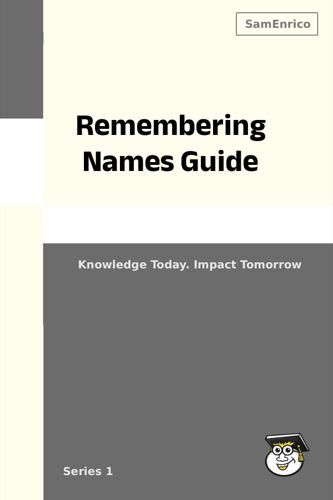
Remembering Names Guide eBook
Use mnemonics and repetition to recall names.
Use mnemonics and repetition to recall names.
Formats
Free sample
Chapter 1: The Name-Forging Lie...--– You have been told a lie. Not a small, harmless fib, but a deep, corrosive falsehood that has cost you friendships, business opportunities, and countless moments of social embarrassment. The lie sounds like this: “I’m just bad with names.” Maybe you’ve said it yourself, perhaps in a moment of apology after forgetting someone you should have remembered. Maybe you’ve heard it from a colleague, a partner, or a parent. It rolls off the tongue with the weight of accepted truth, like saying “I’m bad at math” or “I have no sense of direction.” But here is the unvarnished reality: being “bad with names” is not a personality trait.
It is not wired into your DNA. It is not a permanent condition you must accept and work around for the rest of your life.The truth is far more liberating and far more demanding. Being bad with names is a skill deficit, not a genetic limit. And skill deficits can be repaired. They can be trained, drilled, and overcome with the right techniques and consistent practice.
This entire book exists because that single lie has done more damage to human relationships than almost any other self-limiting belief. It has made millions of people feel inadequate, anxious, and socially clumsy when the only real problem was that no one ever taught them how to encode a name in the first place.Think about the last time you forgot someone’s name. Really picture the moment. You were likely introduced, heard a sound that vaguely resembled syllables, nodded, and then immediately began thinking about what you were going to say next. Your brain was busy rehearsing your own response, scanning the room for exits, or worrying about whether you had spinach in your teeth.
The name never stood a chance. It wasn’t that your memory was broken. It was that you never actually encoded the information. You heard it the way you hear background music in an elevator—present but not processed, audible but not stored.This chapter will dismantle the name-forgetting myth piece by piece, replacing it with a practical, evidence-based understanding of how memory actually works. You will learn the critical difference between hearing and encoding, discover why the first three seconds after an introduction determine everything, and confront the uncomfortable truth about where your attention really goes when someone says their name.
By the end of this chapter, you will never again be able to hide behind the excuse of being “bad with names” because you will know—with absolute certainty—that the only thing standing between you and exceptional name recall is a set of learnable skills.The Anatomy of a Forgotten Name Let us walk through a typical introduction in slow motion. You are at a networking event, a party, or a meeting. Someone approaches, smiles, and extends a hand. They say, “Hi, I’m Michael.” In that exact moment, your brain is doing approximately seventeen things simultaneously. It is processing the person’s face, assessing their emotional state, deciding whether they seem friendly or threatening, calculating social distance, preparing your own name for delivery, and monitoring the environment for other cues.
In this cognitive chaos, the name “Michael” arrives as a brief auditory blip—approximately 0.4 seconds of sound.Here is what happens next in the brain of someone who believes they are “bad with names.” The auditory cortex registers the sound. The hippocampus, which is responsible for forming new memories, receives a weak signal. But before any encoding can occur, the prefrontal cortex—your brain’s executive control center—intervenes with a higher priority instruction: “Prepare your own response.” The name “Michael” is held in working memory, a fragile temporary storage system that lasts about 15 to 30 seconds without active rehearsal. Then you say, “Nice to meet you, I’m Sarah,” and the name “Michael” is immediately displaced by your own name, your next thought, or the ambient noise of the room.By the time you shake hands and release, “Michael” is already fading. Within three seconds, it has lost 50 percent of its retrievability.
Within 20 minutes, without reinforcement, it is gone entirely—not deleted, but buried so deep that spontaneous retrieval is impossible. When you see Michael again at the next event, you will recognize his face perfectly (faces are processed by a different neural pathway, the fusiform face area) but his name will feel like it is trapped behind a glass wall. You can see it, almost touch it, but you cannot say it.This is not a memory problem. This is an encoding problem. The difference is everything.Hearing Versus Encoding: The Critical Distinction To understand why the “bad with names” lie is so dangerous, we must first distinguish between two very different cognitive processes: hearing and encoding.
Hearing is passive. It requires no effort, no intention, and no special skill. Your ears collect sound waves, your auditory nerve transmits signals to your brain, and you register that a sound occurred. You can hear a name while being completely distracted, anxious, or exhausted. Hearing is automatic, like breathing.Encoding is the opposite.
Encoding is the active process of transforming sensory information—in this case, a sequence of syllables—into a lasting memory trace that can be retrieved later. Encoding requires attention, intention, and effort. You cannot encode a name passively. You cannot encode a name while your mind is elsewhere. Encoding is the deliberate act of saying to your brain, “This information matters.
Make a place for it.”The cruel irony is that most people have never been taught how to encode. We are taught to read, to write, to calculate, to analyze—but no one teaches us how to form lasting memories. We assume that if we hear something once, we should remember it. That assumption is biologically false. The human brain did not evolve to remember arbitrary sound sequences like “Michael,” “Jennifer,” or “Takeshi.” It evolved to remember threats, rewards, spatial layouts, and social relationships.
A name is an abstract label, and abstract labels require deliberate encoding.Here is the liberating truth: anyone can learn to encode. The techniques in this book—the sound-alike system, the feature link, the spacing effect, the 5-Minute Drill—are encoding strategies. They transform an abstract name into a vivid, memorable image that your brain cannot ignore. But the first step is admitting that hearing is not enough. You must stop expecting your brain to remember names it was never asked to store.The Three-Second Rule: Your First and Most Powerful Tool Now that you understand the difference between hearing and encoding, we can introduce the single most important technique in this book.
It is simple, nearly effortless, and so effective that it alone will double your name recall within a week. It is called the Three-Second Rule.The Three-Second Rule is this: immediately after hearing a name, you have three seconds to perform at least one active encoding action. If you do nothing in those three seconds, the name will almost certainly be lost. But if you act, you can lock the name into working memory long enough to apply the deeper techniques in later chapters.What counts as an…
This is the end of the free sample. Get the eBook to keep going. Buy now
About this book
Details
- Author
- Han Fredricka
- Publisher
- SamEnrico
- Language
- English
- Genre
- Non-Fiction, Self-Help, Memory Skills
- Released
- 2026-06-10
- Pages (approx.)
- 159
- Available as
- eBook, Audiobook

Read better in the ZLOADR app
Your eBooks on your phone or tablet. Sign in with your SamEnrico account and start reading.
More by Han Fredricka
 Voice Actor Twin Voices MemoirHan Fredricka$11.99
 Stimulant HIV Hep C RiskHan Fredricka$11.99
 Gambling Addiction MindfulnessHan Fredricka$11.99
 Teen People Pleasing CureHan Fredricka$11.99
 Phone Distraction SolutionHan Fredricka$11.99
 Occupational Therapist StressHan Fredricka$11.99
 First Year After Pregnancy LossHan Fredricka$11.99
 The Quantum Leap of Hippocrates: Birth of Western MedicineHan Fredricka$11.99
 The Invisible Champion: How a North Korean Defector Exposed the Dark Side of Olympic PropagandaHan Fredricka$11.99
 How to Start a Conveying Plant (hydraulic and Pneumatic) Business (Beginners Guide)Han Fredricka$11.99
 How to Produce Car Care EquipmentHan Fredricka$11.99
 Growing Aronia (Chokeberry)Han Fredricka$11.99