
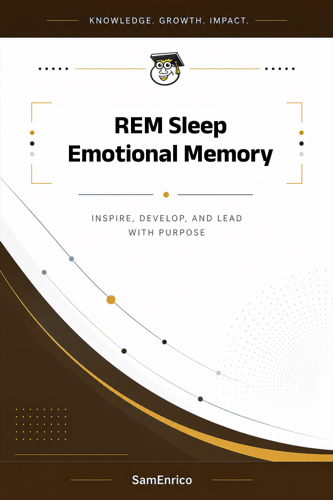
Non-FictionSelf-HelpEmotional Regulation
REM Sleep Emotional Memory
Processes feelings and stores them.
Processes feelings and stores them.
Formats
About this book
Free sample
Chapter 1: The Theft of Midnight...–- Armond Aserinsky was eight years old when he became the first person to have his dreams measured. It was 1952, and his father, a restless graduate student named Eugene, had jury-rigged a machine in the basement of the University of Chicago. The device was crude by today’s standards—a metal box with whirring pens, electrodes salvaged from broken hospital equipment, and enough exposed wires to make a modern safety inspector faint. Eugene had glued the electrodes to his son’s scalp and around his eyes. The wires trailed to the machine like thin black vines.
Then he told Armond to go to sleep.What happened next would shatter seventy years of scientific certainty. But at first, nothing happened. The pens scratched straight lines across the rolling paper. Armond breathed evenly. The basement smelled of dust and old ink.
Eugene sat in the dark, watching, waiting, probably questioning his life choices. Then, approximately fifty minutes into the recording, the pens went wild.The electroencephalogram (EEG) pens—those tracking Armond’s brain waves—began jerking in sharp, low-amplitude zigzags, a pattern that looked nearly identical to the brain of someone fully awake. Simultaneously, the electrooculogram (EOG) pens, which tracked eye movements, showed rapid, synchronized bursts of activity. Beneath his closed lids, Armond’s eyes were darting back and forth, up and down, as if watching something invisible. His breathing had become irregular, faster.
And his body, aside from those flickering eyes, lay completely still.Eugene called his mentor, Nathaniel Kleitman, a white-haired physiologist who had spent decades arguing that sleep was a passive, uniform state of cortical idling. Kleitman came down the stairs, looked at the paper, and said something that history did not record but that we can reasonably imagine as a variation of “What in God’s name is that?”They had discovered Rapid Eye Movement sleep. They had discovered that the sleeping brain is not a dimming lamp but a strobe light—periodically blazing with activity, consuming oxygen at rates equal to or greater than wakefulness, running complex internal programs while the body lies paralyzed. They had…
This is the end of the free sample. Get the eBook to keep going. Buy now
Contents
- Chapter 1
- Chapter 2
- Chapter 3
- Chapter 4
- Chapter 5
- Chapter 6
- Chapter 7
- Chapter 8
- Chapter 9
- Chapter 10
- Chapter 11
- Chapter 12
Details
- Author
- Schumacher Van
- Publisher
- SamEnrico
- Language
- English
- Genre
- Non-Fiction, Self-Help, Emotional Regulation
- Released
- 2026-06-06
- Pages (approx.)
- 134
- Available as
- eBook, Audiobook

Read better in the ZLOADR app
Your eBooks on your phone or tablet. Sign in with your SamEnrico account and start reading.
More by Schumacher Van
 Roseburia InterpretationSchumacher Van$11.99
 Pregnancy Loss Empathy GuideSchumacher Van$11.99
 Governor's Confederate Monument RemovalSchumacher Van$11.99
 Toddler Tantrum Stress Survival GuideSchumacher Van$11.99
 Coping With Student Loan StressSchumacher Van$11.99
 Roam Research MemorySchumacher Van$11.99
 Pomodoro For ReviewSchumacher Van$11.99
 ASV Therapy GuideSchumacher Van$11.99
 The Forgotten Ace: The Untold Story of Eddie Rickenbacker in WWIISchumacher Van$11.99
 The Battle of Antietam: Blood on the CornfieldSchumacher Van$11.99
 Beneath the Grid: The Lost Subterranean Cities of the WorldSchumacher Van$11.99
 Quantum Computing ApplicationsSchumacher Van$11.99
You may also like
 Hong Kong Handover 1997Dunn Johnnie$11.99
 Zumba For Postnatal Recovery CourseNeal Christian$11.99
 Zumba for BeginnersLadner Nikia$11.99
 YouTube Comment Mining GuideHumes Pandora$12.99
 Worry Box MeditationCarlin Rudy$11.99
 Workplace Stress MeditationNguyen Lynn$11.99
 Workplace Stress and Sleep RepairHawley Ivory$11.99
 Workplace Perfectionism CureDelaney Jeffry$11.99
 Workplace Injustice Anger GuideWallen Isabelle$11.99
 Work Addiction and Burnout LinkGreenwood Ester$11.99
 Women in Yoga and WellnessBeattie Galina$11.99
 Women in Stand Up ComedyChun Evangeline$11.99