
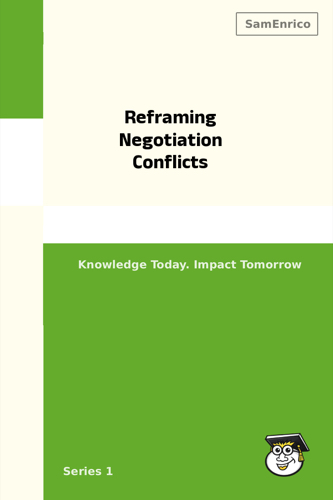
Non-FictionBusiness BriefReframing
Reframing Negotiation Conflicts eBook
Teaches changing how parties view the problem to f
by Noland Nella
Teaches changing how parties view the problem to find solutions.
Formats
Free sample
Chapter 1: The Iceberg Lie--–- You are fighting the wrong war. You have been fighting the wrong war your entire life. Every argument about money, every deadlock over a deadline, every silent treatment after a family disagreement—you thought you were fighting over the thing on the table. You were not. The thing on the table is almost never the real thing.
And until you understand this, you will keep losing negotiations you should win, walking away from deals that were possible, and blaming the other person for being “unreasonable” when the person who is trapped in the wrong story is you.Let me tell you about a CEO who learned this lesson the hard way. Her name is Sarah, and she ran a mid-sized logistics company. She was negotiating a $10 million contract with a major retailer. The negotiation had been going on for six weeks. The sticking point was price.
The retailer wanted a 12 percent discount. Sarah had offered 8 percent. They were stuck at 10 percent. Each side sent angry emails. Each side accused the other of being greedy.
Each side prepared their walkaway position.On the last day, Sarah made her final offer: 9.5 percent. The retailer said no. The deal died.Sarah was furious. She told her board, “They were irrational. They left $500,000 on the table out of pure stubbornness.”Six months later, Sarah ran into the retailer’s procurement head at a conference.
Over drinks, she asked him, “What actually happened? Why did you walk away from a deal that made sense for both of us?”He looked at her and said, “Sarah, it was never about the price. Your delivery timeline was six weeks. Our peak season starts in five weeks. We needed the goods in four weeks.
We told you that in the second email. You never addressed it. So we assumed you couldn’t do it. By the time you came down to 9.5 percent, we had already signed with someone else who charged us 12 percent but delivered in three weeks.”Sarah sat in silence. She had read every email.
She had seen the words “delivery timeline.” But she was so focused on the price—on the number, the position, the battle—that she never asked herself: What is actually driving their need?This is the Iceberg Lie. The Iceberg Lie is the belief that the conflict you see on the surface—the argument about money, time, territory, or resources—is the real conflict. It is not. Above the waterline, you see positions: “I want $10,000.” “I need the report by Friday.” “This is my final offer.” Below the waterline, hidden from view, are interests: Why do they want $10,000? What happens if they don’t get the report by Friday?
What are they afraid will happen if they accept your offer?Most negotiators spend 90 percent of their energy fighting over the tip of the iceberg. The masters spend 90 percent of their energy diving below the surface.This book is about learning to dive. It is about learning to see the invisible frame that traps every conflict and then changing that frame so that solutions appear that were invisible before. The name for this skill is reframing. Reframing is not compromise.
It is not giving in. It is not “meeting in the middle.” Reframing is the act of changing how the parties define the problem so that the problem itself transforms.When Sarah thought the problem was “price,” she was stuck. When she learned the problem was “delivery timeline,” she realized she could have solved it by air-freighting a partial order—a solution that cost less than the 12 percent discount she was fighting over. The problem was never the price. The problem was her frame.The Anatomy of a Frame Every conflict lives inside a frame.
A frame is the set of assumptions, expectations, and definitions that you bring to a situation without realizing you are bringing them. Frames are invisible to the person holding them, just as glasses are invisible to the person wearing them. You do not see the frame. You see through the frame.Here is a simple experiment. Look at the following shape:text Copy Download ▲ ▲ ▲ ▲ ▲ ▲ ▲Do you see a triangle?
Most people do. But there is no triangle. There are three lines arranged in a particular way. Your brain frames those lines as a triangle because it has been trained to see triangles. The frame is so automatic that you do not notice it.
You simply see “triangle.”Negotiation works the same way. When someone says, “I need a raise,” you automatically frame that as a conversation about money. When someone says, “That deadline is impossible,” you automatically frame that as a conversation about time. When a colleague says, “You always interrupt me,” you automatically frame that as a conversation about behavior.But what if the raise is really about respect? What if the deadline is really about fear of failure?
What if the interruption complaint is really about a need to be heard by someone who never listens at home? The frame you choose determines the solutions you can see. Change the frame, and you change the universe of possible agreements.There are three common frames that trap negotiators. You will recognize all of them.The War Frame. This is the assumption that negotiation is a battle.
There is a winner and a loser. Every concession is a defeat. Every question is an attack. Every pause is a trap. People in the War Frame talk about “winning,” “beating,” “fighting,” and “defending.” They prepare for battle by hardening their positions and distrusting everything the other side says.
The War Frame guarantees one thing: even if you “win,” you will have created an enemy who will spend the next year trying to undo your victory.The Game Frame. This is the assumption that negotiation is a performance. The goal is not to solve a problem but to execute a script. People in the Game Frame memorize tactics, practice “power moves,” and treat the other person as an obstacle to be outmaneuvered. The Game Frame produces clever outcomes but fragile agreements.
When the game ends, the relationship often ends with it.The Problem-Solving Frame. This is the assumption that negotiation is a shared puzzle. The goal is not to defeat the other person but to solve the challenge that stands between you. People in the Problem-Solving Frame ask different questions: “What are we both trying to achieve?” “What is getting in our way?” “What would a good solution look like from both perspectives?” This is the frame that produces durable agreements, preserved relationships, and value that neither side saw at the start.The tragedy is that most people default to the War Frame or the Game Frame without ever realizing they have a choice. They react.
They defend. They attack. And then they wonder why the other person became hostile.You have a choice. The first reframing move of this entire book is to recognize that you are the one holding the frame. And you can put it down.Positions vs.
Interests: The Core Distinction If you learn only one concept from this book, learn this one. It is the foundation of everything that follows.A…
This is the end of the free sample. Get the eBook to keep going. Buy now
About this book
Details
- Author
- Noland Nella
- Publisher
- SamEnrico
- Language
- English
- Genre
- Non-Fiction, Business Brief, Reframing
- Released
- 2026-06-10
- Pages (approx.)
- 142
- Available as
- eBook, Audiobook

Read better in the ZLOADR app
Your eBooks on your phone or tablet. Sign in with your SamEnrico account and start reading.
More by Noland Nella
 Trello Card Repeater AutomationNoland Nella$11.99
 Child Loss and Military ParentsNoland Nella$11.99
 Sobriety First Steps Recovery GuideNoland Nella$11.99
 HIIT Progression GuideNoland Nella$11.99
 The Working Memory JournalNoland Nella$11.99
 Heirloom Selection GuideNoland Nella$11.99
 Contested Divorce SupportNoland Nella$11.99
 Raven's Gambit: Loki's Last TrickNoland Nella$11.99
 The Invincible Armada: Spain's Clash of EmpiresNoland Nella$11.99
 How to Produce Motor Vehicle Suspension PartsNoland Nella$11.99
 How to Produce Keyboard and Mouse CombosNoland Nella$11.99
 How to Start a Conveyor for Agricultural Use Business (Beginners Guide)Noland Nella$11.99
You may also like
 Hong Kong Handover 1997Dunn Johnnie$11.99
 Zumba For Postnatal Recovery CourseNeal Christian$11.99
 Zumba for BeginnersLadner Nikia$11.99
 YouTube Comment Mining GuideHumes Pandora$12.99
 Worry Box MeditationCarlin Rudy$11.99
 Workplace Stress MeditationNguyen Lynn$11.99
 Workplace Stress and Sleep RepairHawley Ivory$11.99
 Workplace Perfectionism CureDelaney Jeffry$11.99
 Workplace Injustice Anger GuideWallen Isabelle$11.99
 Work Addiction and Burnout LinkGreenwood Ester$11.99
 Women in Yoga and WellnessBeattie Galina$11.99
 Women in Stand Up ComedyChun Evangeline$11.99