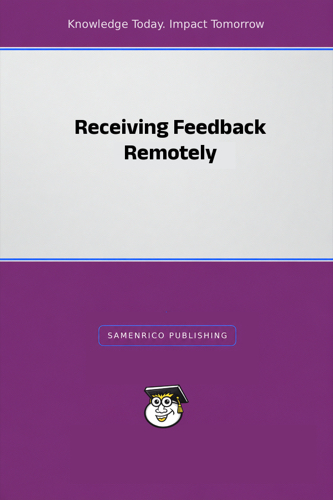
Receiving Feedback Remotely Audiobook
Teaches processing criticism without visual cues a
by Mullis Tory
Teaches processing criticism without visual cues and responding professionally.
Formats
Free sample
Chapter 1: The Vanishing Cue...--You are about to have a perfectly normal workday ruined by a single punctuation mark.Not a period at the end of a harsh sentence. Something worse. Something smaller. A manager who writes “OK” with a period instead of an exclamation point. A colleague who responds “Sounds good” instead of “Sounds good!” A Slack message that says “Let’s talk” with no follow-up emoji, no “no worries,” no softening language of any kind.Your brain will treat this as a threat.Not because you are fragile.
Not because you cannot take criticism. But because human beings evolved to read safety and danger in the faces, voices, and bodies of other humans. And right now, sitting alone in your home office, staring at a screen, you have none of those cues. Your brain is starving for information. So it fills the gap.
And what it fills it with, more often than not, is catastrophe.This is the cue-deficit environment. It is the single most overlooked reason why remote feedback feels so much harder than feedback in person. And until you understand how it works, you will continue to have evenings ruined by three-word Slack messages and weekends destroyed by emails that your manager probably forgot they even sent.The first thing you need to know is that you are not imagining the difficulty. The research is clear: humans are remarkably bad at interpreting tone in written text. A study at the University of Chicago found that people correctly identify the intended tone of an email only about fifty-six percent of the time.
That is barely better than a coin flip. And when the email is neutral or mildly critical? Accuracy drops even further. Because when we cannot see a face or hear a voice, we assume the worst.This is not a bug in your personality. It is a feature of your evolution.The Threat Detection System You Never Asked For Imagine you are a hominid on the African savanna fifty thousand years ago.
You hear a rustle in the tall grass. It could be the wind. It could be a friendly tribesmate. It could be a saber-toothed cat. What is the safest assumption?
The cat. Because if you assume the wind and you are wrong, you die. If you assume the cat and you are wrong, you are embarrassed but alive.Your brain is still wired that…
This is the end of the free sample. Get the Audiobook to keep going. Buy now
About this book
Details
- Author
- Mullis Tory
- Publisher
- SamEnrico
- Language
- English
- Genre
- Non-Fiction, Self-Help, Receptivity
- Released
- 2026-06-10
- Pages (approx.)
- 139
- Available as
- eBook, Audiobook

Listen in the VoxFlicks app
Audiobooks and audio dramas wherever you go. Sign in with your SamEnrico account and press play.
More by Mullis Tory
 Emotional Eating Recovery HandbookMullis Tory$11.99
 The Comfort BoundaryMullis Tory$11.99
 Perfectionist Parent RecoveryMullis Tory$11.99
 Anticipatory Grief and AtheismMullis Tory$11.99
 Twelve Step for Hoarding DisorderMullis Tory$11.99
 The Waitlist Anxiety GuideMullis Tory$11.99
 Growth Hormone Replacement EthicsMullis Tory$11.99
 Movie Theater Snack TrapMullis Tory$11.99
 The Amazon’s Hidden Leviathans: Father Feijóo and the Lost Giants of the Rio NegroMullis Tory$11.99
 Voices of the Greenwood: The Tulsa Race Massacre's Forgotten SurvivorsMullis Tory$11.99
 Chrono Quest: The Lost City of ZarahemlaMullis Tory$11.99
 Understanding AtresiaMullis Tory$17.99