
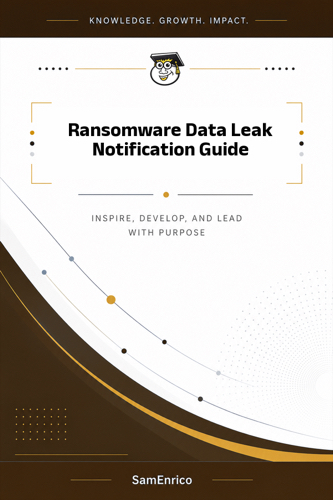
Non-FictionCrisis ManagementRansomware Response
Ransomware Data Leak Notification Guide eBook
Alert customers when ransomware exposes their data
by Artis Joseph
Alert customers when ransomware exposes their data using these extortion response notification scripts.
Formats
Free sample
Chapter 1: The Empathy Deficit--–- The notification landed in Sarah’s inbox at 9:47 on a Tuesday morning. She had just finished her coffee and was reviewing a quarterly report when her phone buzzed. The sender was a company she had trusted with her medical records, her Social Security number, and the details of her children’s insurance coverage. The subject line read: “Important Security Notice Regarding Your Personal Information.” Her heart did not race. It sank.
She had seen these before. What she did not know, as she opened that email, was that she was about to be asked to perform emotional labor for a corporation that had failed her. She was about to be told, in polite and carefully lawyered language, that she should not worry. That there was “no evidence” her data had been misused. That the company took her “privacy seriously.” And she was about to feel something far more dangerous than fear.
She felt contempt.This chapter argues that most breach notifications fail not because they lack legal accuracy, not because they omit required disclosures, but because they are written to protect the company’s emotional position rather than address the victim’s emotional reality. The failure is not technical. It is not regulatory. It is empathetic. Organizations spend millions on forensics, millions on legal defense, and pennies on understanding what it actually feels like to be the person on the other side of the email.
This chapter dismantles the industry standard of “weasel words” and marketing spin, introduces the core psychological framework that will govern every script in this book, and establishes the single most important rule of breach communication: Victims do not want your assurances of safety. They want actionable verification of risk.This is the Empathy Deficit. And it is the root cause of every bad notification you have ever received.The Anatomy of a Bad Notification: A Post-Mortem Before we build better scripts, we must autopsy the corpses of bad ones. Consider a real notification sent by a major healthcare system after a ransomware attack that exfiltrated 500,000 patient records. The email began with a subject line designed to minimize alarm: “Update Regarding Our Systems.” The body opened with a paragraph about how much the organization valued patient privacy.
It then disclosed, in passive voice, that “an unauthorized party may have acquired certain information.” The phrase “certain information” was a euphemism for Social Security numbers, diagnoses, and treatment histories. The letter included the infamous line: “At this time, we have no evidence that your information has been used improperly.”Let us pause here. What does that sentence actually mean? It means the company has not yet discovered fraud committed using your stolen identity. It does not mean your information is safe.
It does not mean the attacker has not sold your data on the dark web. It means the company is asking you to wait until something bad happens to you before you are allowed to be worried. That is not reassurance. That is the opposite of reassurance. That is a liability shield disguised as a customer service.The letter concluded with a toll-free number, an offer of one year of credit monitoring (which most recipients would never activate because the activation process required creating an account on a separate website), and a closing that thanked the recipient for their “continued trust.” Trust in what?
In the organization that just lost your Social Security number?The psychological impact of this letter was predictable and devastating. The organization’s call center received 47,000 calls in the first 72 hours. Average hold time exceeded 45 minutes. Customer satisfaction scores for the brand dropped 62 percent within 30 days. A class action lawsuit was filed within two weeks, citing not just the data loss but the “negligent and dismissive communication” of the notification itself.
The plaintiffs’ lead attorney later told a reporter: “The breach was bad. The letter made it worse. They treated their patients like legal adversaries.”That last sentence is the thesis of this entire book. When you write a breach notification as if your customer is a plaintiff, you guarantee that they will become one.The Three Emotional Tsunamis To understand why bad notifications provoke such intense negative reactions, we must understand what happens inside a victim’s mind in the first ten minutes after reading a breach letter. This chapter introduces the Three Emotional Tsunamis, a framework drawn from post-breach psychological studies and call center transcripts.
These are not theoretical. They are observable, measurable, and predictable.Tsunami One: Shock (Minutes 0-2) – The initial recognition that a trusted entity has failed. The victim’s brain processes the information in a predictable sequence: first, simple recognition (“this email says there was a breach”). Second, categorization (“is this about me specifically or a general notice?”). Third, escalation (“they have my Social Security number”).
During this phase, the victim is not yet angry. They are disoriented. Their cognitive load is maxed out. They are looking for two things: confirmation of whether they are affected, and a clear next step. Bad notifications provide neither.
They provide reassurances (“we value your privacy”) and legal abstractions (“unauthorized acquisition”). The victim’s shock turns to frustration when they realize the letter contains no answer to the only question that matters: “Am I personally at risk, and what do I do right now?”Tsunami Two: Betrayal (Minutes 3-5) – Once the shock subsides, the victim processes the violation. They shared this data voluntarily. They paid for a service. They trusted the organization to protect them.
That trust was broken. The emotion here is not primarily fear of identity theft. It is betrayal. Studies show that victims of data breaches often report feelings similar to those of infidelity victims: a sense that the organization “cheated” on them by being careless with something precious. This is why phrases like “we take your privacy seriously” backfire so spectacularly.
The victim’s internal response is: “If you took it seriously, this wouldn’t have happened. Your statement is evidence of your insincerity.” Bad notifications try to short-circuit the betrayal phase by rushing to solutions (“here is your credit monitoring”). But the victim cannot hear solutions while they are still processing betrayal. They need acknowledgment first.Tsunami Three: Action Paralysis (Minutes 6-10) – The most dangerous phase, because it is the least visible. After shock and betrayal, the victim asks: “What do I do?” If the notification does not provide a clear, specific, low-friction answer, the victim freezes.
They may close the email and do nothing. They may call a 1-800 number and wait on hold until they give up. They may place a credit freeze incorrectly (or not at all). Action paralysis is not laziness. It is a rational response to overwhelming information without clear prioritization.
The victim does not know whether to freeze credit, change passwords, file a police report, call their bank, or simply wait. Bad notifications often list ten recommendations in a bullet-point FAQ, with no hierarchy, no urgency markers, and no single “do this first” instruction. The victim reads the list, feels exhausted, and closes the email.The empirical consequence of action paralysis is severe. Studies of breach notification effectiveness show that when victims receive a bad notification (vague…
This is the end of the free sample. Get the eBook to keep going. Buy now
About this book
Details
- Author
- Artis Joseph
- Publisher
- SamEnrico
- Language
- English
- Genre
- Non-Fiction, Crisis Management, Ransomware Response
- Released
- 2026-06-06
- Pages (approx.)
- 155
- Available as
- eBook, Audiobook

Read better in the ZLOADR app
Your eBooks on your phone or tablet. Sign in with your SamEnrico account and start reading.
More by Artis Joseph
 TM Eyes Closed TechniqueArtis Joseph$11.99
 The Farm Boy GovernorArtis Joseph$11.99
 The Funnel for GymsArtis Joseph$11.99
 IBS Cognitive Behavioral WorkbookArtis Joseph$11.99
 From Tehran to the Top: The Unlikely Rise of a Persian Pop Star in AmericaArtis Joseph$11.99From Tehran to the Top: The Unlikely Rise of a Persian Pop Star in AmericaArtis Joseph$11.99
 The Plague Fires of the Pacific: How Indigenous Healers Tamed Disease in Medieval OceaniaArtis Joseph$11.99
 Gantt Chart Scheduling GuideArtis Joseph$12.99
 Business Plan Header Footer GuideArtis Joseph$12.99
 Understanding Cleft Lip Palate Incisor and Finger AnomaliesArtis Joseph$17.99
 Registered Behavior TechnicianArtis Joseph$11.99
 A Beginners Guide to Artistic billiards (Volume 1)Artis Joseph$11.99
You may also like
 Hong Kong Handover 1997Dunn Johnnie$11.99
 Zumba For Postnatal Recovery CourseNeal Christian$11.99
 Zumba for BeginnersLadner Nikia$11.99
 YouTube Comment Mining GuideHumes Pandora$12.99
 Worry Box MeditationCarlin Rudy$11.99
 Workplace Stress MeditationNguyen Lynn$11.99
 Workplace Stress and Sleep RepairHawley Ivory$11.99
 Workplace Perfectionism CureDelaney Jeffry$11.99
 Workplace Injustice Anger GuideWallen Isabelle$11.99
 Work Addiction and Burnout LinkGreenwood Ester$11.99
 Women in Yoga and WellnessBeattie Galina$11.99
 Women in Stand Up ComedyChun Evangeline$11.99