
Non-FictionHistoryBombing Tactics
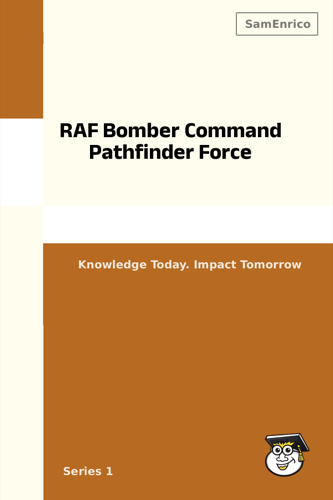
RAF Bomber Command Pathfinder Force eBook
Details the elite crews using H2S radar to mark ta
Details the elite crews using H2S radar to mark targets, coordinate master bombers, and improve area bombing accuracy.
Formats
Free sample
Chapter 1: The Maverick’s Gambit...--In the sweltering summer of 1942, a thirty-two-year-old Australian with a limp and a reputation for impossible navigation walked into the Air Ministry in London. Don Bennett had already escaped from a neutral internment camp, flown the Atlantic blind, and taught celestial navigation to men twice his age. Now he was about to do something far more dangerous: he was going to tell Air Marshal Arthur Harris—"Butcher" Harris, the most feared man in the Royal Air Force—that Harris’s entire bombing strategy was doomed without him.The meeting was not supposed to go Bennett’s way.The Man Who Could Not Be Killed Don Bennett was not born to be a Pathfinder. He was born to be a statistic.Born in 1910 in Toowoomba, Queensland, he learned to fly at sixteen, worked as a bush pilot in the Australian outback, and joined the Royal Air Force in 1931. By 1940, he was a squadron leader flying the Handley Page Hampden—a twin-engine bomber so notoriously unreliable that crews called it the "Flying Suitcase." On a raid over Norway, his aircraft was hit.
Bennett survived the crash, evaded capture for weeks, and eventually made his way to neutral Sweden. The Swedes interned him.Most men would have waited out the war in a comfortable hotel.Bennett escaped.He stole a small boat, sailed through a minefield, reached England, and reported for duty within seventy-two hours. The Air Ministry was dumbfounded. Harris, who had never met Bennett, heard the story and muttered something about "bloody colonials showing off."But Bennett was not showing off. He was demonstrating, in the most dramatic way possible, that he possessed a quality that Bomber Command desperately needed and could not teach: the ability to navigate precisely under any conditions, with any equipment, without any margin for error.That quality would soon be called the "Bennett Standard." And it would become the entrance exam for the Pathfinder Force.The State of the Night War To understand why Bennett was necessary, one must first understand the catastrophe that was Bomber Command in 1941 and early 1942.The concept was simple enough: by bombing German cities at night, the RAF would destroy industrial production, kill civilian morale, and force the Nazi regime to divert resources from the front lines to air defense.
It was a strategy of attrition, and Arthur Harris believed in it with religious fervor.There was only one problem. The bombers could not find their targets.In August 1941, a civilian statistician named David Butt delivered a confidential report to the War Cabinet. The Butt Report, as it came to be known, was a masterpiece of bureaucratic understatement that concealed a bombshell. Butt had analyzed reconnaissance photographs from over 600 bombing raids. His conclusion: on nights with a full moon over a well-defended German city, only one in ten aircraft claiming to have bombed the target actually got within five miles of it.One in ten.The other nine bombed empty fields, neighboring villages, or nothing at all.
Over the Ruhr—Germany's industrial heartland, defended by hundreds of flak batteries and searchlights—the numbers were even worse. In the darkest winter months, when clouds obscured the ground entirely, success rates dropped to one in thirty.Harris, who took command of Bomber Command in February 1942, was handed the Butt Report on his first day. He read it, set it aside, and ordered more raids.He had no choice. The political pressure to "do something" against Germany was immense. Stalin was demanding a second front.
Churchill needed to show Parliament that the RAF was striking back. Harris believed—correctly, as it turned out—that area bombing would eventually work if he threw enough aircraft at the problem.But he also knew, privately, that his crews were flying blind. The navigation technology available in 1942 was primitive. The primary tool was dead reckoning: calculating position based on speed, time, and heading from the last known point. In practice, this meant that after an hour of flying over the blacked-out North Sea, with no landmarks and no radio beacons, most navigators had only a vague idea of where they were.
The "Gee" radio navigation system, introduced in 1941, provided some help—but its range was limited to the coast of France and its signals could be jammed. The "Oboe" system (detailed in Chapter 3) was still experimental. H2S, the airborne ground-scanning radar that would revolutionize night bombing, did not exist yet.The result was a campaign of staggering inefficiency. In the first six months of 1942, Bomber Command dropped 30,000 tons of bombs on Germany. Post-raid reconnaissance showed that only 2,000 tons—less than seven percent—landed within five miles of their intended targets.
The rest fell randomly across the German countryside.More troubling, from Harris's perspective, was the morale effect on his own crews. Men who flew night after night, braved flak and night fighters, and then learned that they had bombed a cow pasture instead of a factory—those men began to ask questions. Why were they risking their lives? Was anyone in command competent? Was the war even winnable?Harris needed an answer.
And Don Bennett, limping into the Air Ministry with his escape story and his celestial navigation charts, was about to provide one.The Reluctant Sponsor The meeting between Harris and Bennett was arranged by Air Vice-Marshal Robert Saundby, Harris's deputy. Saundby had heard of Bennett's navigation skills and believed that Bomber Command needed a dedicated "target finding" force—a small group of elite crews who would fly ahead of the main force, locate the target using specialized equipment, and mark it with flares or incendiaries. The idea was not new; the Germans had used a similar system (Kampfgruppe 100) during the Blitz. But the RAF had resisted it, fearing it would create an "elite within an elite" and damage morale among ordinary squadrons.Harris hated the idea.He hated it for practical reasons: he believed that every bomber should be capable of finding its own target, and that creating a specialized force would weaken the rest of his command. He hated it for political reasons: he feared that the Air Ministry would use the Pathfinders as an excuse to reduce his overall bomber strength.
And he hated it for personal reasons: he disliked the notion of "super crews" who would get the best aircraft, the best equipment, and the most glory while ordinary crews did the dirty work.But Saundby persisted. And on July 10, 1942, Harris grudgingly agreed to meet with Bennett.The meeting lasted two hours. By the end, Harris had not changed his mind—but he had met his match.Bennett was not a typical RAF officer. He did not play cricket, did not drink whiskey, and did not suffer fools. He spoke in clipped, precise sentences, like a man who had calculated the minimum number of words required to convey a thought.
When Harris asked him how he would select crews for the new force, Bennett replied: "I will take the top five percent from every squadron in Bomber Command. If a squadron commander refuses to release a man, I will go over his head to you. If you refuse, I will go to the Air Ministry."Harris, who had…
This is the end of the free sample. Get the eBook to keep going. Buy now
About this book
Details
- Author
- Cupp Dannette
- Publisher
- SamEnrico
- Language
- English
- Genre
- Non-Fiction, History, Bombing Tactics
- Released
- 2026-06-06
- Pages (approx.)
- 117
- Available as
- eBook, Audiobook

Read better in the ZLOADR app
Your eBooks on your phone or tablet. Sign in with your SamEnrico account and start reading.
More by Cupp Dannette
 Napping Study Recovery GuideCupp Dannette$11.99
 Twelve Step Program History PrimerCupp Dannette$11.99
 Fentanyl's Second ChanceCupp Dannette$11.99
 Horse Racing Betting RecoveryCupp Dannette$11.99
 Resettled Venezuelan ChildCupp Dannette$11.99
 Social Rhythm Therapy GuideCupp Dannette$11.99
 Nutrition for Caregiver EnergyCupp Dannette$11.99
 Disappointment In Wedding DayCupp Dannette$11.99
 Bubble Burst: The Rise and Fall of the Miami Condo BoomCupp Dannette$11.99
 Whispers of the Forgotten: The Last Song of the MegalodonCupp Dannette$11.99
 The Pillars of Power: The Untold Story of the Salk Vaccine EmpireCupp Dannette$11.99
 How to Start a Police Laboratories Business (Beginners Guide)Cupp Dannette$11.99
You may also like
 Hong Kong Handover 1997Dunn Johnnie$11.99
 Zumba For Postnatal Recovery CourseNeal Christian$11.99
 Zumba for BeginnersLadner Nikia$11.99
 YouTube Comment Mining GuideHumes Pandora$12.99
 Worry Box MeditationCarlin Rudy$11.99
 Workplace Stress MeditationNguyen Lynn$11.99
 Workplace Stress and Sleep RepairHawley Ivory$11.99
 Workplace Perfectionism CureDelaney Jeffry$11.99
 Workplace Injustice Anger GuideWallen Isabelle$11.99
 Work Addiction and Burnout LinkGreenwood Ester$11.99
 Women in Yoga and WellnessBeattie Galina$11.99
 Women in Stand Up ComedyChun Evangeline$11.99