
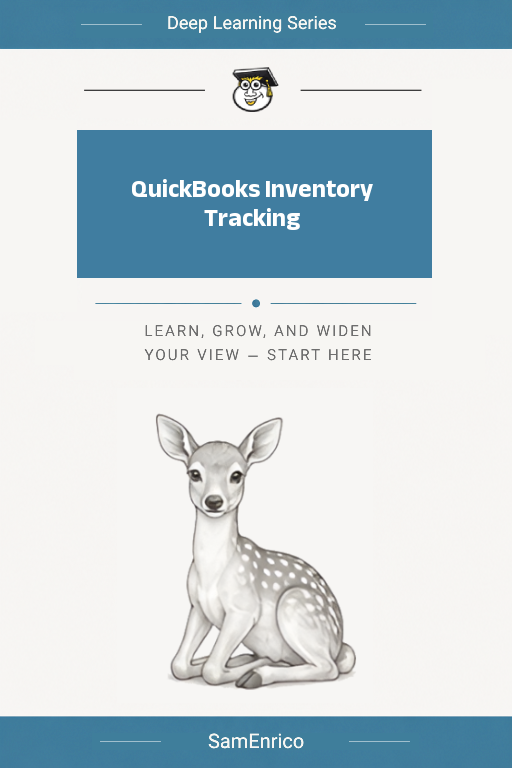
Non-FictionFirst 30 DaysBookkeeping
QuickBooks Inventory Tracking eBook
Set up inventory tracking in QuickBooks Online. Ad
Set up inventory tracking in QuickBooks Online. Add products, track quantities, and calculate COGS.
Formats
Free sample
Chapter 1: The Cash Trap--– You are probably sitting on more cash than you realize. You are also probably losing more cash than you realize. And the strange thing is, both statements can be true about the exact same pile of boxes stacked in your garage, your back office, or your third-party warehouse.Let me show you what I mean.Imagine you own a small business that sells handmade leather bags. Last month, you bought 20,000worthofleather,hardware,andpackaging.Youwrotethecheck.Yourbankaccountbalancedroppedby20,000 worth of leather, hardware, and packaging. You wrote the check.
Your bank account balance dropped by 20,000worthofleather,hardware,andpackaging.Youwrotethecheck.Yourbankaccountbalancedroppedby20,000. You feel poorer. Your spouse asks why you spent so much. You stay up late worrying about cash flow.But here is what your bank account does not know. Those raw materials are now inventory.
And that inventory is still an asset. It is just cash in a different costume—one that cannot pay rent or make payroll, but one that will eventually turn back into cash when a customer buys a bag. The $20,000 is not gone. It has shapeshifted.Now imagine you sell ten bags for 500each.Totalrevenue:500 each. Total revenue: 500each.Totalrevenue:5,000.
You deposit the money. Your bank account goes up. You feel richer. You take your team out for lunch to celebrate.But here is what your bank account does not know. Each bag used 200ofmaterials.Thatmeansyourtrueprofitisnot200 of materials.
That means your true profit is not 200ofmaterials.Thatmeansyourtrueprofitisnot5,000. It is 5,000minus5,000 minus 5,000minus2,000, or 3,000.Theother3,000. The other 3,000.Theother2,000 is not profit. It is reimbursement for the inventory you gave up. That $2,000 is called Cost of Goods Sold, or COGS.If you do not track COGS correctly, you will make two catastrophic mistakes.
First, you will think you are richer than you actually are. Second, you will pay taxes on money that was never really yours.This chapter exists because that scenario—the cash trap—plays out thousands of times every day in small businesses across the country. Business owners watch their bank accounts bounce up and down, but they have no idea which transactions are genuinely profitable and which are just converting one form of asset into another. They are trapped in the illusion that cash in the bank equals success.By the time you finish this chapter, you will understand exactly why that illusion is so dangerous. You will learn the three specific ways inaccurate inventory tracking destroys cash flow.
You will see why Quick Books Online handles inventory differently than the software you might have used a decade ago. And you will know, with certainty, whether you even have the right subscription to begin this journey.But most importantly, you will break free from the cash trap. You will stop looking only at your bank balance and start looking at the full picture—your inventory asset, your COGS, and your true profitability. That shift in perspective is the difference between a business that survives and a business that thrives.The Asset That Does Not Feel Like an Asset Let us pause on that word: asset. It sounds formal.
It sounds like something a banker would say while adjusting their glasses. But an asset is simply anything that will eventually put money in your pocket.Your laptop is an asset because you use it to generate revenue. Your customer list is an asset because you can sell to those people again. Your reputation is an asset because it brings you referrals.Inventory is an asset for the same reason. It will eventually become cash.
The only difference is timing. Cash is ready now. Inventory is cash that has agreed to wait patiently on a shelf until a customer picks it up.This is not a philosophical distinction. It is an accounting rule with real financial consequences. On your balance sheet, inventory appears under Current Assets, right next to cash and accounts receivable.
It has value. It counts toward your net worth. If you apply for a loan, the bank will look at your inventory valuation. If you sell your business, the buyer will pay you for your inventory.But most business owners do not treat inventory like an asset. They treat it like an expense that has already happened.
They write the check to their supplier, wince at the bank balance, and never think about that inventory again until it either sells or becomes a dusty problem.This mindset is the root of the cash trap. When you treat inventory as an expense, you stop managing it. You stop measuring it. You stop asking basic questions like "How many units do I actually have?" and "What did I really pay for each one?" and "Which products are earning their keep?"The result is predictable. You run out of best-sellers because you did not know you were low.
You accumulate dead stock because you did not notice it was not moving. You overpay taxes because you never properly calculated COGS. Each of these outcomes bleeds cash. And the bleeding is silent, because your bank account alone cannot tell you where the problem started.The Three Silent Cash Bleeders Most business owners think inventory problems announce themselves loudly. A customer complains about a backorder.
A supplier says you missed the reorder window. Your accountant sends a panicked email a week before taxes are due.But those are symptoms. The real bleeding happens silently, invisibly, inside your data—or more accurately, inside the gaps in your data.The first silent cash bleeder is the phantom stockout. You think you have forty units of your best-selling product. Your website says forty.
Your spreadsheet says forty. But when a customer orders five, you go to the shelf and find only thirty-two. Where did eight units go? Some were damaged and never recorded. Some were given as samples and forgotten.
Some were stolen. Some were just miscounted six months ago and the error never corrected.You ship the customer five units from the thirty-two. Now you have twenty-seven. You think you have thirty-five because the spreadsheet still says forty minus five equals thirty-five. But you actually have twenty-seven.
That eight-unit gap is a phantom. It does not exist. When those eight phantom units fail to materialize for the next eight customers, you will lose eight sales. You will apologize. You will offer refunds.
You will lose credibility. And you will have no idea why your "inventory" disappeared.The second silent cash bleeder is the zombie product. A zombie product is one that sells just enough to stay in your catalog but never enough to justify its shelf space. It sells two units per month. You reorder twelve units every six months.
It looks fine on paper. But that product is occupying space that could be used for something that sells twenty units per month. It is tying up cash that could be used to buy more of your best-sellers. It is adding complexity to your purchasing, your receiving, and your picking. Zombie products do not scream for attention.
They just sit there, quietly consuming resources, quietly eroding your return on invested capital.Most business owners discover zombie products only when they run an inventory valuation report and sort by sales velocity. That report…
This is the end of the free sample. Get the eBook to keep going. Buy now
About this book
Details
- Author
- Torrence Steffanie
- Publisher
- SamEnrico
- Language
- English
- Genre
- Non-Fiction, First 30 Days, Bookkeeping
- Released
- 2026-05-29
- Pages (approx.)
- 141
- Available as
- eBook, Audiobook

Read better in the ZLOADR app
Your eBooks on your phone or tablet. Sign in with your SamEnrico account and start reading.
More by Torrence Steffanie
 The Zen Commuter PodcastTorrence Steffanie$11.99
 Deep Work Interruption Protection CourseTorrence Steffanie$11.99
 IELTS Task 2 Essay PromptsTorrence Steffanie$11.99
 Divorce and Sibling RelationshipTorrence Steffanie$11.99
 The Nutrition Sleep Memory LinkTorrence Steffanie$11.99
 The Phantom of the Grand Canal: Venice's Architectural EnigmaTorrence Steffanie$11.99
 How to Start a Temporary Shelters BusinessTorrence Steffanie$11.99
 Association ManagerTorrence Steffanie$11.99
 Banking M&A GuideTorrence Steffanie$12.99
 Understanding Piussan–lenaerts–mathieu SyndromeTorrence Steffanie$17.99
You may also like
 Hong Kong Handover 1997Dunn Johnnie$11.99
 Zumba For Postnatal Recovery CourseNeal Christian$11.99
 Zumba for BeginnersLadner Nikia$11.99
 YouTube Comment Mining GuideHumes Pandora$12.99
 Worry Box MeditationCarlin Rudy$11.99
 Workplace Stress MeditationNguyen Lynn$11.99
 Workplace Stress and Sleep RepairHawley Ivory$11.99
 Workplace Perfectionism CureDelaney Jeffry$11.99
 Workplace Injustice Anger GuideWallen Isabelle$11.99
 Work Addiction and Burnout LinkGreenwood Ester$11.99
 Women in Yoga and WellnessBeattie Galina$11.99
 Women in Stand Up ComedyChun Evangeline$11.99