
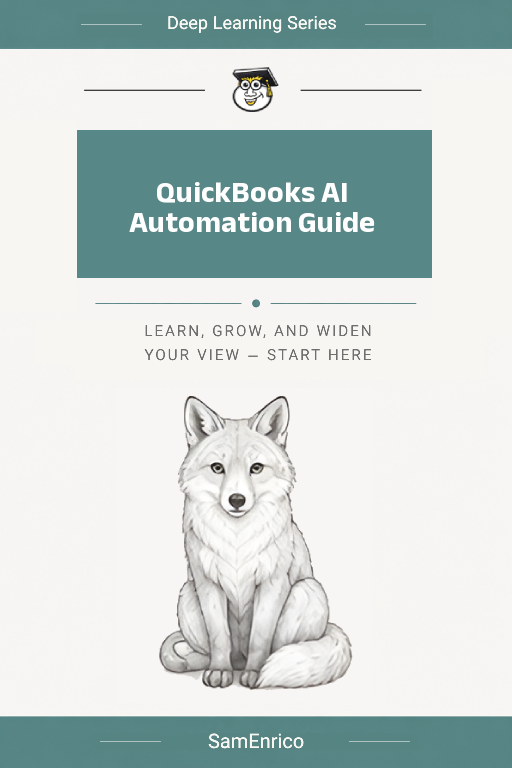
QuickBooks AI Automation Guide eBook
Use QuickBooks AI to auto-categorize transactions,
by Allen Julian
Use QuickBooks AI to auto-categorize transactions, reconcile bank feeds, and generate financial reports, saving 10+ hours monthly for small businesses.
Formats
Free sample
Chapter 1: The Midnight Ledger--–- The scene is familiar to nearly every small business owner. It is 11:47 PM. The house is quiet. Everyone else is asleep. You are sitting at the kitchen table, laptop open, three credit card statements spread out like a losing hand of poker, and a growing sense of dread pooling in your stomach.
Quick Books is open. The "For Review" tab shows 187 uncategorized transactions. Your eyes are glazing over. You have a big meeting tomorrow, payroll to approve, and a vendor who hasn't been paid. And yet, here you are, at midnight, asking yourself the same question you asked last month: Is this really what success feels like?This book is not about accounting.
It is not about debits and credits, or the difference between an LLC and an S-Corp. You can hire people for that. This book is about one thing, and one thing only: getting your time back. Specifically, the ten to fifteen hours per month that vanish into the black hole of manual data entry, transaction hunting, and bank reconciliation. The hours you will never get back.
The hours that could have been spent with your kids, growing your business, or simply sleeping.There is a dirty secret that Quick Books has never wanted you to fully understand, until now. For years, the software sold you on "automation." You set up a few rules: If the payee is Amazon, categorize it as Office Supplies. That worked for a while. But the moment you bought a personal item on Amazon, or a client reimbursed you for shipping, your beautiful rule broke. You spent just as much time fixing the exceptions as you did doing it manually.
That old system—Rule-Based Automation (RBA)—has hit a wall. It is brittle, stupid, and literal.We are now living through a fundamental shift in how software works. We have moved from RBA to Generative AI and AI Agents. The difference is the difference between a calculator and a data scientist. A calculator follows your exact button presses.
A data scientist observes your patterns, learns from past behavior, and predicts what you want to do next—even when the situation is slightly different from before.This chapter is not a setup guide. You will not touch a single setting in these pages. Instead, this is the psychological reorientation. If you do not change how you think about bookkeeping, the best AI in the world will not save you. You will simply find new, faster ways to be anxious about your numbers.
The goal of this chapter is to convince you, down to your bones, that manual data entry is no longer a sign of diligence. It is a tax on your ignorance. And it is time to stop paying it.The Three Lies You Believe About Your Books Before we can talk about the solution, we have to name the enemy. The enemy is not Quick Books. The enemy is not your accountant.
The enemy is the set of comfortable lies you have told yourself to justify why you still touch every single transaction.Lie #1: "I need to review everything to catch mistakes."This sounds responsible. It sounds like good stewardship. But let us look at the data. A human manually categorizing 200 transactions will make a mistake on roughly 2-4% of them. That is 4 to 8 errors per month.
Fatigue, distraction, and midnight brain fog guarantee this. An AI model, once trained on 30 days of your data, makes mistakes on roughly 0.5-1% of transactions. More importantly, its mistakes are different. A human will mis-categorize a restaurant meal as "Office Supplies" because they were tired. An AI will mis-categorize a similar transaction because it genuinely lacks context.
But here is the kicker: You catch both types of mistakes at the same speed. You can review 200 AI suggestions in the time it takes you to manually enter 20 transactions. The "review everything" lie is actually a confession that you do not trust your own training data.Lie #2: "My business is too unique for AI."I have heard this from a bakery owner, a commercial fishing boat captain, a dental practice manager, and a freelance graphic designer. They all said the same thing: "You don't understand. My transactions are weird." Here is the truth: your transactions are not weird.
They are just yours. AI does not need your transactions to be generic. It needs them to be consistent with your own history. The only thing that breaks AI is inconsistency—not uniqueness. If you categorize the same vendor three different ways over six months, the AI will get confused.
That is not AI's fault. That is your fault. The solution is not to abandon AI. The solution is to clean up your own act, which we will do in Chapter 2.Lie #3: "If I automate this, I will lose control."This is the most painful lie, because it touches on identity. Many small business owners secretly believe that the act of touching the finances is what makes them a responsible owner.
They think, "If I am not in the bank feed every day, how will I know what is happening?" This is a confusion between control and visibility. You do not need to steer the ship by staring at the engine pistons. You need to steer by looking at the horizon. AI gives you back the horizon. It handles the pistons.
You review the course. Losing control would mean not knowing when something is wrong. With AI properly configured, you will actually have more control, because you will be alerted to anomalies instantly, rather than discovering them three months later during tax prep.The 10,000 Hour Rule (The One You Haven't Heard Of)Malcolm Gladwell popularized the idea that it takes 10,000 hours to master a skill. Let me propose a different 10,000 Hour Rule: Every hour you spend manually categorizing transactions is an hour you are paying yourself $0. Worse, it is an hour you are actively avoiding higher-value work.Let us do the math.
A typical small business owner making 80,000peryearhasanhourlyvalueofroughly80,000 per year has an hourly value of roughly 80,000peryearhasanhourlyvalueofroughly40. If you spend 10 hours per month on manual bookkeeping (the low end of the average), that is 400permonth,or400 per month, or 400permonth,or4,800 per year, of your own time spent on work that a machine can now do for pennies. But that is not the real loss. The real loss is the opportunity cost. What could you do with 120 hours per year?
You could:Learn a new high-value skill (sales, negotiation, product design)Take on one new client per quarter (easily worth 5,000−5,000-5,000−20,000)Sleep an extra hour every night for four months Start that side project that has been sitting in your notebook The machine, by contrast, costs almost nothing. Quick Books AI is included in your existing subscription (for most plans) or costs a nominal fee for advanced features. The AI does not get tired. It does not take weekends off. It does not resent you for asking it to categorize the 500th transaction of the month.Here is the painful truth that no software company will tell you: The only reason you are still doing manual data entry is habit, not necessity.
The technology has been ready for two years. You have been the bottleneck.The Supervisor Mindset: Your New Job Description If…
This is the end of the free sample. Get the eBook to keep going. Buy now
About this book
Details
- Author
- Allen Julian
- Publisher
- SamEnrico
- Language
- English
- Genre
- Non-Fiction, Business Brief
- Released
- 2026-06-01
- Pages (approx.)
- 140
- Available as
- eBook, Audiobook

Read better in the ZLOADR app
Your eBooks on your phone or tablet. Sign in with your SamEnrico account and start reading.
More by Allen Julian
 CPR Recertification GuideAllen Julian$11.99
 Energy Audit WorkbookAllen Julian$11.99
 Reading Hour Morning PlanAllen Julian$11.99
 Sales Professional ImposterAllen Julian$11.99
 Performance Anxiety TriggersAllen Julian$11.99
 HIIT for Beginners ProtocolAllen Julian$11.99
 Burn Blister ManagementAllen Julian$11.99
 Authority Cues That WorkAllen Julian$11.99
 The Ballerina Kings: How African Grace Conquered the World StageAllen Julian$11.99
 Budapest's Jazz Pioneer: The Untold Story of Márton Szűts and the Birth of Hungarian SwingAllen Julian$11.99
 How to Produce SapoteAllen Julian$11.99
 A Collector's Handbook to the Austin 14Allen Julian$11.99
You may also like
 Hong Kong Handover 1997Dunn Johnnie$11.99
 Zumba For Postnatal Recovery CourseNeal Christian$11.99
 Zumba for BeginnersLadner Nikia$11.99
 YouTube Comment Mining GuideHumes Pandora$12.99
 Worry Box MeditationCarlin Rudy$11.99
 Workplace Stress MeditationNguyen Lynn$11.99
 Workplace Stress and Sleep RepairHawley Ivory$11.99
 Workplace Perfectionism CureDelaney Jeffry$11.99
 Workplace Injustice Anger GuideWallen Isabelle$11.99
 Work Addiction and Burnout LinkGreenwood Ester$11.99
 Women in Yoga and WellnessBeattie Galina$11.99
 Women in Stand Up ComedyChun Evangeline$11.99