
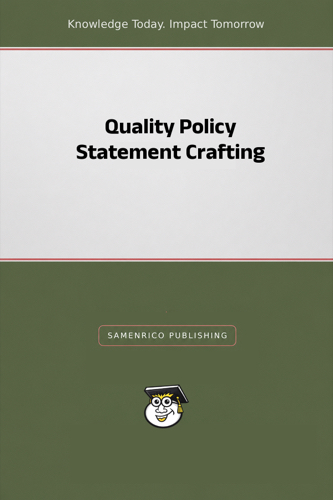
Non-FictionOperational Efficiency ManualPolicy Design
Quality Policy Statement Crafting eBook
Write a concise quality policy that drives organiz
Write a concise quality policy that drives organizational behavior.
Formats
Free sample
Chapter 1: The $50 Million Gap--–- The framed document hung directly across from the CEO’s desk, just to the right of the window. It was printed on heavy cream paper, mounted behind non-glare glass, and bordered by a matte that cost more than most employees made in a week. The words were carefully chosen by a consulting firm that specialized in ISO certification. The language was aspirational, inclusive, and completely useless. “We are committed to delivering exceptional quality that exceeds customer expectations through continuous improvement and employee empowerment.” Forty-two words.
Zero verbs. Zero decisions embedded. Zero chance of survival past the first late shipment on a Friday afternoon.Every organization has this document. Sometimes it is laminated and posted by the time clock. Sometimes it is printed in the employee handbook that nobody reads past page three.
Sometimes it is buried in a policy management system, accessible only through a login that nobody remembers. But it is always there, a monument to something—perhaps hope, perhaps compliance, perhaps just the universal human desire to feel that we have declared our values even if we never actually follow them.The problem is not that these policies exist. The problem is that they cost money. Not the cost of the frame or the consulting fees—though those are not trivial—but the invisible, compounding, silent cost of policies that fail to drive behavior. This chapter introduces a concept that will appear throughout the book: the $50 Million Gap.
It is the difference between the quality you claim to deliver and the quality you actually produce. It is the sum of every rework hour, every returned product, every customer who left because they felt betrayed by a promise your policy made but your operations could not keep. It is the tax you pay for pretending that a poster is a strategy.Most leaders have no idea how much money their useless quality policy is costing them. They see the rework line on the profit and loss statement. They see the customer churn numbers in the quarterly review.
They see the internal friction—the arguments between departments, the blame sessions, the silent resentment of people who know that the policy is a joke but are too polite to say so. But they do not connect these costs to the document on the wall. They assume the problem is execution. They assume their people are lazy or unmotivated or insufficiently committed to excellence. They assume anything except the possibility that the policy itself is broken.This chapter will change that assumption.
It will show you how to diagnose your current policy using a simple three-category system. It will introduce the concept of Simultaneous Loose-Tight Properties, drawn from one of the best-selling management books of all time. And it will end with an exercise that has exposed more hollow policies than any audit I have ever witnessed. By the time you finish this chapter, you will know exactly how much your current quality policy is costing you—and you will be ready to build something better.The Framed Lie Let me tell you a story. It is a composite of about fifty different organizations I have worked with over the past decade, but every detail is true to someone’s experience.A manufacturing plant in the Midwest had a quality policy that read, “We are dedicated to delivering defect-free products that delight our customers and stakeholders.” The plant manager believed this policy with genuine sincerity.
He had signed it himself. He had presented it at the annual all-hands meeting. He had even commissioned a video where employees recited the policy on camera. The policy was everywhere. And yet, the plant had a defect rate of 8.5 percent.
Rework cost them $4.2 million annually. Returns cost another $1.8 million. Customer churn was accelerating.The plant manager called a meeting with his shipping team. He asked a simple question: “What decision would our quality policy help a shipping clerk make at 4:45 PM on a Friday when a pallet of product is ready to go but the final inspection shows a cosmetic deviation?” The shipping lead looked at him for a long moment. Then she said, “Our policy doesn’t help us make any decision.
It tells us to be dedicated and to delight people. That doesn’t tell me whether to ship or stop. So I ship. Because my bonus is based on volume, not on delight.”The plant manager was stunned. He had never considered that his policy was not actionable.
He had assumed that everyone understood what “defect-free” meant. But the shipping lead was right. The policy contained no verb that instructed behavior, no condition that triggered an action, and no measurable outcome that distinguished success from failure. It was not a policy. It was a sentiment.
And sentiments do not stop shipments.This is the Framed Lie. It is the gap between the aspirational language on the wall and the actual decision-making criteria that employees use when no one is watching. The lie is not intentional. No CEO wakes up planning to deceive their workforce. The lie is structural.
It emerges from the belief that quality policies are about values rather than about trade-offs. It emerges from the fear that being specific will be constraining or legalistic. It emerges from the simple human tendency to prefer pleasant vagueness over uncomfortable clarity.But pleasant vagueness has a price. That price is the $50 Million Gap.Defining the $50 Million Gap Let me be precise about what I mean by this term. The $50 Million Gap is the annualized cost—across rework, customer churn, and internal friction—of a quality policy that fails to drive behavior.
The number $50 million is not arbitrary. It is approximately 5 percent of the average annual revenue of a mid-sized manufacturing firm, scaled to a round number for memorability. Your actual gap may be larger or smaller. But it is almost certainly larger than you think.The gap has three components. Each is measurable.
Each is hiding in plain sight on your profit and loss statement, if you know where to look.Component One: Rework. Every time a product is inspected, found defective, and sent back for repair or replacement, you pay for the same labor twice. You pay for the materials a second time. You pay for the overhead of the rework station, the tracking system, and the quality assurance staff who verify the fix. In most organizations, rework accounts for 2 to 5 percent of cost of goods sold.
For a $1 billion company, that is $20 to $50 million annually—before you even get to the other components. And the root cause of most rework is not technical. It is that someone, somewhere, made a decision to pass a defect downstream because the policy did not tell them to stop.Component Two: Customer Churn. Every customer who receives a defective product is less likely to buy from you again. The math is brutal: acquiring a new customer costs five to seven times more than retaining an existing one.
Yet most quality policies are written as if the only cost of a defect is the immediate cost of replacement. They ignore the lifetime value of the customer who leaves. A single manufacturing defect…
This is the end of the free sample. Get the eBook to keep going. Buy now
About this book
Details
- Author
- Coulter Frederica
- Publisher
- SamEnrico
- Language
- English
- Genre
- Non-Fiction, Operational Efficiency Manual, Policy Design
- Released
- 2026-06-09
- Pages (approx.)
- 140
- Available as
- eBook, Audiobook

Read better in the ZLOADR app
Your eBooks on your phone or tablet. Sign in with your SamEnrico account and start reading.
More by Coulter Frederica
 Direct Amends Step Nine ActionCoulter Frederica$11.99
 Ornithine for HGH SupportCoulter Frederica$11.99
 Hypnosis File OrganizationCoulter Frederica$11.99
 Government Salary NegotiationCoulter Frederica$11.99
 Ayaan Hirsi Ali MemoirCoulter Frederica$11.99
 Grief and Faith After Parent DeathCoulter Frederica$11.99
 DoorDash Alcohol Delivery GuideCoulter Frederica$11.99
 Clockwork and the Clockmaker: The Forgotten Android of PragueCoulter Frederica$11.99
 The Lionheart: Richard I and the Crusades of GloryCoulter Frederica$11.99
 A Collector's Handbook to the Opus-hrf OpusCoulter Frederica$11.99
 Automated Customer OnboardingCoulter Frederica$12.99
 Employee Handbooks vs Policies GuideCoulter Frederica$12.99
You may also like
 Hong Kong Handover 1997Dunn Johnnie$11.99
 Zumba For Postnatal Recovery CourseNeal Christian$11.99
 Zumba for BeginnersLadner Nikia$11.99
 YouTube Comment Mining GuideHumes Pandora$12.99
 Worry Box MeditationCarlin Rudy$11.99
 Workplace Stress MeditationNguyen Lynn$11.99
 Workplace Stress and Sleep RepairHawley Ivory$11.99
 Workplace Perfectionism CureDelaney Jeffry$11.99
 Workplace Injustice Anger GuideWallen Isabelle$11.99
 Work Addiction and Burnout LinkGreenwood Ester$11.99
 Women in Yoga and WellnessBeattie Galina$11.99
 Women in Stand Up ComedyChun Evangeline$11.99