
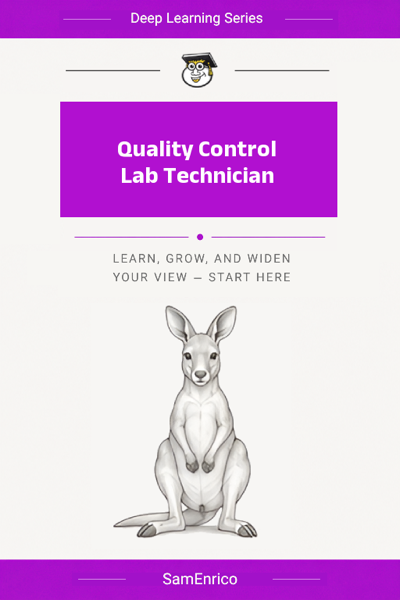
Non-FictionInformativeEducational
Quality Control Lab Technician eBook
A Coursebook on Quality Control Lab Technician
by Mckeever Sam
A Coursebook on Quality Control Lab Technician
Formats
Free sample
Chapter 1: The Last Line of Defense--The vial felt heavier than it should have. Not physically – it was a standard 10 m L glass vial, the kind Maria had handled hundreds of times during her training. But this one was different. This one held a batch of intravenous medication that would be administered to patients at St. Jude's Hospital starting tomorrow morning.
And she was the only person standing between that vial and those patients.Maria Sanchez had been a Quality Control Lab Technician for exactly eleven days. She had graduated from her community college's biotechnology program four months ago, passed her certification exam on the first attempt, and beat out forty-seven other applicants for this position at Apex Pharmaceuticals. Now, at 7:45 AM on a Tuesday, she was holding a sample that had just failed its endotoxin test. The specification was less than 0.5 EU/m L. Her result: 1.8 EU/m L.Her hand hovered over the phone.
The standard operating procedure was clear: any out-of-specification result must be reported immediately to the Quality Assurance manager. But her trainer, a twenty-year veteran named Dave, had told her something just yesterday that echoed in her ears. "Maria, the worst thing you can do is bury a bad result. The second worst thing is to panic and retest without documentation. The FDA doesn't care if you make a mistake.
They care if you hide one."She picked up the phone.That moment – the choice between integrity and convenience, between documentation and denial – is what separates a professional Quality Control Lab Technician from someone who simply knows how to run instruments. This book exists to ensure that when you face that moment, you make the right call. Not just because it's the ethical choice, but because your career, your company's future, and most importantly, patient lives depend on it.1.1 What Exactly Is a Quality Control Lab Technician?Before you can master the skills of a QC Lab Technician, you must understand the role's position within the larger ecosystem of pharmaceutical, medical device, food, and cosmetic manufacturing. This is not simply a "lab job." It is a regulatory gatekeeper function with legal, ethical, and professional responsibilities that extend far beyond the four walls of your laboratory.The Gatekeeper Definition A Quality Control Lab Technician is a trained professional who performs analytical, microbiological, and physical testing on raw materials, in-process samples, finished products, and environmental samples to verify that they meet predetermined specifications and regulatory requirements. The technician documents all results, investigates any deviations, and provides the data that Quality Assurance uses to release or reject products.But that definition, while technically accurate, misses the soul of the role.
Let me give you a better one.The QC Lab Technician is the last line of defense between a manufacturing error and a patient.When a tablet is too strong, a QC technician catches it before it reaches the pharmacy. When a raw material is contaminated with endotoxins, a QC technician flags it before it becomes an injectable drug. When a cleanroom's air contains too many particles, a QC technician identifies the problem before a single vial is filled. You are not just testing samples. You are protecting lives.The Six Domains of Competency Every QC Lab Technician must master six interconnected domains.
Think of these as the legs of a stool – if any one is weak, the entire structure collapses.Domain One: Laboratory Skills. This is the "wet lab" competency – pipetting, titration, weighing, solution preparation, instrument operation, and method execution. Without these fundamental skills, you cannot generate reliable data. Chapter 4 of this book will transform you from a nervous beginner into a confident bench chemist.Domain Two: Documentation. In a regulated laboratory, if it isn't written down, it didn't happen.
This domain covers logbooks, analytical notebooks, certificates of analysis, and electronic records. You will learn the difference between good documentation (clear, complete, contemporaneous) and documentation that will fail an audit. Chapter 2 and Chapter 8 cover this in depth.Domain Three: Compliance. Current Good Manufacturing Practices (c GMP) and Good Laboratory Practices (GLP) are not suggestions. They are federal regulations with the force of law.
Violations can result in warning letters, fines, product recalls, and even criminal charges for individuals who knowingly falsify data. Chapter 2 provides the complete framework.Domain Four: Contamination Control. For sterile products, a single microorganism can kill a patient. This domain covers cleanroom behavior, environmental monitoring, aseptic technique, and microbiological testing methods including bioburden and endotoxin testing. Chapter 6 is your complete guide.Domain Five: Data Integrity.
This is the hottest topic in regulatory enforcement today. Between 2018 and 2024, over 80% of FDA warning letters cited data integrity failures. ALCOA+ (Attributable, Legible, Contemporaneous, Original, Accurate, plus Complete, Consistent, Enduring, Available) is the framework you must live by. Chapter 8 is dedicated entirely to this critical subject.Domain Six: Safety. Chemical, biological, and radiological hazards exist in every QC laboratory.
You will learn proper handling, storage, disposal, and emergency response procedures. Safety is not just about protecting yourself – it is about protecting your coworkers and the environment.Before you proceed further, turn to the Appendix and complete the Six Domains Self-Assessment. This twelve-question tool will identify your current strengths and weaknesses, helping you focus your study time on the areas that need the most attention.1.2 The Critical Distinction: QC Versus QAOne of the most persistent and dangerous misunderstandings in the pharmaceutical industry is the difference between Quality Control and Quality Assurance. New technicians – and unfortunately, some experienced ones – frequently confuse these two functions, with potentially catastrophic consequences.Quality Control: Testing the Product Quality Control is the laboratory function. QC technicians sample materials, perform tests, operate instruments, calculate results, and document findings.
QC answers the question: "Does this specific batch of product meet its specifications?" QC is reactive – it tests what has already been manufactured.A QC technician does not decide what to test (that is defined in methods and specifications). A QC technician does not approve or reject batches (that decision belongs to Quality Assurance after reviewing QC data). A QC technician does not change procedures without authorization. The QC role is execution with integrity.Quality Assurance: Building the System Quality Assurance is the system function. QA professionals write standard operating procedures, conduct internal and external audits, investigate deviations, approve or reject batches based on QC data, manage change control, and ensure the overall quality system complies with regulations.
QA answers the question: "Is our quality system designed correctly to prevent problems?"QA is proactive – it builds quality into processes before manufacturing begins. If QC is the goalie who stops the ball, QA is the coach who designs the defensive strategy and trains the team.Why the Distinction Matters Consider the scenario that opened this chapter. The technician told Maria, "QA already approved the supplier, so I don't need to check the COA." This statement reveals a fundamental misunderstanding that could cost lives.The supplier's Certificate of Analysis (COA) is a document from the supplier's QA department stating that the material passed their testing. But under c GMP regulations (21 CFR 211.84), the receiving company's QC department must perform at least some testing on incoming raw materials. QA cannot "approve away" this requirement.
The regulation requires testing, period. QA can reduce testing frequency for qualified suppliers, but QC must still perform the tests…
This is the end of the free sample. Get the eBook to keep going. Buy now
About this book
Details
- Author
- Mckeever Sam
- Publisher
- SamEnrico
- Language
- English
- Genre
- Non-Fiction, Informative, Educational
- Released
- 2026-05-18
- Pages (approx.)
- 156
- Available as
- eBook, Audiobook

Read better in the ZLOADR app
Your eBooks on your phone or tablet. Sign in with your SamEnrico account and start reading.
More by Mckeever Sam
 Body Scan Meditation RetreatMckeever Sam$11.99
 Menopause Books ListMckeever Sam$11.99
 Consumer Choice TheoryMckeever Sam$11.99
 The Jersey Shore Cast GuideMckeever Sam$11.99
 The Sky-Piercing Towers of Great Zimbabwe: Africa's Ancient EngineersMckeever Sam$11.99
 How to Produce Active ComponentsMckeever Sam$11.99
 Skills Gap Analysis GuideMckeever Sam$12.99
 How to Become a Paleontological HelperMckeever Sam$11.99
You may also like
 Hong Kong Handover 1997Dunn Johnnie$11.99
 Zumba For Postnatal Recovery CourseNeal Christian$11.99
 Zumba for BeginnersLadner Nikia$11.99
 YouTube Comment Mining GuideHumes Pandora$12.99
 Worry Box MeditationCarlin Rudy$11.99
 Workplace Stress MeditationNguyen Lynn$11.99
 Workplace Stress and Sleep RepairHawley Ivory$11.99
 Workplace Perfectionism CureDelaney Jeffry$11.99
 Workplace Injustice Anger GuideWallen Isabelle$11.99
 Work Addiction and Burnout LinkGreenwood Ester$11.99
 Women in Yoga and WellnessBeattie Galina$11.99
 Women in Stand Up ComedyChun Evangeline$11.99