
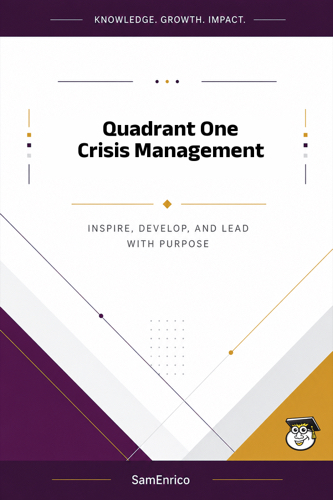
Quadrant One Crisis Management eBook
Handles urgent and important fires effectively.
Handles urgent and important fires effectively.
Formats
Free sample
Chapter 1: Beyond the Matrix--Most people discover the concept of Quadrant One the same way they discover that their house has a faulty electrical system: something catches fire.For me, it was a server room in downtown Chicago at 2:47 AM on a Tuesday. I was twenty-six years old, three months into my first leadership role, and entirely convinced that I had time management figured out. I had read Stephen Covey. I had color-coded my calendar. I had even bought a leather-bound planner that made me look like the kind of person who definitely would not be standing in a pool of sprinkler water at three in the morning, watching three hundred thousand dollars of hardware smoke itself to death.The alarm had triggered at 2:47.
The fire department arrived at 2:52. The server room was offline by 2:55. And I stood there, soaked and useless, realizing that every "urgent" email I had answered that day, every "critical" meeting I had attended, every fire I had proudly extinguished—none of it mattered. Because the real fire had been burning in Quadrant Two for months, and I had been too busy fighting imaginary flames to notice.That night changed everything.Over the next fifteen years, as I moved from operations to crisis consulting, I watched the same pattern repeat itself across hundreds of organizations. Smart people.
Good intentions. Endless urgency. And a complete inability to distinguish between the fires that mattered and the ones they had set themselves.This book is the manual I wish I had that night in Chicago.The Quadrant You Thought You Knew Stephen Covey's time management matrix is one of the most reproduced, referenced, and misunderstood frameworks in business literature. Most people can sketch it from memory: four boxes, two axes (urgent versus important), and a clear instruction to spend more time in Quadrant Two (important but not urgent) and less time in Quadrants Three and Four (the urgent-unimportant and the neither).But here is what most interpretations miss: Covey never said that Quadrant One was bad.He said it was necessary. He said it was the realm of genuine crises, real deadlines, and problems that demand immediate attention.
He also warned that people who live exclusively in Quadrant One burn out, make poor decisions, and eventually break. But he never suggested that a life without Quadrant One was possible or even desirable.The problem is not that Quadrant One exists. The problem is that we have filled Quadrant One with impostors.Think about the last time you felt truly, viscerally urgent. Maybe it was a deadline that snuck up on you. Maybe it was a customer complaint that escalated because you had ignored the first three.
Maybe it was a team meltdown that could have been prevented with a single conversation two weeks earlier. Whatever it was, I am willing to bet that the urgency was real—your heart was pounding, your palms were sweating, your brain was in full alarm mode—but the importance was manufactured.This is the central deception of modern work: we have learned to mistake panic for priority.We have built entire career identities around being the person who thrives under pressure, who does their best work at the last minute, who saves the day when everything is on fire. We have turned reactivity into a virtue and prevention into a bore. We give bonuses to the executive who works eighty hours a week fighting fires and ignore the one who works forty hours a week preventing them.And then we wonder why we are exhausted.The Two Types of Fire To master Quadrant One, you must first understand that not all fires are created equal. Through my work with crisis response teams, emergency rooms, and military units, I have identified two fundamentally distinct categories of fire.
They look the same from the outside. They feel the same to the person holding the hose. But they require completely different responses.Type One: Genuine System Fires These are the real Quadrant One crises. A data breach that exposes customer information. A patient whose condition deteriorates unexpectedly.
A product failure that endangers users. A key supplier that goes bankrupt overnight. A natural disaster that disrupts operations.Genuine system fires share four characteristics:First, they originate outside your control. You did not cause them through neglect or procrastination. You could not have prevented them with better planning last week.
They are external shocks to the system.Second, they cascade. One failure triggers another, which triggers another. The payment system fails, so orders stop, so customers complain, so reputation suffers, so revenue drops. Each new failure creates new urgency.Third, they consume resources at an alarming rate. Money, attention, personnel, and goodwill vanish faster than you can replenish them.
The crisis literally eats the organization.Fourth, they have an irreversible threshold. There is a point of no return—a moment after which the damage becomes permanent. The data becomes public. The patient dies. The contract is lost forever.Type Two: Manufactured Emergencies These are the impostors.
A report that is due tomorrow that you have known about for three weeks. A customer complaint that escalated because you ignored the first two. A team conflict that exploded because you avoided a difficult conversation. A project that is behind schedule because no one planned the work.Manufactured emergencies share a different set of characteristics:First, they originate inside your control. You caused them—not through malice, but through neglect, avoidance, or procrastination.
You prioritized the urgent over the important until the important became urgent.Second, they are isolated. Solve the immediate problem, and the emergency disappears. The report is submitted. The customer is appeased. The conflict is papered over.
Nothing has changed about the underlying system.Third, they consume resources inefficiently. You spend ten hours fixing what could have been prevented in one. Your team works the weekend because no one planned the week.Fourth, they have no irreversible threshold. The deadline passes, and the world does not end. The customer complains, and they forget by next month.
The project is late, and everyone moves on.Here is the critical insight: most organizations spend 80 percent of their crisis energy on Type Two emergencies. They have built entire response systems, communication protocols, and leadership incentives around fighting fires that they set themselves. They are addicted to the adrenaline of manufactured urgency, and they have confused that addiction with competence.The Adrenaline Addiction There is a reason we fall for this deception. Adrenaline feels good.When your brain detects a threat—real or manufactured—it releases a cascade of neurochemicals. Cortisol sharpens your focus.
Adrenaline accelerates your heart rate and floods your muscles with oxygen. Dopamine creates a sense of purpose and reward. In small doses, this cocktail is exhilarating. It makes you feel alive, important, and effective.The problem is that adrenaline is also addictive.Every time you successfully "save the day" on a manufactured emergency, your brain learns a dangerous lesson: Urgency leads to reward. The report was late, but you finished it.
The customer was angry, but you calmed them. The project was behind, but you delivered. Your brain does not care that you caused the problem in the first…
This is the end of the free sample. Get the eBook to keep going. Buy now
About this book
Details
- Author
- Sheets Karina
- Publisher
- SamEnrico
- Language
- English
- Genre
- Non-Fiction, Self-Help, Crisis
- Released
- 2026-06-10
- Pages (approx.)
- 142
- Available as
- eBook, Audiobook

Read better in the ZLOADR app
Your eBooks on your phone or tablet. Sign in with your SamEnrico account and start reading.
More by Sheets Karina
 Teen Flow State GuideSheets Karina$11.99
 The 90 Minute Focus CycleSheets Karina$11.99
 Morning Dew WalkSheets Karina$11.99
 Stress Libido Sexual HealthSheets Karina$11.99
 Bowling Hypnosis GuideSheets Karina$11.99
 Self Talk for WritersSheets Karina$11.99
 Lighthouse Keeper CalmSheets Karina$11.99
 Love, Lies, and a Royal Scandal: The Untold Story of Princess Margaret and Roddy LlewellynSheets Karina$11.99
 The Silent Uprising: How a Librarian Defied the NazisSheets Karina$11.99
 White Tigers: Genetic AnomalySheets Karina$11.99
 Cooperatives Value Addition GuideSheets Karina$12.99
 Chinese Supplier Relationship BlueprintSheets Karina$12.99
You may also like
 Hong Kong Handover 1997Dunn Johnnie$11.99
 Zumba For Postnatal Recovery CourseNeal Christian$11.99
 Zumba for BeginnersLadner Nikia$11.99
 YouTube Comment Mining GuideHumes Pandora$12.99
 Worry Box MeditationCarlin Rudy$11.99
 Workplace Stress MeditationNguyen Lynn$11.99
 Workplace Stress and Sleep RepairHawley Ivory$11.99
 Workplace Perfectionism CureDelaney Jeffry$11.99
 Workplace Injustice Anger GuideWallen Isabelle$11.99
 Work Addiction and Burnout LinkGreenwood Ester$11.99
 Women in Yoga and WellnessBeattie Galina$11.99
 Women in Stand Up ComedyChun Evangeline$11.99