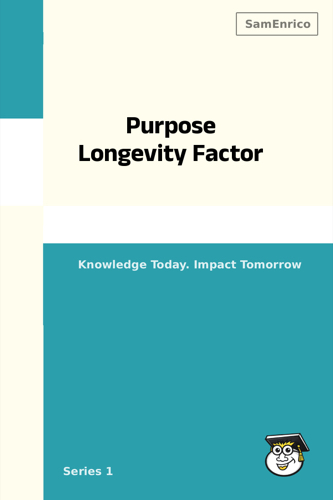
Purpose Longevity Factor eBook
Find your why to add seven to ten years of life.
by Vick Kelley
Find your why to add seven to ten years of life.
Formats
Free sample
Chapter 1: The Seven-Year Question--–- The first time I heard about the seven-year promise, I was sitting in a cramped hospital waiting room, watching my father sleep through the thin curtain of his ICU cubicle. He was sixty-eight years old. His cholesterol panel was the envy of men half his age. He ran three miles a day, ate vegetables he grew in his own garden, and had never touched a cigarette. The cardiologist pulled me aside and used a phrase I have never forgotten: "failure to thrive." The autopsy, when it came three weeks later, showed no single cause of death.
No massive infarction. No occult malignancy. No infection. Just a body that had, apparently, decided to stop.I was thirty-four years old, and I had spent my entire adult life believing that health was a math problem. Eat the right things.
Move the right amount. Sleep the right hours. Get the right screenings. If you did the math correctly, the equation would yield more years. My father had done the math correctly.
And he was dead.In the months that followed, I became obsessed with a question that the medical establishment seemed unable to answer: what had he been missing? I read every study I could find on longevity. I interviewed geriatricians, epidemiologists, and the directors of every major longitudinal aging study in the English-speaking world. I traveled to Okinawa, Sardinia, and Ikaria—the three "Blue Zones" where centenarians were so common that they had their own social clubs. And slowly, a pattern emerged that the standard health checkup had completely missed.The centenarians I met were not health optimizers.
They did not track their macros or wear continuous glucose monitors. Many of them ate white rice, drank wine, and went to bed at irregular hours. But they all shared one thing that my father, for all his discipline, had lacked. When I asked them, through translators and fractured conversations, what got them out of bed in the morning, they did not talk about happiness. They did not talk about feeling good.
They talked about reason. They talked about belonging. They talked about repair.And then they asked me a question I could not answer: "Who are you for?"The Promise That Changed Longevity Science The claim that purpose adds seven to ten years to your life sounds like the kind of thing you would find on a motivational poster next to a picture of a mountain climber. It sounds soft. It sounds unprovable.
And for decades, the scientific community largely ignored it because it sounded soft and unprovable.That changed in 2014, when a team of researchers led by Dr. Patrick Hill at Carleton University published a landmark analysis of the Midlife in the United States (MIDUS) study. They had followed 6,000 Americans for fourteen years, tracking everything from income and education to exercise habits and medical history. But they had also asked a question that most longitudinal studies skipped: "Do you have a sense of purpose in your life?"The results were stunning. Participants who reported a strong sense of purpose at the beginning of the study were significantly less likely to die during the follow-up period—even after controlling for age, gender, income, education, physical health, smoking, drinking, and exercise.
The effect size was not small. It was comparable to the difference between smokers and non-smokers. Purpose, it appeared, was a longevity intervention on par with quitting cigarettes.The Harvard Study of Adult Development, the longest-running longitudinal study of human health ever conducted, found something similar. For eighty years, Harvard researchers tracked hundreds of men from adolescence to death, measuring everything from their cholesterol to their careers to their marriages. The strongest predictor of who lived to ninety was not their cholesterol at fifty.
It was their relationships at fifty—and, just as importantly, whether they had a sense that their lives mattered to someone else.The Blue Zones research, popularized by Dan Buettner and National Geographic, added ethnographic texture to the statistical findings. In Okinawa, the word ikigai translates roughly to "a reason to be alive." In Sardinia, the centenarians spoke of ragione di vita—the reason for life. In Ikaria, they simply pointed to their gardens, their goats, their grandchildren, and their neighbors. No one used the English word "purpose" because the English word "purpose" sounds like a job description. They used words that meant something closer to "breath" or "belonging" or "repair."The biological mechanism, when researchers finally began to look for it, turned out to be surprisingly straightforward.
Purpose appears to regulate the human stress response. People with a clear sense of purpose have lower baseline cortisol levels. They recover more quickly from stressful events. They show less systemic inflammation, which is a driver of heart disease, dementia, and autoimmune disorders. And in a 2019 study from the University of California, San Francisco, researchers found that people with high purpose had longer telomeres—the protective caps at the ends of chromosomes that shorten with age and stress.The telomere finding was particularly striking.
Telomere length is considered a biomarker of cellular aging. Shorter telomeres are associated with earlier mortality and higher rates of chronic disease. The UCSF study found that the difference in telomere length between high-purpose and low-purpose individuals was equivalent to the difference between a forty-year-old and a fifty-year-old. Purpose, in other words, was not just adding years to the end of life. It was slowing the aging process itself.By the time I finished my research tour, I had collected hundreds of pages of studies, dozens of interviews, and a growing conviction that my father had not died because he failed to eat enough kale.
He had died because, in the last years of his life, he had lost his answer to the question "Who am I for?"The Problem the Books Don't Tell You But here is where I have to pause and tell you something that most books on this topic will not tell you. The story I just told you—the promise that purpose adds seven to ten years—has a complication. A serious one. And if I hid it from you, you would be right to throw this book across the room.In 2022, a team of researchers led by Dr. Eileen Graham at Northwestern University published a reanalysis of the Health and Retirement Study, a longitudinal study of more than 20,000 older Americans.
They were trying to replicate the purpose-longevity finding. And they found something troubling.The relationship between purpose and mortality was real—but the direction of causation was not as clear as earlier studies had suggested. When Graham and her team controlled for baseline health more rigorously than previous studies had done, they found that much of the purpose-mortality link could be explained by reverse causation. In plain English: when people become ill, their sense of purpose collapses. So it looks like low purpose causes illness, when in fact, illness causes low purpose.This is not a small quibble.
It is a fundamental challenge to the entire purpose-longevity movement. If purpose is merely a byproduct of good health—if healthy people feel purposeful and sick people do not—then telling someone to "find their purpose" is like telling someone…
This is the end of the free sample. Get the eBook to keep going. Buy now
About this book
Details
- Author
- Vick Kelley
- Publisher
- SamEnrico
- Language
- English
- Genre
- Non-Fiction, Health & Wellness, Purpose
- Released
- 2026-06-10
- Pages (approx.)
- 131
- Available as
- eBook, Audiobook

Read better in the ZLOADR app
Your eBooks on your phone or tablet. Sign in with your SamEnrico account and start reading.
More by Vick Kelley
 Systematic Inventive ThinkingVick Kelley$11.99
 Morning Pain Reset PracticeVick Kelley$11.99
 Downward Arrow Anger GuideVick Kelley$11.99
 The Aunty Joy Murphy WandinVick Kelley$11.99
 Task Breakdown GuideVick Kelley$11.99
 Gut Brain Hormone AxisVick Kelley$11.99
 Gambling Addiction Recovery GuideVick Kelley$11.99
 The Fires of Harmony: Black Composers Who Shaped Classical MusicVick Kelley$11.99
 Silk and Gold: The Byzantine Silk Road EmpireVick Kelley$11.99
 The Essential Guide to TV SoundtrackVick Kelley$11.99
 How to Start a Mineral Water Bottling Business (Beginners Guide)Vick Kelley$11.99
 How to Produce Eye PillowsVick Kelley$11.99