
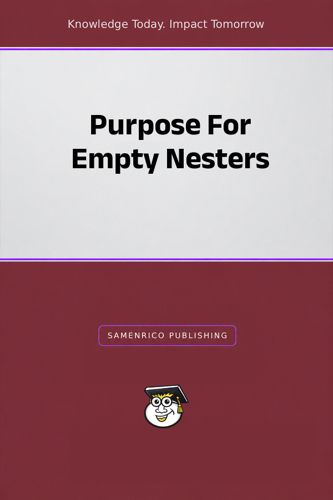
Purpose For Empty Nesters eBook
Redefines meaning after children leave.
Redefines meaning after children leave.
Formats
Free sample
Chapter 1: The Last Load...--The morning my daughter left for college, I stood in the doorway of her bedroom for forty-seven minutes. I know the exact number because I counted. I was not counting time. I was counting the number of times I told myself to walk away and then did not. The room was clean in a way it had not been since she learned to crawl.
The bed was made with hospital corners I had never taught her. The desk where she had written furious midnight essays about climate change and first love and the impossibility of being seventeen was bare except for a single thumbtack she had missed. On the floor, invisible except to a parent's eye, was the indentation where her hamper had sat for six years. The hamper was gone. The laundry was gone.
The noise was gone.I sat on the edge of her bed and listened to the silence.It was not the quiet of a sleeping house. I knew that quiet. I had crept through it a thousand times, stepping over the third stair because it creaked, holding my breath outside bedroom doors, praying for just twenty more minutes of stillness before the chaos began again. That quiet was a truce. This quiet was an ending.I did not cry.
I wanted to. I felt the pressure behind my eyes, the familiar ache in my throat that had accompanied every first day of kindergarten, every sleepaway camp drop-off, every driver's license photo that made her look terrifyingly adult. But the tears did not come. Instead, I felt something I did not have a name for then but have since learned to recognize. I felt the absence of my own job description.For twenty-two years, I had been the Manager.
Not the CEO—that was a fantasy sold by parenting magazines. CEOs have bonuses and corner offices and the ability to fire people. I had none of those things. I had schedules. I had permission slips.
I had a mental inventory of every food allergy, every homework due date, every friendship drama, every pediatrician appointment, every shoe size, every snack preference, every hidden stash of Halloween candy, and every lie my children told me about having brushed their teeth.I was not a parent. I was a cruise director trapped on an infinite voyage with tiny, adorable, exhausting passengers who refused to tip.And then, in one afternoon, the cruise ended. The passengers disembarked. And I was left standing on the dock with a clipboard and no ship.The Physiology of Letting Go There is a reason the silence feels physical. It is.For the duration of your active parenting years, your body has been running a low-grade emergency response.
Cortisol, the stress hormone, has been your constant companion. It spiked at 2 AM when you heard a cough that sounded like croup. It surged when the phone rang during school hours. It lived in your chest during every driving test, every job interview, every first date your child went on with someone who had a tattoo you did not approve of and hair that suggested questionable life choices.Cortisol is not the enemy. Cortisol is the chemical that kept you alert, capable, and chronically exhausted for two decades.
It is also addictive in its own way. Not chemically addictive—but behaviorally. When cortisol drops, as it does when the emergency ends, your body does not feel relief. It feels withdrawal. It feels wrong.
It feels like you are forgetting something important, like you left the stove on or the garage door open or the baby in the car.You did not leave the baby in the car. The baby is in a dormitory eating pizza at midnight and texting you one-word answers. But your body does not know that. Your body knows only that the emergency has stopped and that stopping an emergency is itself an emergency.This is why you are tired. This is why you are restless.
This is why you cannot decide whether to sleep for three days or repaint the kitchen at 11 PM. Your nervous system is recalibrating after two decades of constant, low-level crisis mode. It does not know how to do nothing. It never learned.The Piles of Laundry Metric Here is a confession that made me uncomfortable to write and may make you uncomfortable to read: I measured my worth by the size of my laundry piles.Not consciously. I would have denied it if you had asked me.
I would have said my worth came from my children's happiness, their grades, their character, their college acceptances. But those things were abstract. Laundry was real. Laundry was measurable. Laundry was a problem I could solve in ninety minutes with the right detergent and enough quarters for the dryer.Every parent has a Piles of Laundry Metric.
It might not be laundry. It might be the number of lunches packed, the miles driven, the homework assignments reviewed, the tears dried, the arguments mediated, the birthday parties organized, the orthodontist appointments kept. But every parent has something. A tangible, countable, undeniable metric that proves you are doing your job.The problem with the Piles of Laundry Metric is not that it is shallow. The problem is that it works.
It gives you dopamine hits at regular intervals. Basket empty. Lunch packed. Problem solved. You are good.
You are needed. You are essential.And then the children leave, and the laundry stops piling up, and the metric disappears overnight.You are not sad that your child is gone. Not entirely. A part of you—the part that is honest enough to read this book—is sad that the metric is gone. You miss the proof of your own value.
And that sadness feels shameful, which makes it worse, which makes you feel guilty, which makes you miss the laundry even more.Stop. Take a breath. That shame is not yours to carry. The Piles of Laundry Metric was a survival mechanism. It got you through.
But it was never designed to be your permanent source of meaning. No metric that depends on someone else's mess can survive their departure.Your Child vs. Your Role This distinction is the single most important thing you will learn in this book, so I want you to read it twice. Once for your head. Once for your heart.Missing your child and missing your role as a parent are not the same thing.
They overlap. They tangle. But they are distinct, and learning to separate them is the first step toward building a life that does not collapse when the laundry stops.Missing your child is specific. You miss their laugh, their particular way of leaving cabinets open, the smell of their hair after a shower, the inside jokes that no one else understands, the sound of their key in the door at night. This grief is personal.
It heals slowly, but it heals. Phone calls help. Visits help. Seeing them become functional adults helps.Missing your role is different. You miss the schedule, the chaos, the feeling of being the center of a small, loud universe.
You miss solving problems that are not your own. You miss being the person who knows everything—every password, every preference…
This is the end of the free sample. Get the eBook to keep going. Buy now
About this book
Details
- Author
- Southerland Danyel
- Publisher
- SamEnrico
- Language
- English
- Genre
- Non-Fiction, Self-Help, Empty Nest
- Released
- 2026-06-09
- Pages (approx.)
- 155
- Available as
- eBook, Audiobook

Read better in the ZLOADR app
Your eBooks on your phone or tablet. Sign in with your SamEnrico account and start reading.
More by Southerland Danyel
 Negotiation Implementation GuideSoutherland Danyel$11.99
 Relapse Prevention BlueprintSoutherland Danyel$11.99
 HIIT and Yoga ComboSoutherland Danyel$11.99
 The Task Switching MethodSoutherland Danyel$11.99
 Social Media Travel ComparisonSoutherland Danyel$11.99
 Asana Workload Management FeatureSoutherland Danyel$11.99
 Divorce and Adult ChildrenSoutherland Danyel$11.99
 The Cruise Ship Conspiracy: How a Luxury Liner Exposed Global Prison CorruptionSoutherland Danyel$11.99
 Cortés: The Conqueror and the Fall of an EmpireSoutherland Danyel$11.99
 How to Produce Motor Vehicle Video Monitor MountsSoutherland Danyel$11.99
 How to Produce Leasing ServicesSoutherland Danyel$11.99
 A Collector's Handbook to the Riley 1½-litre RmaSoutherland Danyel$11.99
You may also like
 Empty Nest Stress GuideBertrand Domitila$11.99
 DBT for Empty NestEdge Brianne$11.99
 The Empty Nest AnxietyDonnelly Renna$11.99
 Self Esteem for Empty Nest CouplesHardwick Dreama$11.99
 Empty Nest Stress Couples GuideWolford Lindsy$11.99
 The Empty Nest Relationship Renewal GuideSmalley Temeka$11.99
 Empty Nest DivorceBroussard Kitty$11.99
 Loneliness After Empty NestBunting Mary$11.99
 Empty Nest Relationship GuideHolden Kory$11.99
 The Empty Nest Anger GuideBetz Rod$11.99
 Self Esteem Empty Nest GuideBooker Deandre$11.99
 Empty Nest Purpose Rediscovery CourseWelsh Jama$11.99