
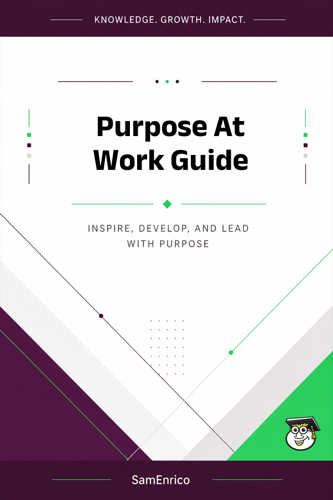
Purpose At Work Guide eBook
Finds meaning in current job.
by Mosley Macy
Finds meaning in current job.
Formats
Free sample
Chapter 1: The Waiting Trap--–- Every morning, millions of professionals walk into offices, cubicles, coffee shops, and construction sites carrying a secret that feels too embarrassing to say out loud: This isn't what I thought it would be. They stare at computer screens, tighten bolts, answer phones, review spreadsheets, attend meetings, and somewhere beneath the surface of their competent exteriors, a quiet voice whispers, "There has to be more than this." That voice is not a sign of failure. It is not evidence that you chose the wrong career or that you lack ambition. It is, in fact, the most common psychological experience in the modern workplace—and nearly everyone misunderstands it completely.The misunderstanding takes a specific and damaging form. Most people believe that the quiet voice of dissatisfaction is a signal.
They interpret it as proof that they haven't yet found their "dream job," their "calling," or their "true purpose." They imagine that somewhere out there—in a different company, a different industry, a different role—there exists a version of work that would feel effortlessly meaningful, deeply fulfilling, and consistently exciting. And because they haven't found that magical destination yet, they assume something is wrong with their current position, their current boss, or their current self. So they wait. They browse job listings at midnight. They fantasize about quitting to become a photographer, a nonprofit founder, a freelance writer, a coffee shop owner.
They tell themselves, "As soon as I find the right opportunity, everything will change."This chapter exists to deliver uncomfortable but liberating news: The waiting is the trap.The belief that meaning is something you find—like a lost set of keys or a hidden treasure—is not only incorrect but actively harmful. Drawing on decades of career psychology research, management science, and the best-selling work of authors like Cal Newport (So Good They Can't Ignore You) and Oliver Burkeman (Four Thousand Weeks), this chapter will dismantle the myth of the dream job and replace it with a more useful, more empowering, and more evidence-based framework. You will learn why passion is almost never the cause of fulfilling work but rather its byproduct. You will discover the concept of career capital—the rare and valuable skills you build over time—and why it matters more than any job title. You will confront the tyranny of the "should" narrative, the quiet shame of unfulfilled expectations, and the finite nature of the only resource that truly matters: your time.By the end of this chapter, you will stop waiting.
You will be ready to build.The Quiet Epidemic of Waiting Let us begin with a deceptively simple question: What do you believe about how people find meaningful work?If you are like most people, your answer draws from a cultural script that has been repeated so often it feels like common sense. The script goes something like this: Every person has a unique "calling" or "passion" somewhere inside them. The job of life is to discover what that passion is. Once discovered, the goal is to find work that aligns with that passion. When you find that alignment, work will no longer feel like work—it will feel like play, like purpose, like self-expression.
If your current job does not feel that way, you simply haven't found your calling yet. Keep searching. Keep waiting. Keep hoping.This script is everywhere. It appears in graduation speeches ("Follow your passion").
It appears in motivational posters ("Do what you love, and you'll never work a day in your life"). It appears in Linked In profiles, career advice columns, and the whispered conversations of friends who just quit their jobs to "find themselves." It is so pervasive that questioning it can feel almost blasphemous—like doubting the existence of gravity.And yet, the script is demonstrably false.Psychologists have studied the relationship between passion and work for decades, and the findings are remarkably consistent: Passion is not something you find; it is something you build. In a landmark study of workplace engagement, researchers found that people who reported the highest levels of passion for their work almost never started with that passion. Instead, they developed passion over time as they mastered skills, gained autonomy, and saw the impact of their efforts. The causal arrow points in the opposite direction from what the dream-job myth suggests.
It is not: Find passion → become excellent → find meaning. It is: Build skills → become excellent → develop passion → find meaning.This distinction matters enormously because it changes the fundamental question you should be asking. The dream-job myth asks: "What am I passionate about?" That question leads to paralysis because it assumes passion is a pre-existing essence waiting to be discovered—and if you haven't discovered it yet, you must be defective. The evidence-based alternative asks: "What skills can I build, and how can I use them to create value for others?" That question leads to action.Consider the data. A study of over 500 university students found that those who believed in the "find your passion" myth were significantly more likely to change majors, drop out of courses when they became difficult, and report lower satisfaction with their career choices.
Why? Because when they hit inevitable obstacles—a boring assignment, a difficult boss, a repetitive task—they interpreted that difficulty as evidence that they hadn't found their "real" passion yet. So they quit and looked elsewhere. Meanwhile, students who believed that passion is developed through effort and mastery stuck with challenges longer, reported higher satisfaction, and were more likely to end up in careers they loved.The waiting trap, then, is not merely passive. It is actively destructive.
It trains you to interpret boredom as a signal to leave rather than a signal to craft. It trains you to interpret difficulty as a sign of misalignment rather than a sign of growth. It trains you to believe that meaning exists out there rather than in here—in your own capacity to shape your experience.Career Capital: The Real Foundation of Fulfilling Work If passion is not the starting point, what is? The answer is career capital.Career capital is the collection of rare and valuable skills you possess. These are skills that are (a) difficult to acquire, (b) in demand in the marketplace, and (c) transferable across different roles or industries.
Examples include technical expertise (coding, data analysis, engineering design), interpersonal abilities (negotiation, management, conflict resolution), creative skills (writing, design, problem-solving), and procedural knowledge (project management, process improvement, quality control).The career capital framework, developed most prominently by Cal Newport, makes a simple but powerful claim: The traits that make work fulfilling—autonomy, competence, relatedness, purpose—are not things you can demand. They are things you earn through career capital.Think of it this way. Imagine you walk into your boss's office tomorrow and announce, "I've decided I need more autonomy in my role. Starting next week, I'll be setting my own hours, choosing my own projects, and reporting directly to the CEO." Unless you have extraordinary leverage (which is itself a form of career capital), that conversation will not go well. Autonomy is not a gift; it is a reward for demonstrated competence.
The same is true for purpose. You cannot simply declare that your work should feel meaningful. You must first develop…
This is the end of the free sample. Get the eBook to keep going. Buy now
About this book
Details
- Author
- Mosley Macy
- Publisher
- SamEnrico
- Language
- English
- Genre
- Non-Fiction, Self-Help, Career Purpose
- Released
- 2026-06-05
- Pages (approx.)
- 148
- Available as
- eBook, Audiobook

Read better in the ZLOADR app
Your eBooks on your phone or tablet. Sign in with your SamEnrico account and start reading.
More by Mosley Macy
 The Confident New Employee GuideMosley Macy$11.99
 Gambling Addiction and Casino Employee RecoveryMosley Macy$11.99
 Nonprofit Partnership GuideMosley Macy$11.99
 The Corsi Block TrainingMosley Macy$11.99
 Interruption PodcastsMosley Macy$11.99
 Wedding Ring After DivorceMosley Macy$11.99
 Child Loss and Single ParentsMosley Macy$11.99
 Silk and Sabers: The Fashion Revolution That Defied a DictatorMosley Macy$11.99
 The Ballot Bombshell: How a Single Election Night Glitch Almost Overturned a PresidencyMosley Macy$11.99
 How to Start a Conveyor Belting (woven) Business (Beginners Guide)Mosley Macy$11.99
 How to Produce Motor Vehicle Rims and WheelsMosley Macy$11.99
 How to Produce Hydraulic PartsMosley Macy$11.99