
Non-FictionSelf-HelpEmpty Nest
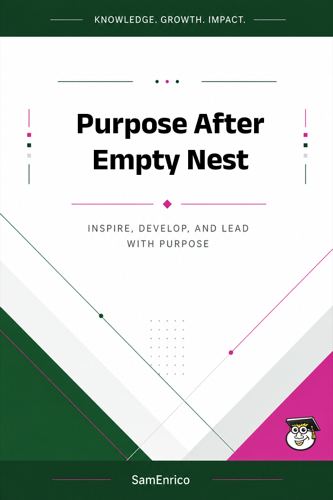
Purpose After Empty Nest eBook
Redefines meaning when children leave home.
Redefines meaning when children leave home.
Formats
Free sample
Chapter 1: The Grief of the Gone--The first morning after the last child leaves does not arrive with a bang. It arrives with the absence of one. No alarm clock silenced by small feet. No second-round snooze battleground. No shout of "Mom, where are my cleats?" or "Dad, did you sign the permission slip?" Just the hum of the refrigerator, the tick of a clock you never noticed before, and the weight of a quiet so complete it feels like a physical presence in the room.You stand in the kitchen at 7:32 on a Tuesday morning, coffee mug in hand, and for the first time in nearly two decades, you have nowhere to be and no one to manage.
The cereal boxes remain unopened. The back door does not slam. The dog looks at you confused, as if asking, "When do the small humans return?" You have no answer.This moment—this disorienting vertigo of the soul—is where every empty nest journey begins. Not with relief, not with celebration, not with the eagerly anticipated "freedom" your friends keep congratulating you about. It begins with grief.
A strange, unnamed, unrecognizable grief that has no funeral, no body, no closure. It is the grief of a role you didn't know you would mourn until it was gone.And here is the counterintuitive truth that this entire chapter rests upon: You cannot build a new sense of purpose on a foundation of unacknowledged grief. Many empty nesters try. They sprint toward new hobbies, book exotic travel, redesign the spare bedroom, adopt a puppy, or throw themselves into work with desperate energy. And then, six weeks or six months later, they crash into a wall of sadness they thought they had outrun.
The sadness was not outrun. It was merely waiting, patient and unhealed, for the sprint to end.This chapter is an invitation to stop sprinting. To sit in the silence. To name the grief so that it can be honored, and then—only then—transformed.The Myth of the Seamless Transition Popular culture has sold us a fantasy about the empty nest. In movies and sitcoms, parents wave goodbye at the dormitory door, share a wistful smile, and then promptly reinvent themselves as glamorous travelers, passionate lovers, or sudden entrepreneurs.
The message is clear: you should be happy. You should be free. Something is wrong with you if you are not.This is what the author calls toxic positivity—the well-intentioned but deeply harmful insistence that only positive emotions are acceptable. Friends say, "You must be so relieved!" Colleagues say, "Enjoy the quiet while it lasts!" Family members say, "At least you still have each other." Each statement, meant as comfort, lands as an accusation. It implies that your sadness is not just unwelcome but somehow incorrect.The research tells a different story.
A landmark study published in the Journal of Family Psychology followed 436 parents through the transition to an empty nest and found that nearly 60 percent reported moderate to significant emotional distress in the first six months. Another longitudinal study from the University of California, Berkeley, found that the dip in life satisfaction following the last child's departure is comparable in magnitude to the dip following divorce or job loss. These are not weak people having inappropriate reactions. These are normal human beings responding normally to a profound loss.Yet the loss is unusual, which makes it difficult to name. You have not lost your child to death.
They are alive, probably thriving, probably texting you back with one-word answers and emojis. You have not lost your spouse to divorce or your home to disaster. What you have lost is something more difficult to articulate: your daily role as an active parent. The thousand small decisions, the constant background hum of responsibility, the feeling of being essential to someone's survival and flourishing. That role is gone.
And it is entirely appropriate to grieve it.Ambiguous Loss: The Psychology of the Unmourned The term ambiguous loss was coined by family psychologist Dr. Pauline Boss in the 1970s to describe a unique form of grief that defies traditional mourning. Unlike a death, which has a body, a funeral, and a clear before-and-after, ambiguous loss is loss without closure. It occurs when a loved one is physically present but psychologically absent (as in dementia or addiction) or psychologically present but physically absent (as in divorce, migration, or—relevant to us—the launch of a child into adulthood).The empty nest is a textbook case of ambiguous loss. Your child is not dead.
They are not estranged (in most cases). They are simply... elsewhere. Living their own life. Needing you less.
And that "less" is the knife that cuts. You are still a parent, but the daily performance of parenthood has ended. The title remains. The job has been eliminated.Dr. Boss's research found that ambiguous loss is often the most debilitating form of grief precisely because it receives the least social validation.
When someone dies, you get casseroles, sympathy cards, and bereavement leave. When your child leaves for college, you get platitudes about freedom. The grief is real, but the cultural script for handling it does not exist. So you stuff it down. You tell yourself you should be happy.
You compare yourself to the neighbor who seems thrilled to have her house back. And you feel, in the dark of the night, that something is wrong with you.Nothing is wrong with you. You are experiencing a normal, predictable, psychologically documented response to the end of a major life stage. The first step toward healing is not to stop feeling the grief. It is to stop judging yourself for feeling it.The Four Stages of Role-Identity Grief To give structure to this otherwise chaotic emotional experience, the author has adapted the classic Kübler-Ross grief model specifically for empty nesters.
These are the Four Stages of Role-Identity Grief. They are not rigid, they do not move in perfect sequence, and you may cycle through them more than once. But naming them gives you a map for a territory that otherwise feels unnavigable.Stage One: Shock (Days 1–7)The first week is characterized by a dissociative fog. Your body continues to perform old routines even though the cues for those routines have vanished. You find yourself setting an extra plate at dinner.
You buy groceries your child does not eat. You walk past their bedroom door and feel a jolt of confusion when you see it closed. The brain has not yet caught up to the new reality.This stage is evolutionarily adaptive. The brain resists rapid changes to entrenched patterns because, for most of human history, sudden changes in routine signaled danger. Your nervous system is not malfunctioning; it is doing exactly what it evolved to do: proceed with caution.
The problem is that there is no danger, only absence. And the brain takes time to learn that absence is not a threat.During this stage, do not make major decisions. Do not rearrange the furniture. Do not sell the house. Do not adopt a pet unless you already planned to.
Do not quit your job. Your brain is not operating at full capacity. Your task for the first week is…
This is the end of the free sample. Get the eBook to keep going. Buy now
About this book
Details
- Author
- Bobo Marquetta
- Publisher
- SamEnrico
- Language
- English
- Genre
- Non-Fiction, Self-Help, Empty Nest
- Released
- 2026-06-06
- Pages (approx.)
- 133
- Available as
- eBook, Audiobook

Read better in the ZLOADR app
Your eBooks on your phone or tablet. Sign in with your SamEnrico account and start reading.
More by Bobo Marquetta
 Brand Momentum Growth IndicatorsBobo Marquetta$11.99
 Growing Up in Foster Care with a DisabilityBobo Marquetta$11.99
 Opioid Free Mindset Transformation ManualBobo Marquetta$11.99
 Social Proof Influence CourseBobo Marquetta$11.99
 Mick DodsonBobo Marquetta$11.99
 Russian Mafia in CyprusBobo Marquetta$11.99
 Middle Passage Liberated AfricansBobo Marquetta$11.99
 The Wolf in Sheep's Clothing: How Wolfgang Beltracchi Fooled the Art WorldBobo Marquetta$11.99
 Enki's Abzu: The Architect of the DeepBobo Marquetta$11.99
 Service Providers Guide to Public SpeakersBobo Marquetta$11.99
 A Collector's Handbook to the Mini MkiiBobo Marquetta$11.99
 How to Produce Weather Forecasters and StationsBobo Marquetta$11.99
You may also like
 Hong Kong Handover 1997Dunn Johnnie$11.99
 Zumba For Postnatal Recovery CourseNeal Christian$11.99
 Zumba for BeginnersLadner Nikia$11.99
 YouTube Comment Mining GuideHumes Pandora$12.99
 Worry Box MeditationCarlin Rudy$11.99
 Workplace Stress MeditationNguyen Lynn$11.99
 Workplace Stress and Sleep RepairHawley Ivory$11.99
 Workplace Perfectionism CureDelaney Jeffry$11.99
 Workplace Injustice Anger GuideWallen Isabelle$11.99
 Work Addiction and Burnout LinkGreenwood Ester$11.99
 Women in Yoga and WellnessBeattie Galina$11.99
 Women in Stand Up ComedyChun Evangeline$11.99