
Non-FictionStartup GuideAccelerator PrepAgricultural Insurance
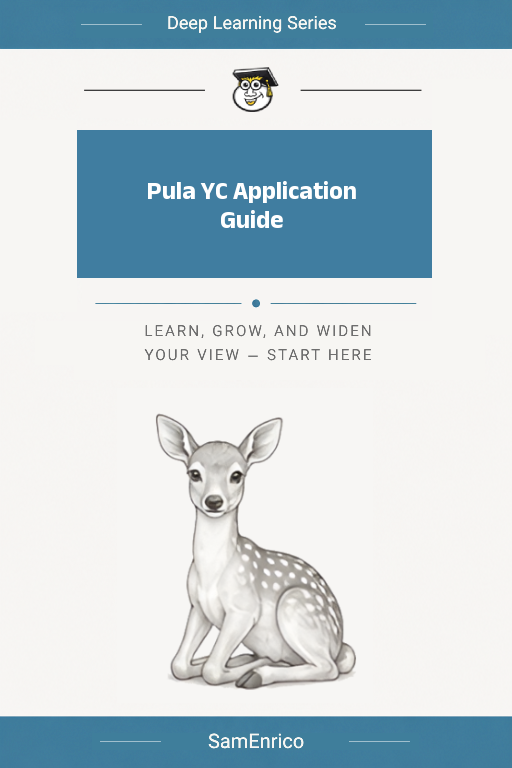
Pula YC Application Guide eBook
Study Pula Y Combinator agricultural insurance app
Study Pula Y Combinator agricultural insurance application and apply their risk management story to African startups.
Formats
Free sample
Chapter 1: The Door You Don't Need...--–- The first thing you need to understand about applying to Y Combinator is that you probably shouldn't. Not yet. Not unless you have already passed a threshold that most founders never reach—the point where an accelerator would be a nice-to-have, not a lifeline. This is the Pula Threshold, named after the agricultural insurance company that turned African volatility into a billion-dollar moat without begging for permission. Rose Goslinga and Thomas Njeru, the co-founders of Pula, did not apply to YC in their first year, or their second, or their third.
They applied only after they had already insured 234,000 farmers, survived a drought that should have bankrupted them, and built a distribution network that governments envied. When they finally walked into YC's offices, they did not need the money. They needed the network. That is the difference between a desperate applicant and a inevitable partner.This chapter exists because the original outline of this book contained a fatal contradiction—a logical whiplash that would have left any careful reader confused and frustrated. Chapters one through seven gave tactical YC application advice: how to write the problem statement, how to frame unit economics, how to structure the vision section.
Then Chapter Twelve argued that the "Ultimate Pula Strategy" was to become so good that you do not need YC at all, and instead graduate from applicant to partner or accelerator owner. A reader following that structure would finish the appendix, turn to Chapter Twelve, and feel betrayed. "Why did you just teach me how to apply," they would ask, "if the real goal is to skip the application entirely?"This chapter resolves that contradiction by moving the strategic framing to the front of the book, where it belongs. Before you learn how to write a YC application, you must first answer a more important question: Should you even apply? And if the answer is no—if you discover that you are not yet ready, or that YC is not the right path for your specific startup—then this book has still served its purpose.
You will have saved yourself months of distraction and, more importantly, you will have a clear roadmap for what to build instead. The rest of this book assumes you have passed what we will call the Pula Threshold. If you have not, close the book after this chapter, build for six more months, and then return. The application will wait. The market will not.The Pula Threshold: Three Questions You Must Answer Before Applying Let us define the Pula Threshold precisely.
It consists of three questions. Answering yes to all three does not guarantee that YC will accept you. But answering no to any of them guarantees that you should not apply, because you will be applying from a position of weakness rather than strength. And YC partners can smell weakness from across the room.Question One: Can you acquire your first one thousand customers without paid marketing?This is the most important question, and the one that filters out ninety percent of applicants. Pula did not buy a single Facebook ad to acquire their first farmers.
They could not have. Their customers were smallholder farmers in rural Kenya who did not have smartphones, let alone Facebook accounts. Instead, Pula walked. They showed up at agricultural cooperatives. They partnered with seed companies.
They put stickers on bags. Their customer acquisition cost was measured in shoe leather and relationship hours, not dollars per click.Why does this matter for YC? Because YC partners know that paid acquisition at the early stage is a crutch. If you can acquire customers only by buying them, you have not proven product-market fit. You have proven that you have a marketing budget.
The moment that budget runs out, the customers disappear. Pula's customers stayed because the product—insurance bundled with seeds—was valuable regardless of whether anyone was running ads.If you cannot answer yes to this question, here is your six-month roadmap: Turn off all paid marketing. Delete your Google Ad Words account. Pause your Facebook campaigns. Now go acquire one hundred customers manually.
Call them. Email them. Show up at their offices. Visit their homes. Do things that do not scale, as Paul Graham famously said.
Once you have one hundred manual customers, figure out how to get to one thousand without turning the ads back on. This is not punishment. This is training. The discipline of manual acquisition will teach you more about your customers than any dashboard ever could.Question Two: Can you deliver your core value proposition without external funding?Pula's core value proposition was simple: If your crops fail, we will pay you within seven weeks. They delivered this promise without any external funding in the first eighteen months.
How? They started small. They insured only crops that had predictable loss histories. They partnered with reinsurers who paid claims on Pula's behalf. They did not build a proprietary technology platform from day one.
They used spreadsheets, paper forms, and manual verification. The product worked, even if it was not yet scalable.This question filters out another ninety percent of the remaining applicants. Most founders raise money to build the product. Pula raised money to scale a product that was already working. The difference is subtle but catastrophic.
If you need funding to deliver any value at all, you are not a startup. You are a research project. Investors should not fund your product development. They should fund your expansion.If you cannot answer yes to this question, here is your six-month roadmap: Strip your product down to its absolute minimum. Remove every feature that requires external capital.
Ask yourself: What is the smallest possible version of this product that still solves a real problem for a real customer? Build that version with sweat equity, open source tools, and manual processes. Then sell it. The revenue may be small. The margins may be terrible.
But if you can close a single paying customer without outside money, you have proven that your business model is not a fantasy. Everything after that is optimization.Question Three: Do you have at least one "near-death" story that taught you something your competitors will never understand?This is the question that most founders fail to appreciate. YC partners do not want to fund founders who have never faced extinction. They want to fund founders who have looked into the abyss and learned something that cannot be taught in a classroom or coded into a product. Pula's near-death story happened in 2018, eighteen months after they launched.
They had insured a maize crop in a region of Kenya that experienced a once-in-a-decade drought. The reinsurer, a global giant based in Europe, delayed the payout. Their process required additional documentation. Their underwriters were on holiday. Their claims department was understaffed.
Meanwhile, farmers in Kenya were rioting. They had planted seeds, paid their premiums, and watched their crops wither. They needed cash to buy seeds for the next season, and they needed it now.Thomas Njeru, Pula's co-founder and the actuary who grew up on a farm, made a decision that nearly destroyed the company. He flew to the…
This is the end of the free sample. Get the eBook to keep going. Buy now
About this book
Details
- Author
- Sanderson Peggie
- Publisher
- SamEnrico
- Language
- English
- Genre
- Non-Fiction, Startup Guide, Accelerator Prep, Agricultural Insurance
- Released
- 2026-06-01
- Pages (approx.)
- 141
- Available as
- eBook, Audiobook

Read better in the ZLOADR app
Your eBooks on your phone or tablet. Sign in with your SamEnrico account and start reading.
More by Sanderson Peggie
 Pinterest VA Canva Design Crash CourseSanderson Peggie$11.99
 Email Forwarding Etiquette GuideSanderson Peggie$11.99
 Remote Communication AssessmentSanderson Peggie$11.99
 Understanding Breast Biopsy ResultsSanderson Peggie$11.99
 Small Talk for Blind DatesSanderson Peggie$11.99
 The Last Letter: A Love Story Written in FireSanderson Peggie$11.99
 The Frozen Gambit: How a Mathematician Tamed Antarctica's ChaosSanderson Peggie$11.99
 Understanding Cockayne's SyndromeSanderson Peggie$17.99
 Ultimate Handbook Guide to Shizuoka : (Japan) Travel GuideSanderson Peggie$11.99
 Calendar Blocking TemplatesSanderson Peggie$12.99
You may also like
 Hong Kong Handover 1997Dunn Johnnie$11.99
 Zumba For Postnatal Recovery CourseNeal Christian$11.99
 Zumba for BeginnersLadner Nikia$11.99
 YouTube Comment Mining GuideHumes Pandora$12.99
 Worry Box MeditationCarlin Rudy$11.99
 Workplace Stress MeditationNguyen Lynn$11.99
 Workplace Stress and Sleep RepairHawley Ivory$11.99
 Workplace Perfectionism CureDelaney Jeffry$11.99
 Workplace Injustice Anger GuideWallen Isabelle$11.99
 Work Addiction and Burnout LinkGreenwood Ester$11.99
 Women in Yoga and WellnessBeattie Galina$11.99
 Women in Stand Up ComedyChun Evangeline$11.99