
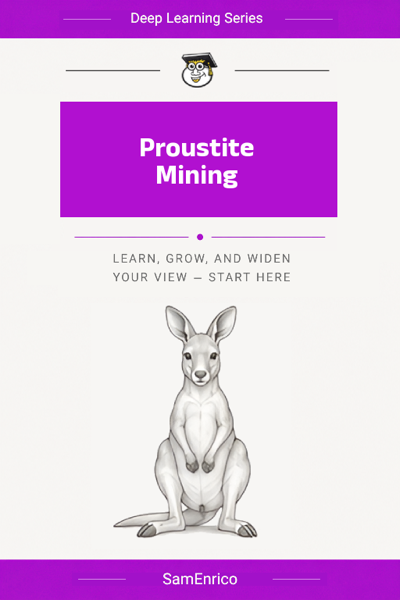
Proustite Mining eBook
A Coursebook on Proustite Mining
A Coursebook on Proustite Mining
Formats
Free sample
Chapter 1: The Mountain That Eats Men--– The first thing you notice about the Cerro Rico is not the mountain itself but the dust. It hangs in the air of Potosí like a fine red mist, catching the high-altitude sun and turning everything the color of dried blood. The dust is everywhere—on your clothes, in your throat, settling into the creases of your skin. It tastes like copper and pennies and something else, something sharper, something that leaves a metallic ache at the back of your tongue. That sharpness is arsenic, and the locals have a name for it: el polvo de la muerte.
The dust of death.I arrived in Potosí on a Tuesday morning in late October, when the Bolivian spring was supposed to be warming the high plains but instead delivered a biting cold that cut through my jacket like broken glass. The city sits at 4,090 meters—thirteen thousand four hundred feet—above sea level, a fact that announced itself with every labored breath. I had come looking for proustite, the fabled "ruby silver" that had made and destroyed fortunes here for five centuries. What I found was a mountain that had consumed nine million people and was still hungry.The Cerro Rico—"Rich Mountain"—looms over Potosí like a tombstone shaped like a pyramid. From a distance, it looks like any other Andean peak: brown, barren, streaked with scree slopes and the occasional patch of hardy ichu grass.
But get closer, and you see the holes. Thousands of them. They pockmark the mountain's flanks like the burrows of some giant, diseased insect. These are the mine entrances, and each one is a mouth that has swallowed men whole.I had read the statistics before coming. They are the kind of numbers that live in your brain like splinters.
Eight million indigenous laborers forced into the mountain during Spanish colonial rule, most dying within six months of entering. Another million miners since independence, crushed, suffocated, poisoned, or simply worn to dust. The mountain has produced an estimated sixty thousand tons of silver—enough to build a bridge of pure metal from Potosí to Madrid. But the real product of the Cerro Rico was never silver. It was corpses.My guide was a man named Don Ricardo Mamani, seventy-two years old, with a face that looked like a relief map of the Andes—deep creases, weathered peaks, and eyes the color of wet slate.
He had worked the mountain for fifty-three years, starting as a colqueiri (silver miner) at age nineteen, the same year his father had been carried out of the San Pablo tunnel on a stretcher, his lungs full of red dust. Don Ricardo's grandfather had died in the same mountain, crushed by a fall of rock in 1934. His great-grandfather had been a mitayo—a forced laborer under the Spanish system—and had simply disappeared into the mountain one day, never to emerge."La montaña come hombres," Don Ricardo said as we stood at the mouth of the San Antonio tunnel. The mountain eats men. He said it the way you might say "the sun rises" or "water flows downhill"—as a statement of natural law, not tragedy.He handed me a hard hat with a broken headlamp, a pair of rubber boots two sizes too large, and a small cloth bag of coca leaves.
"Mastica esto," he said. Chew this. The coca, he explained, would keep the soroche (altitude sickness) at bay and would also appease the Tío, the demon who lives inside the mountain and demands offerings of coca, alcohol, and sometimes blood.I chewed the coca. It tasted like bitter grass and made my tongue numb.Then we walked into the mountain.The San Antonio tunnel is not a tourist mine, despite the occasional foreigner like me who pays Don Ricardo for access. It is an active, working mine, still producing silver ore—though the silver these days is measured in grams per ton, not kilos.
The tunnel is low, narrow, and wet. Within fifty meters, the daylight behind us became a dim gray glow, then a pinprick, then nothing. The headlamp, even working, barely pierced the darkness. It cast a weak yellowish circle on the rock walls, revealing rough-hewn andesite streaked with white veins of quartz and calcite.Those white veins were what we were looking for. In the eighteenth century, they would have been stuffed with native silver—wire silver, horn silver, and the deep red crystals of proustite that the Spanish called plata roja (red silver).
The Spanish had been so desperate for this silver that they had invented the mita system, a rotating draft of indigenous labor that sent one seventh of the adult male population of Bolivia into the mountain at any given time. They worked in shifts of six months, and most did not survive their first shift.The rock walls here are rich in arsenic—not just in the proustite crystals themselves but in the associated minerals: arsenopyrite, realgar, orpiment. The Spanish did not know that the brilliant red and yellow minerals they called "ruby silver" and "king's yellow" were slowly killing their workers. They only knew that when you crushed the rock and mixed it with mercury, silver came out. The cost—in lives—was someone else's accounting.Don Ricardo stopped at a junction in the tunnel and pointed to a dark side passage.
"Allí," he said. "Allí encontré una veta de plata rubí en 1987." There. That's where I found a vein of ruby silver in 1987.I shone my weak light into the passage. The ceiling was so low that I would have to crawl. Don Ricardo, despite his seventy-two years and a back crooked as a corkscrew, got down on his hands and knees and motioned for me to follow.We crawled for what felt like an hour but was probably ten minutes.
The rock scraped my spine through my jacket. Water dripped onto my neck, cold and smelling faintly of sulfur. Then Don Ricardo stopped and pointed his own light at the wall.The vein was still there, though picked clean of anything valuable. But I could see the ghost of what had been—a gash in the rock perhaps two meters long and thirty centimeters wide, lined with tiny cavities where crystals had once grown. In some of those cavities, a faint red stain remained.
Don Ricardo touched it with a fingertip and then held it under my nose."Olor a ajo," he said. Smells like garlic.He was right. The red stain—oxidized proustite dust—had the sharp, pungent smell of garlic mixed with metal. That is the signature of arsenic trioxide, the volatile poison that boils out of proustite when it decomposes. The garlic smell is arsenic's calling card, and in the San Antonio tunnel, it was everywhere.Don Ricardo told me the story of the 1987 vein as we crawled back to the main tunnel.
He had been working alone that day—his partner, a man named Julio Quispe, had stayed home with a fever. Don Ricardo had heard the rock creaking, a sound he knew meant that a pocket was opening. He had tapped the wall with his…
This is the end of the free sample. Get the eBook to keep going. Buy now
About this book
Details
- Author
- Schroeder Sung
- Publisher
- SamEnrico
- Language
- English
- Genre
- Non-Fiction, Informative, Educational
- Released
- 2026-05-18
- Pages (approx.)
- 136
- Available as
- eBook, Audiobook

Read better in the ZLOADR app
Your eBooks on your phone or tablet. Sign in with your SamEnrico account and start reading.
More by Schroeder Sung
 People Pleasing at Job GuideSchroeder Sung$11.99
 Carpool Calm EffectSchroeder Sung$11.99
 Underwater X Ray FluorescenceSchroeder Sung$11.99
 PCOS Fertility Treatment GuideSchroeder Sung$11.99
 Light Therapy for Depression GuideSchroeder Sung$11.99
 The Great Stupa of Sanchi: The Architect Who Defied EmpiresSchroeder Sung$11.99
 Manitoba PNP Graduate StreamSchroeder Sung$12.99
 M&T Bank SWOTSchroeder Sung$12.99
 Understanding Orofaciodigital Syndrome Gabrielli TypeSchroeder Sung$17.99
 How to Start a Musical Instruments Rental and Leasing Business (Beginners Guide)Schroeder Sung$11.99