
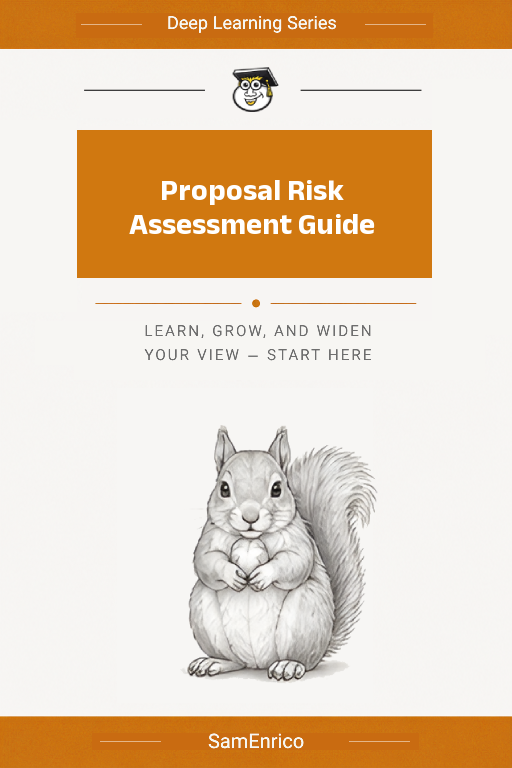
Proposal Risk Assessment Guide
Identify and mitigate potential risks in research
by Ladd Drema
Identify and mitigate potential risks in research proposals including technical timeline and budget uncertainties.
Formats
About this book
Free sample
Chapter 1: The Proposal Paradox--Every research proposal is a lie. Not a malicious lie, not a fraudulent lie, but a lie nonetheless. It is a promise of certainty in an inherently uncertain world. You write that the experiment will take four months, that the equipment will work on the first try, that the graduate student will not fall ill, that the supplies will arrive on time, that the hypothesis will survive its first encounter with reality. You write these things because you must.
Funding agencies do not award millions of dollars to researchers who say, "Honestly, we have no idea how long this will take or whether it will work at all."Yet here is the paradox that gives this chapter its name: the proposal that promises perfect certainty is the proposal most likely to fail. And the proposal that acknowledges its own uncertainty—that names its risks, quantifies its doubts, and demonstrates a plan for handling the unexpected—is the proposal that sponsors trust most.This is not opinion. It is a finding replicated across decades of project management research, portfolio analysis, and funding agency post-mortems. The data are unforgiving. Approximately seventy percent of projects fail to meet their original time and cost goals.
Some analyses put the number even higher, approaching eighty-five percent for large-scale research initiatives. The failures are not primarily technical. They are not caused by bad science or incompetent researchers. They are caused by a single, predictable, human error: the systematic underestimation of uncertainty in the proposal phase.Consider what this means in practical terms. For every ten research proposals that receive funding, seven will run late, over budget, or both.
The principal investigators of those seven projects are not fools. They are not lazy. They are not bad scientists. They are, in most cases, optimistic people who wanted to believe their own plans. And that optimism, untempered by rigorous risk assessment, is precisely what doomed them.The central argument of this book—and the foundation of everything that follows in these twelve chapters—is that the proposal phase is the single most leveraged point for preventing project failure.…
This is the end of the free sample. Get the eBook to keep going. Buy now
Contents
- Chapter 1
- Chapter 2
- Chapter 3
- Chapter 4
- Chapter 5
- Chapter 6
- Chapter 7
- Chapter 8
- Chapter 9
- Chapter 10
- Chapter 11
- Chapter 12
Details
- Author
- Ladd Drema
- Publisher
- SamEnrico
- Language
- English
- Genre
- Non-Fiction, Student's Shortcut, Risk Assessment, Mitigation Guide
- Released
- 2026-05-29
- Pages (approx.)
- 152
- Available as
- eBook, Audiobook

Read better in the ZLOADR app
Your eBooks on your phone or tablet. Sign in with your SamEnrico account and start reading.
More by Ladd Drema
 Divorce Loneliness Recovery GuideLadd Drema$11.99
 Cross Border LBO GuideLadd Drema$11.99
 Bariatric Surgery Fiber Supplementation GuideLadd Drema$11.99
 Screen Time Family Contract WorkbookLadd Drema$11.99
 Lactose Free Supplement GuideLadd Drema$11.99
 The Silent Revolution: How a Teenage Hacker Toppled a DictatorLadd Drema$11.99
 The Last Oracle of Delphi: A Voice Between WorldsLadd Drema$11.99
 How to Start a Poster Advertising Business (Beginners Guide)Ladd Drema$11.99
 AI Financial Data Literacy GuideLadd Drema$12.99AI Financial Data Literacy GuideLadd Drema$12.99
 Understanding Celiac Disease Epilepsy Occipital CalcificationsLadd Drema$17.99
 Overnight StockerLadd Drema$11.99