
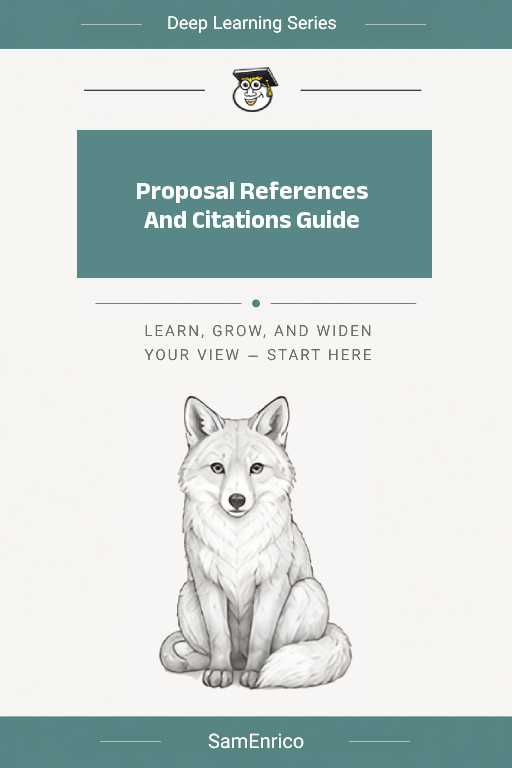
Proposal References And Citations Guide eBook
Format citations perfectly in APA MLA or Chicago f
Format citations perfectly in APA MLA or Chicago for your research proposal.
Formats
Free sample
Chapter 1: The Architecture Blueprint--–- Every research proposal tells two stories. The first story is what you intend to discover, prove, or create. The second story—the one most proposal writers neglect—is about your relationship with existing knowledge. Reviewers read both stories simultaneously. They evaluate your idea, yes, but they also evaluate how you position yourself among the scholars who came before you.
Citations are the grammar of that second story. Get them right, and reviewers see a competent colleague who understands the rules of academic conversation. Get them wrong, and reviewers see a careless outsider who hasn't mastered the basics—and they stop reading your ideas with generosity.This chapter deconstructs the standard research proposal into its five core structural elements, but with a specific focus that no other citation guide provides: where citations belong within each element, how many citations each section typically requires, and what those citations signal to reviewers. By the end of this chapter, you will understand the proposal as a citation ecosystem—each section playing a distinct role, each citation density serving a specific purpose, and every misplaced comma or missing DOI threatening to undermine your credibility before your first contribution is evaluated.The Five Pillars of Every Proposal Every research proposal, regardless of discipline or citation style, contains five core structural elements. Some proposal templates rename them.
Some combine them. Some reorder them. But the underlying architecture remains remarkably consistent across the humanities, social sciences, and natural sciences. Understanding this architecture is the first step toward mastering proposal citations because different sections demand different citation strategies.The five pillars are: Introduction, Literature Review, Methodology, Bibliography, and Appendices. Some proposals include an abstract preceding these elements.
Some include a timeline or budget section following the methodology. Some include a positionality statement or ethical considerations appendix. But the five pillars below form the citation-bearing walls of every substantive proposal.The Introduction (1–2 citations per page)The introduction is the narrowest part of your proposal funnel. It begins broadly—establishing why your topic matters to the world—and narrows toward your specific research question or hypothesis. In citation terms, the introduction is the lightest section.
You should cite sparingly here, typically one to two sources per page, and those citations serve a very specific purpose: they establish the research gap.A research gap is not simply something that hasn't been studied. Every topic has countless unstudied corners. A genuine research gap, in proposal terms, is a tension, contradiction, or omission in the existing literature that your project can resolve. To establish that tension, you need to cite at least two sources that disagree with each other or that leave an obvious question unanswered. For example: "Smith (2021) argues that social media use correlates with adolescent anxiety, while Jones (2022) finds no relationship when controlling for baseline mental health.
Neither study examines the role of parental mediation, which this proposal investigates."Note the citation density in that example: two citations in two sentences. That is appropriate for an introduction. Now compare it to a problematic introduction: "Social media has been studied extensively. Smith (2021) looked at anxiety. Jones (2022) looked at depression.
Lee (2023) looked at sleep. Williams (2024) looked at academic performance. However, no one has looked at parental mediation." This laundry list approach (discussed in detail in Chapter 6) signals that you have read several papers but have not yet synthesized them into a coherent gap. Reviewers penalize this pattern as uncritical reading.The introduction should never cite more than three sources in its opening paragraph. A dense cluster of citations at the very beginning suggests that you are letting other scholars speak for you rather than establishing your own voice.
Lead with your claim about why the topic matters. Then bring in a citation to support that claim. Then introduce the tension. Then state your research question. That arc typically requires three to five citations total for an introduction of one to two pages.The Literature Review (8–12 citations per page)The literature review is the citation-dense heart of your proposal.
This is where you demonstrate mastery of your field, show that you have read the key works, and—most importantly—synthesize those works into a coherent narrative that justifies your project. Expect to cite eight to twelve sources per page in this section. That density can feel uncomfortable to new proposal writers. It should. Writing a literature review requires you to balance your own voice against the voices of dozens of other scholars, and that balance is difficult to achieve.The most common mistake in literature reviews is the laundry list pattern mentioned above.
A laundry list review reads like an annotated bibliography in paragraph form: "Smith (2020) found X. Jones (2021) found Y. Lee (2022) found Z. Patel (2023) found A. Chen (2024) found B.
Therefore, more research is needed." Each sentence introduces a new source, summarizes one finding, and then moves on. There is no conversation between sources. No synthesis. No identification of disagreements, methodological differences, or theoretical tensions.A strong literature review, by contrast, groups sources thematically and shows them arguing with each other. Consider this example: "Researchers have taken three approaches to understanding academic procrastination.
Behavioral economists like Smith (2020) and Jones (2021) frame procrastination as a failure of self-regulation, with Smith showing that commitment devices reduce delay by 40 percent. Psychologists including Lee (2022) and Patel (2023) counter that procrastination is primarily emotional, arguing that anxiety management predicts task initiation better than any behavioral intervention. More recently, Chen (2024) has synthesized both views, proposing a dual-pathway model in which emotional dysregulation triggers delay, but behavioral tools mitigate its duration. What remains untested is how these pathways interact across different task types—a gap this proposal addresses by comparing writing-intensive courses against problem-set-heavy courses."Notice the citation density: eight sources in five sentences, or roughly ten citations per page if this paragraph were part of a full page. Notice also the conversation structure: Smith and Jones agree with each other (behavioral economics), Lee and Patel agree with each other (psychology), Chen synthesizes both, and the proposal inserts itself at the point of remaining tension.
Reviewers see this structure and recognize a writer who has mastered the literature, not merely collected it.Chapter 6 provides the complete toolkit for achieving synthesis, including the visual "Confetti Method" for breaking laundry list habits. For now, the key takeaway is density alone is insufficient. Eight citations per page arranged as a laundry list will fail. Eight citations per page arranged as a conversation will succeed.The Methodology (Rare but Not Forbidden Citations)The methodology section describes what you plan to do. This creates a unique citation situation that confuses many proposal writers.
In most of the proposal, you cite others' work to establish what is known. In the methodology, you describe your own planned procedures. Therefore, you generally do not cite your own planned procedures. You also do not cite sources that describe similar methods unless you are explicitly adapting those methods for your own context.When to cite in the methodology section: You cite prior methods when you are adapting an established protocol. For example: "We followed Smith's (2020) RNA sequencing protocol with the following modifications: we extended the amplification step to 45 cycles due to low input material." You also cite tools…
This is the end of the free sample. Get the eBook to keep going. Buy now
About this book
Details
- Author
- Mcgehee Suzan
- Publisher
- SamEnrico
- Language
- English
- Genre
- Non-Fiction, Student's Shortcut
- Released
- 2026-05-30
- Pages (approx.)
- 138
- Available as
- eBook, Audiobook

Read better in the ZLOADR app
Your eBooks on your phone or tablet. Sign in with your SamEnrico account and start reading.
More by Mcgehee Suzan
 Music Therapy for Parent LossMcgehee Suzan$11.99
 Spin Virtual ClassesMcgehee Suzan$11.99
 Bipolar Borderline DifferentialMcgehee Suzan$11.99
 Escaping Eastern Europe RingsMcgehee Suzan$11.99
 The Nap Frequency FormulaMcgehee Suzan$11.99
 Self Compassion PainMcgehee Suzan$11.99
 Jumia E-book Selling GuideMcgehee Suzan$11.99
 Memorializing Your ChildMcgehee Suzan$11.99
 Boundary Setting For StudentsMcgehee Suzan$11.99
 The Vanishing Act: The Mysterious Disappearance of the Lost Colony of RoanokeMcgehee Suzan$11.99
 The Art of the Fake: How Frank Abagnale Jr. Outsmarted the WorldMcgehee Suzan$11.99
 Neptune’s Gambit: The Lost Treasure of the Titanic’s Sister ShipMcgehee Suzan$11.99
You may also like
 Hong Kong Handover 1997Dunn Johnnie$11.99
 Zumba For Postnatal Recovery CourseNeal Christian$11.99
 Zumba for BeginnersLadner Nikia$11.99
 YouTube Comment Mining GuideHumes Pandora$12.99
 Worry Box MeditationCarlin Rudy$11.99
 Workplace Stress MeditationNguyen Lynn$11.99
 Workplace Stress and Sleep RepairHawley Ivory$11.99
 Workplace Perfectionism CureDelaney Jeffry$11.99
 Workplace Injustice Anger GuideWallen Isabelle$11.99
 Work Addiction and Burnout LinkGreenwood Ester$11.99
 Women in Yoga and WellnessBeattie Galina$11.99
 Women in Stand Up ComedyChun Evangeline$11.99