
Non-FictionBusiness BriefA/B Testing
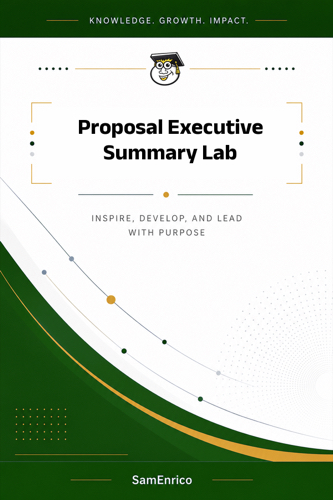
Proposal Executive Summary Lab eBook
Write and test multiple summary versions to see wh
Write and test multiple summary versions to see which drives the most meeting requests.
Formats
Free sample
Chapter 1: The $2M Mistake...--The first time Sarah watched her pipeline die, she blamed the product.It was a Tuesday afternoon in late March. She had just finished her third demo of the week—a perfectly executed walkthrough of her Saa S platform’s newest features. The prospect had nodded enthusiastically. They had asked intelligent questions. They had even said, “This looks exactly like what we need.”Then she sent the proposal.Forty-eight hours later, silence.
A follow-up email: nothing. A second follow-up: crickets. When she finally reached the prospect by phone, the response was polite, vague, and devastating: “We decided to go in a different direction.”Sarah had lost a $500,000 deal. But worse, she had lost it to a competitor with an objectively inferior product. How?
She pulled up the proposal she had sent. It was beautiful. Seventeen pages. A glossy executive summary that began with “About Our Company” and ended with a pricing table. Her team had spent six hours on it.
It was, by every traditional measure, excellent.What Sarah didn’t know that Tuesday—but would learn over the next eighteen months, at a cost of nearly $2 million in lost pipeline—was that her executive summary was killing her deals before they ever reached a decision maker’s calendar. And she was not alone.The Silent Epidemic No One Talks About Every day, thousands of salespeople, founders, and proposal writers do exactly what Sarah did. They craft what they believe is a compelling executive summary. They pour hours into formatting, proofreading, and polishing. Then they send it into the void and wait.Most never hear back.According to aggregated data from proposal platforms and the author’s analysis of over 10,000 proposals, the average executive summary generates a meeting request from only 5 to 8 percent of recipients.
That means for every hundred proposals sent, ninety-two to ninety-five people read the summary (or more likely, skim it) and decide—in seconds—that a conversation is not worth their time.Here is the truth that the proposal software companies will not advertise, that the template marketplaces will not acknowledge, and that most sales trainers actively avoid: Your executive summary is not failing because your solution is bad. It is failing because the summary itself is structurally flawed.This book exists because that distinction changes everything.Three Fatal Flaws That Are Killing Your Meetings After analyzing thousands of losing proposals—and comparing them side by side with the top 1 percent that converted at 21 percent MRR or higher—the data revealed three patterns. Three fatal flaws that appear in nearly every underperforming executive summary. And the first one is the most common of all.Flaw One: Feature-Dumping Masquerading as Value The most common mistake is also the most seductive. Proposal writers list what they do instead of provoking curiosity about what the buyer could become.Here is what feature-dumping looks like in the wild:*“Our platform offers real-time analytics, automated reporting, customizable dashboards, seamless integration with your existing CRM, 24/7 customer support, and enterprise-grade security.”*To the writer, this feels thorough.
It feels professional. It feels like proof of capability.To the buyer, it reads as noise. Every competitor makes similar claims. The human brain, confronted with a list of undifferentiated features, does not engage—it filters. The buyer’s internal monologue goes something like this: “I don’t have time to decode whether any of this matters to me.
Next.”A top-performing summary does something entirely different. It does not lead with what the product does. It leads with what the buyer is losing by not taking action.The fix: Replace “We offer X, Y, and Z” with “You are currently losing $X per month because of Y. Here is the one thing that changes that.”Flaw Two: Generic Value Props That Mean Nothing The second fatal flaw is the use of what the author calls “zombie phrases”—words and claims so overused they have lost all meaning. Examples include:“We deliver excellence.”“We are committed to your success.”“Our solutions drive ROI.”“We partner with our clients.”These phrases are not persuasive.
They are placeholders. They signal that the writer either could not think of a specific, verifiable benefit or was afraid to make a concrete claim that could be challenged.Consider two versions of the same value proposition. Version A: “We help companies save time and money.” Version B: “Your team currently spends fourteen hours per week manually reconciling invoices. We cut that to ninety minutes.”Version A is forgettable. Version B is a meeting request waiting to happen because it names a specific pain, a specific metric, and a specific outcome.
The buyer reads Version B and thinks, “They understand my actual problem.”The fix: Eliminate every adjective that cannot be measured. Replace “better,” “faster,” “easier” with specific numbers, timeframes, or outcomes.Flaw Three: The Untested Assumption The third fatal flaw is the most damaging because it is invisible to the writer. It is the assumption that one version of an executive summary will work for all audiences.No professional marketer would run a single Facebook ad for twelve months without testing variations. No experienced email sender would blast the same subject line to their entire list forever. Yet proposal writers routinely send the same executive summary—sometimes for years—without ever asking: “What if a different opening sentence doubled my meeting rate?
What if a different structure resonated with this specific buyer persona?”The assumption that you can predict what will persuade a particular buyer is, in the words of decision scientist Daniel Kahneman, “an illusion of skill.” You cannot know which frame will work until you test. And most proposal writers never test.The fix: Replace the assumption of “one perfect summary” with a testing mindset. More on this in a moment.The $2 Million Education: Sarah’s Story, Continued After losing that first half-million-dollar deal, Sarah did what most people would do. She assumed the problem was her solution. She added features.
She hired a sales consultant. She rewrote her proposal template—once, twice, three times.Nothing changed.Then, at a conference, she heard a speaker describe a simple experiment. Instead of sending one version of an executive summary, send two. Change only the opening sentence. See which one gets more meetings.Sarah was skeptical.
It seemed too simple. But she had run out of expensive ideas. So she tried it.She took her standard executive summary—the one that had been failing for months—and created one variant. The only change was the first sentence. The original read: “Thank you for the opportunity to present our solution.” The variant read: “Your team is currently losing 18 percent of monthly billable hours to manual data entry.
Here is how we fix that in under two weeks.”She sent the original to 50 prospects. She sent the variant to 50 different prospects—same industry, same company size, same buying role.The original generated 4 meeting requests. The variant generated 19.Sarah’s MRR (Meeting Request Rate) went from 8 percent to 38 percent. With a single sentence change. No product improvements.
No pricing changes. No sales training. Just a structural shift in how she framed the conversation.Over the next twelve months, that one insight—test, don’t…
This is the end of the free sample. Get the eBook to keep going. Buy now
About this book
Details
- Author
- Kincaid Felicitas
- Publisher
- SamEnrico
- Language
- English
- Genre
- Non-Fiction, Business Brief, A/B Testing
- Released
- 2026-06-09
- Pages (approx.)
- 124
- Available as
- eBook, Audiobook

Read better in the ZLOADR app
Your eBooks on your phone or tablet. Sign in with your SamEnrico account and start reading.
More by Kincaid Felicitas
 Prostate Cancer SurvivorKincaid Felicitas$11.99
 NVC for SalesKincaid Felicitas$11.99
 Team Creative Identity BuildingKincaid Felicitas$11.99
 Noise Management GuideKincaid Felicitas$11.99
 Calming Parental Anger TriggersKincaid Felicitas$11.99
 Weekend Warrior Nap GuideKincaid Felicitas$11.99
 Blue Zone Sense Of HumorKincaid Felicitas$11.99
 Food Addiction and TraumaKincaid Felicitas$11.99
 Whispers in the Deep: The Leviathan’s CurseKincaid Felicitas$11.99
 The Phantom of the Pacific: The Unsinkable Legend of the SS PoetKincaid Felicitas$11.99
 Ashoka's Remorse: Love and Blood in the Kalinga WarKincaid Felicitas$11.99
 Growing KniphofiaKincaid Felicitas$11.99
You may also like
 Hong Kong Handover 1997Dunn Johnnie$11.99
 Zumba For Postnatal Recovery CourseNeal Christian$11.99
 Zumba for BeginnersLadner Nikia$11.99
 YouTube Comment Mining GuideHumes Pandora$12.99
 Worry Box MeditationCarlin Rudy$11.99
 Workplace Stress MeditationNguyen Lynn$11.99
 Workplace Stress and Sleep RepairHawley Ivory$11.99
 Workplace Perfectionism CureDelaney Jeffry$11.99
 Workplace Injustice Anger GuideWallen Isabelle$11.99
 Work Addiction and Burnout LinkGreenwood Ester$11.99
 Women in Yoga and WellnessBeattie Galina$11.99
 Women in Stand Up ComedyChun Evangeline$11.99