
Non-FictionBusiness BriefProofreading
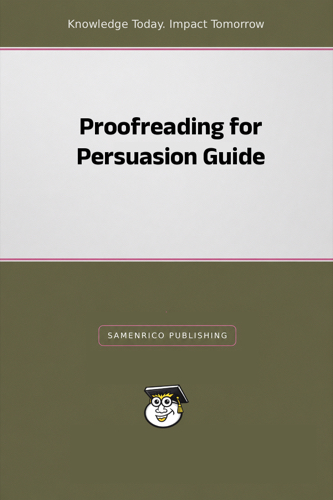
Proofreading for Persuasion Guide
Remove typos, awkward phrasing, and ambiguity that
by Eaton Blake
Remove typos, awkward phrasing, and ambiguity that destroy credibility before submission.
Formats
About this book
Free sample
Chapter 1: The $10,000 Comma--–- On a Tuesday morning in March, a senior consultant named David pressed send on an email that he thought would close a $10,000 contract. The proposal was flawless. The strategy was sound. The client had already said, "We're 95 percent there." David’s only job was to confirm the payment terms and attach the signed scope of work. He typed quickly: "We look forward to starting next Monday.
Your’re approval is the final step."–- The client never signed.–- Three days later, David’s boss called him into a glass-walled conference room. "They went with someone else," she said, sliding a printout across the table. The client’s exact words were circled in red: "If they can’t proofread their own contract, how can we trust them with our account?"–- A single apostrophe. One character out of nearly twelve hundred words. Cost: $10,000.–- David is not real.
But his story is a composite of dozens of real cases documented in hiring studies, sales analytics, and legal reviews. The details change—a missing hyphen on a resume, a misplaced comma in a terms of service agreement, a homophone error in a funding pitch—but the outcome is eerily consistent: surface errors destroy credibility faster than almost any other variable within a writer’s control.–- This chapter is about why that happens, how much it actually costs, and why proofreading—real proofreading, not a quick spellcheck—is not a matter of polish. It is a matter of survival for anyone who writes to persuade.The Reverse Halo Effect: Why One Error Erases Ten Strengths–- Psychologists have long studied what they call the halo effect: the tendency to assume that a person with one obvious positive trait (beauty, confidence, eloquence) possesses other positive traits (intelligence, honesty, competence) without evidence. When we meet someone who dresses well and speaks smoothly, we unconsciously assume they are also good at their job, even if we have never seen them work.–- The reverse halo effect—sometimes called the horn effect—works the same way but in reverse. A single negative trait casts a shadow over everything else.–- Here is how…
This is the end of the free sample. Get the eBook to keep going. Buy now
Contents
- Chapter 1
- Chapter 2
- Chapter 3
- Chapter 4
- Chapter 5
- Chapter 6
- Chapter 7
- Chapter 8
- Chapter 9
- Chapter 10
- Chapter 11
- Chapter 12
Details
- Author
- Eaton Blake
- Publisher
- SamEnrico
- Language
- English
- Genre
- Non-Fiction, Business Brief, Proofreading
- Released
- 2026-06-09
- Pages (approx.)
- 152
- Available as
- eBook, Audiobook

Read better in the ZLOADR app
Your eBooks on your phone or tablet. Sign in with your SamEnrico account and start reading.
More by Eaton Blake
 NVC for Social WorkersEaton Blake$11.99
 Wandering Attention FixEaton Blake$11.99
 Maternal Anger UnpackedEaton Blake$11.99
 Wise Old Man Dream FigureEaton Blake$11.99
 Folate Pregnancy Nutrition GuideEaton Blake$11.99
 Young Adult Cancer SurvivorEaton Blake$11.99
 Elijah Wood RingEaton Blake$11.99
 Crossed Arms Deception ClueEaton Blake$11.99
 Eclipsed by Shadows: The Forgotten Rivalry of Plato and IsocratesEaton Blake$11.99
 The Golden Quill of Timbuktu: Ahmed Baba and the Legacy of African ScholarshipEaton Blake$11.99
 Ragnarök in the Sands: Odin’s Quest for the Egyptian Sun DiskEaton Blake$11.99
 Growing Laelia (An Orchid Genus)Eaton Blake$11.99
You may also like
 Hong Kong Handover 1997Dunn Johnnie$11.99
 Zumba For Postnatal Recovery CourseNeal Christian$11.99
 Zumba for BeginnersLadner Nikia$11.99
 YouTube Comment Mining GuideHumes Pandora$12.99
 Worry Box MeditationCarlin Rudy$11.99
 Workplace Stress MeditationNguyen Lynn$11.99
 Workplace Stress and Sleep RepairHawley Ivory$11.99
 Workplace Perfectionism CureDelaney Jeffry$11.99
 Workplace Injustice Anger GuideWallen Isabelle$11.99
 Work Addiction and Burnout LinkGreenwood Ester$11.99
 Women in Yoga and WellnessBeattie Galina$11.99
 Women in Stand Up ComedyChun Evangeline$11.99