
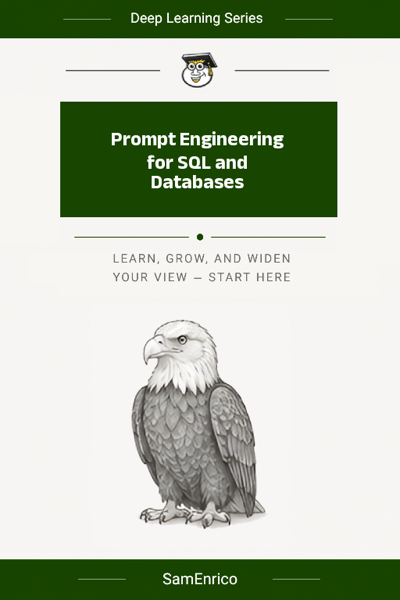
Prompt Engineering for SQL and Databases eBook
A Coursebook on Prompt Engineering for SQL and Dat
by Engel Colene
A Coursebook on Prompt Engineering for SQL and Databases
Formats
Free sample
Chapter 1: The Flighty Junior Developer--– "Write a query to find customers who rented more than ten films in May 2005." You type this sentence into a chat window, press enter, and ten seconds later, SQL appears. It looks correct. It has a JOIN between rental and customer. It has a COUNT(*) with a HAVING clause. It even aliases the aggregates with AS rental_count, which is exactly how your team likes to write SQL. You copy it into your database client, run it, and the error arrives: ERROR: column customer.full_name does not exist. The query references a column that has never existed in your database. The model invented it.This is your first encounter with the reality of prompt engineering for SQL. The model is not dumb. It knows SQL syntax. It understands the question. It even respects your team's aliasing convention. But it has never seen your schema, and it confidently guessed that a customer table would have a full_name column. In most training data, it does. In your database, the customer's name is split across first_name and last_name. The model was wrong, but it was wrong in a way that feels intelligent. That is precisely what makes this hard.Welcome to the new syntax. Natural language is becoming a legitimate query language, but it requires a new kind of discipline. This is not about "asking nicely" or "prompting harder." This is about engineering context. You are no longer writing SQL yourself; you are curating the information that an AI uses to write SQL for you. The shift is subtle but profound. A SQL developer writes precise instructions. A prompt engineer designs probabilistic systems that generate precise instructions. The difference is the difference between a carpenter cutting wood themselves versus teaching an apprentice who knows the tools but has never seen your workshop.This chapter establishes the foundational mental model that will carry you through the entire book. You will learn to think of the LLM (Large Language Model) as what we call a flighty but brilliant junior developer. This metaphor is not cute marketing. It is a practical tool for predicting failure modes and designing solutions. A junior developer knows SQL syntax. They know common patterns. They want to help. But they have never seen your database. They will invent column names when they don't know the real ones. They will write queries that are syntactically perfect but semantically wrong. They will not ask clarifying questions because they are overconfident. Your job is not to fire them. Your job is to give them the right context, the right examples, and the right guardrails so they succeed.We will cover the token economy: why pasting your entire 500-table schema guarantees failure. We will cover temperature: the dial that controls whether the model is creative or deterministic. We will cover model selection: when to use local models versus cloud APIs. And we will end with a lab where you write your first prompt, watch it succeed, watch it fail with a hallucinated column, and learn to recognize the difference. By the end of this chapter, you will understand the problem that the rest of the book solves.The Shift: From Writing to Curating For twenty years, querying a database meant writing SQL. You learned the syntax. You memorized the functions. You developed muscle memory for SELECT, FROM, WHERE, GROUP BY, HAVING, ORDER BY. The computer did exactly what you told it, no more and no less. If you wrote JOIN customer ON rental.customer_id = customer.id, it joined. If you wrote customer.full_name on a table that did not have that column, it threw an error immediately. The feedback was deterministic and immediate.Prompting an LLM is fundamentally different. You are not giving instructions to a deterministic engine. You are making a request to a probabilistic system that has been trained on billions of lines of text and code. When you ask it to write SQL, it is not "executing" your prompt. It is predicting the most likely sequence of tokens that follows your input, given its training data and the context you provided. This is why the same prompt can produce slightly different SQL each time (if temperature is above zero). This is why the model might invent customer.full_name—because in its training data, that pattern appears thousands of times, and it is statistically likely.The mental model that works best is the flighty but brilliant junior developer. Let us break down each part of that phrase.Brilliant. The LLM knows SQL better than most human developers. It can write subqueries, window functions, recursive CTEs, and pivot tables. It knows the difference between RANK() and DENSE_RANK(). It knows that EXISTS is often faster than IN. It knows the syntax for every major database dialect. In terms of raw SQL knowledge, it is a world-class expert.Flighty. The same brilliance makes it unreliable without context. Because it knows 10,000 ways to write a query, it might choose the wrong one. Because it has seen 100,000 database schemas, it will assume patterns that do not exist in yours. Because it cannot see your database, it cannot verify its own work. It will confidently produce SQL that references columns that do not exist, joins tables on the wrong foreign keys, and applies business rules that are completely wrong for your domain.Junior Developer. Like a well-intentioned junior developer, it does not know what it does not know. It will not ask clarifying questions. It will not say, "I need to see the schema first." It will assume, guess, and produce something plausible. Your job as the senior engineer is to provide the missing context: the exact schema, the business rules, the examples of correct queries, the error feedback when it fails.This mental model predicts almost every failure mode in text-to-SQL. Hallucinated column? The junior developer assumed a common naming pattern. Wrong join? The junior developer guessed the relationship between tables. Missing filter? The junior developer did not know about the "exclude test accounts" business rule. The solution is never "get a smarter model." The solution is better context engineering.The Token Economy: Why Less Schema Is More When you paste an entire database schema into a prompt, you are operating under a faulty intuition: more information is better. The LLM has a large context window—128,000 tokens for GPT-4, 200,000 for Claude. Surely it can handle a 500-table schema? Technically, yes. The schema might be 50,000 tokens. The model can ingest it. But the problem is not capacity. The problem is context drift.Context drift occurs when the model loses track of the most important information because it is buried in a sea of less important information. The user's question appears at the end of the prompt. The schema appears before it. By the time the model reaches the question, the schema details from the beginning of the prompt have faded in its attention. This is not a memory limitation in the traditional sense. It is a phenomenon observed in all large language models: information near the beginning and end of a long prompt is attended to more than information in the middle. But more critically, when you show the model 500 tables, you show it 10,000 columns. Most of those columns have nothing to do with the…
This is the end of the free sample. Get the eBook to keep going. Buy now
About this book
Details
- Author
- Engel Colene
- Publisher
- SamEnrico
- Language
- English
- Genre
- Non-Fiction, Informative, Educational
- Released
- 2026-05-11
- Pages (approx.)
- 146
- Available as
- eBook, Audiobook

Read better in the ZLOADR app
Your eBooks on your phone or tablet. Sign in with your SamEnrico account and start reading.
More by Engel Colene
 Trance for Creativity BoostEngel Colene$11.99
 The Bell Tower EchoEngel Colene$11.99
 Postpartum Strength ReturnEngel Colene$11.99
 Is Everyone Hanging OutEngel Colene$11.99
 Notice Period AnalysisEngel Colene$11.99
 The Mortuary Worker Stress GuideEngel Colene$11.99
 Pre Talk Script TemplatesEngel Colene$11.99
 Pelvic Floor Exercise BallsEngel Colene$11.99
 Time Blocking For DeclutteringEngel Colene$11.99
 Whispers of the Silk Road: The Forbidden Love of Lady Murasaki and the Persian MerchantEngel Colene$11.99
 The Lioness of Thebes: Hatshepsut's Secret WarEngel Colene$11.99
 The Architect of Dreams: Brunelleschi and the Dome of FlorenceEngel Colene$11.99