
Non-FictionInformativeEducational
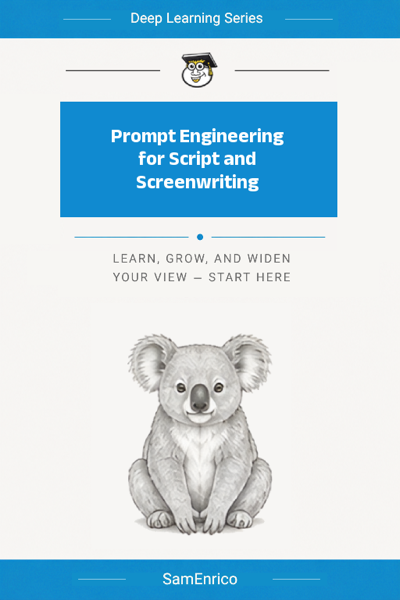
Prompt Engineering for Script and Screenwriting eBook
A Coursebook on Prompt Engineering for Script and
A Coursebook on Prompt Engineering for Script and Screenwriting
Formats
Free sample
Chapter 1: The Blank Page Killer...--Every screenwriter knows the feeling. You sit down at your desk, coffee growing cold, cursor blinking on a white void that seems to mock you. You have the idea — the one that woke you at 3 AM, the one you've been turning over in your mind for weeks, the one that feels like the one. But when your fingers touch the keyboard, nothing comes out. Or worse, something comes out — something flat, generic, and embarrassingly bad.You are not alone.
And the problem is not your talent.The problem is that you have been taught to treat creative tools like oracles. You ask for a finished product, and you expect wisdom to descend. But artificial intelligence — for all its miraculous capabilities — is not an oracle. It is a mirror, a collaborator, an intern who has read every screenplay ever written but has never felt a single human emotion. And if you command it like a king, it will obey like a servant — producing exactly what you asked for, which is never what you actually wanted.This book exists because the intersection of prompt engineering and screenwriting is where two impossible things become possible: writing faster without losing soul, and using machines to become more human, not less.But before we can build, we must unlearn.The Hallmark Channel Trap Let me show you what I mean.
Open any AI chatbot — Chat GPT, Claude, Gemini, it doesn't matter. Type this exact prompt: "Write a scene where two people break up in a coffee shop."Go ahead. I'll wait.What you received was almost certainly terrible. Here is what you probably got, or something very close to it:INT. COFFEE SHOP - DAYSARAH (30s) and MARK (30s) sit across from each other.
Tension fills the air.SARAH: Mark, we need to talk.MARK: I know. I've been feeling it too.SARAH: This isn't working anymore.MARK: I still love you.SARAH: Sometimes love isn't enough.MARK: Is there someone else?SARAH: No. That's not it.MARK: Then what?SARAH: I don't recognize myself when I'm with you.MARK: (fighting tears) I never wanted to hurt you.SARAH: I know. That's what makes this so hard.If you are a working screenwriter, your eye is twitching right now. This scene contains every sin the craft warns against: on-the-nose dialogue that explains emotions instead of revealing them, no subtext whatsoever, a complete absence of visual storytelling, characters who speak in therapy-speak rather than human speech, and a generic setting that contributes nothing to the conflict.And yet, millions of writers are typing prompts exactly like this every day, receiving output exactly like this, and concluding one of three things: (1) AI is useless for creative writing, (2) they are bad writers, or (3) they should copy-paste the output and call it a first draft.All three conclusions are wrong.The problem is not the AI.
The problem is not your talent. The problem is the prompt — and more specifically, the assumptions behind the prompt. You treated the AI like an oracle that already knows your vision, your characters, your subtext, your visual language. You asked for a finished scene without providing the scaffolding that makes a scene work. You commanded, and the AI obeyed — giving you the statistical average of every coffee shop breakup scene in its training data.That average is Hallmark Channel.
That average is平庸. That average is the enemy of art.The Virtual Writing Partner Model This book proposes a different relationship with AI. Not master and servant. Not oracle and supplicant. But showrunner and staff writer.
Director and cinematographer. Composer and first chair.I call this the Virtual Writing Partner (VWP) Model.In the VWP Model, you are the Showrunner. You retain final cut, creative voice, and ultimate vision. The AI is your knowledgeable but subordinate creative assistant — an intern who has read every screenplay in existence but has never lived a single day of human life. The AI provides structural options, variations, continuity checks, and first-pass drafts.
You provide taste, judgment, emotional truth, and the final word.Here is the distinction that will save you hundreds of hours of frustration:Old Paradigm (AI as Oracle)VWP Model (AI as Partner)You ask for finished output You ask for options, analysis, or first passes You accept or reject You revise, redirect, and refine One prompt, one answer Iterative dialogue across multiple exchanges AI generates; you judge AI collaborates; you direct"Write a breakup scene""Here are my characters' psychological profiles. Generate three variations of a breakup scene that reveals their subtext through action rather than dialogue."The VWP Model is not about getting AI to do your work for you. It is about getting AI to do work with you — handling the heavy lifting of structure, variation, and formatting so you can focus on the irreplaceably human elements: emotional truth, thematic depth, and the specific texture of your voice.Throughout this book, you will learn to apply the VWP Model to every stage of screenwriting: ideation, structure, character, dialogue, revision, and technical formatting. But before we can do any of that, you need to understand the tools you will be using and the fundamental grammar of communicating with them.The Degrees of AI Autonomy Not every writing task requires the same level of AI involvement. Sometimes you want the AI to shut up and just analyze.
Sometimes you want it to generate fifty options so you can pick the best one. Sometimes you want to trade lines back and forth like a jazz improvisation.To help you choose the right level of AI involvement for each task, I have developed the Degrees of AI Autonomy Scale. You will see a callout box at the beginning of every chapter telling you which level or levels that chapter primarily uses.Level 1: Advisor — The AI analyzes only. It never generates prose, dialogue, or scene description. It identifies structural weaknesses, continuity errors, pacing problems, and logical inconsistencies.
You do the writing; the AI provides the notes. Use this when you already have material and need a second set of eyes.Level 2: Typist — The AI writes first drafts from your detailed outlines and specifications. You provide the creative direction (character goals, emotional beats, visual requirements); the AI handles the mechanical execution of formatting and prose. Use this when you know exactly what you want but want to save typing time.Level 3: Explorer — The AI generates multiple options, variations, or approaches. You review, select, and rewrite.
This is the most common level for brainstorming and overcoming creative blocks. Use this when you have a direction but want to see possibilities you might not have considered.Level 4: Collaborator — The AI and you alternate contributions. You write a line; the AI writes the next. You establish a rhythm; the AI follows and occasionally surprises. Use this when you are in a flow state and want a creative sparring partner.Here is the single most important rule of the Autonomy Scale: Never use Level 4 (Collaborator) until you have mastered Levels 1-3.
Collaboration without foundation produces chaos. Learn to direct before you learn to jam.Throughout this book, each chapter will specify its Autonomy Level. For example, structural analysis chapters…
This is the end of the free sample. Get the eBook to keep going. Buy now
About this book
Details
- Author
- Conner Ramona
- Publisher
- SamEnrico
- Language
- English
- Genre
- Non-Fiction, Informative, Educational
- Released
- 2026-06-03
- Pages (approx.)
- 151
- Available as
- eBook, Audiobook

Read better in the ZLOADR app
Your eBooks on your phone or tablet. Sign in with your SamEnrico account and start reading.
More by Conner Ramona
 Metta For Boss ResentmentConner Ramona$11.99
 Mindful Running MeditationConner Ramona$11.99
 Eisenhower For Decision FatigueConner Ramona$11.99
 Fireplace RageConner Ramona$11.99
 Wholesaling Pre Foreclosure DealsConner Ramona$11.99
 Stress Fracture Recovery GuideConner Ramona$11.99
 Depressed Parent Self EsteemConner Ramona$11.99
 Cleft Lip Scar AcceptanceConner Ramona$11.99
 Christian Conversion FearConner Ramona$11.99
 Wifredo Lam: The Afro-Cuban Surrealist Who Redefined Modern ArtConner Ramona$11.99
 The Silk and the Scandal: The Untold Affair That Rocked a Royal HouseholdConner Ramona$11.99
 The Fire and the Equation: Polynesian Navigators and the Secrets of Volcanic MathConner Ramona$11.99
You may also like
 Hong Kong Handover 1997Dunn Johnnie$11.99
 Zumba For Postnatal Recovery CourseNeal Christian$11.99
 Zumba for BeginnersLadner Nikia$11.99
 YouTube Comment Mining GuideHumes Pandora$12.99
 Worry Box MeditationCarlin Rudy$11.99
 Workplace Stress MeditationNguyen Lynn$11.99
 Workplace Stress and Sleep RepairHawley Ivory$11.99
 Workplace Perfectionism CureDelaney Jeffry$11.99
 Workplace Injustice Anger GuideWallen Isabelle$11.99
 Work Addiction and Burnout LinkGreenwood Ester$11.99
 Women in Yoga and WellnessBeattie Galina$11.99
 Women in Stand Up ComedyChun Evangeline$11.99