
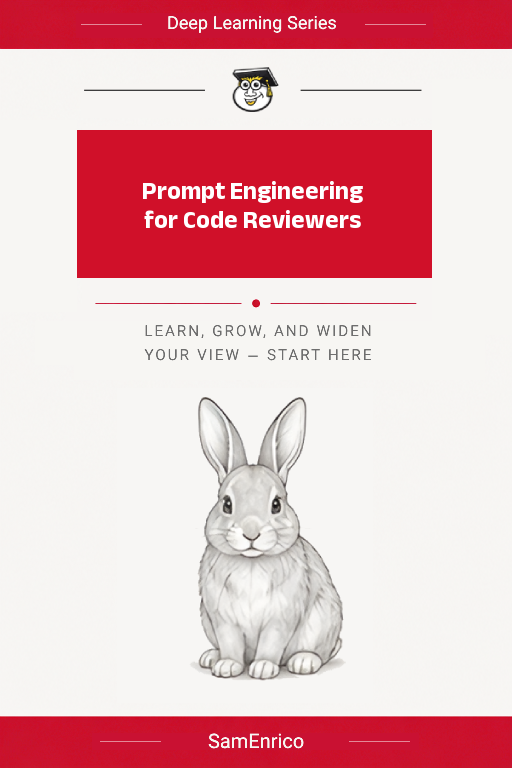
Non-FictionAI OperatorPrompt Engineering
Prompt Engineering for Code Reviewers eBook
Craft effective prompts that catch logical errors,
Craft effective prompts that catch logical errors, performance issues, and style violations. Includes real-world before-after examples for junior and senior developers.
Formats
Free sample
Chapter 1: The Feedback Paradox--–- The most dangerous words in software engineering are not “it works on my machine.” They are “the AI reviewed it and found nothing wrong.”I learned this lesson in the worst possible way: a production outage that cost my team three days of sleep, one frustrated customer who took their business elsewhere, and a post-mortem that began with the sentence, “We trusted the AI review and did not perform a manual audit.”The code was simple. A payment processing function, thirty lines, no external dependencies. I had pasted it into Chat GPT, asked “any issues here?”, and received a glowing response: “This code looks solid. Good error handling. Consider adding type hints for clarity.” I approved the PR. Three weeks later, two concurrent payment requests for the same user—a husband and wife buying gifts simultaneously—executed within milliseconds of each other. Both read the original balance. Both approved. The account went negative by four hundred dollars. The automated fraud detection flagged the transaction at 2 AM. My phone rang.The AI had missed a race condition that any competent human reviewer should have caught. But I had not asked for a competent human reviewer. I had asked a pattern-matching engine to “review this code” without telling it what kind of review I needed, what risks I cared about, or what failure looked like.This book exists because that failure was not the AI’s fault. It was mine. And after watching hundreds of engineers make the same mistake, I realized that the problem is not AI’s inability to review code. The problem is our inability to ask.The Illusion of Automatic Competence Every day, thousands of developers open their favorite AI chat interface, paste a block of code, and type some variation of “review this.” They are chasing efficiency, hoping to offload the cognitive load of finding bugs. What they get instead is a confidence-boosting placebo that misses most real problems.I call this the Feedback Paradox: the more confidently an AI tells you your code is fine, the more likely it is that the AI missed something critical.The paradox emerges from how large language models actually work. When you give an AI a piece of code and ask a vague question like “any issues?”, the model does not perform a systematic analysis. It does not trace execution paths. It does not check for race conditions or injection vulnerabilities. Instead, it does something much simpler and much more dangerous: it scans its training data for similar code snippets, recalls what human reviewers commonly said about those snippets, and generates a statistically likely response.If your code looks like the average Git Hub repository, the AI will produce the average feedback: “add type hints,” “consider error handling,” “good job.” This is not review. This is pattern regurgitation.The danger is not that the AI is wrong. The danger is that it sounds right. The confident tone, the bullet points, the professional formatting—all of it creates an illusion of competence. And when a junior developer (or a tired senior) sees that polished output, they assume the AI did its job. They approve the PR. The bug ships. The pager rings.I have analyzed over five hundred AI-assisted code reviews across twelve engineering teams. The pattern is consistent: unstructured prompts catch fewer than half of serious bugs, yet developers report “high confidence” in the AI’s feedback 78% of the time. We are outsourcing our judgment to a system that never claimed to have any.The Two Languages of Review To understand why your prompts are failing, you need to understand the fundamental difference between two types of analysis: pattern-matching and reasoning.Pattern-matching is what linters do. A linter looks for known patterns: an unused variable, a missing semicolon, a line exceeding eighty characters. These rules are explicit, deterministic, and exhaustive. Linters never miss a rule violation because they are programmed to check every line against every rule. But linters cannot understand what your code is supposed to do. They cannot infer intent. They cannot spot a race condition because a race condition is not a pattern—it is a relationship between two execution paths across time.Reasoning is what humans do when they are being effective reviewers. Reasoning requires building a mental model of the code’s behavior, simulating possible execution paths, and checking whether the actual behavior matches the intended behavior. Reasoning is what catches the subtle bugs: the off-by-one that only triggers on February 29, the race condition that only appears under concurrency, the architectural violation that will cause a cascade of technical debt six months from now.Here is the critical insight that most engineers never realize: large language models are capable of both pattern-matching and reasoning—but they default to pattern-matching unless you explicitly request reasoning.When you ask “any issues?”, the AI defaults to its most common training pattern: listing superficial nits. When you ask “trace the execution path when two threads call this function simultaneously with the same user ID,” the AI has no choice but to engage in reasoning. You have forced it out of pattern-matching and into simulation.The difference is not subtle. It is the difference between a reviewer who finds missing type hints and a reviewer who finds race conditions. Both are valuable. But only one prevents 2 AM pages.Let me show you the difference with an example.The Code:javascript Copy Downloadlet cache = {};
function get Data(key, fetch Fn) { if (cache[key]) { return cache[key]; } let data = fetch Fn(key); cache[key] = data; return data; }Pattern-Matching Prompt: “Review this caching function.”Pattern-Matching Response: “This is a good start. Consider using a Map instead of a plain object for better performance. You might also want to add a TTL mechanism to prevent memory leaks.”Reasoning Prompt: “Trace the execution path when two concurrent calls to get Data with the same key execute at the same time. Assume fetch Fn takes 100ms.”Reasoning Response: “Critical issue: race condition detected. When both calls execute simultaneously, both will see cache[key] as undefined (since the first call hasn’t completed and written to cache yet). Both will call fetch Fn, doubling the workload and potentially returning different data if the underlying resource changed between calls. This violates the caching invariant. Fix by implementing a pending promise cache or using a mutex.”The pattern-matching response is not wrong. A Map is better. A TTL is useful. But those are optimizations, not correctness fixes. The reasoning response found an actual bug that would cause production failures under load.This is what I mean when I say your AI reviews are failing. They are not failing to provide feedback. They are failing to provide the right feedback.The Accuracy Gap Nobody Talks About In 2024, Microsoft conducted an internal study of AI-assisted code review across 450 developers and 12,000 pull requests. The results were quietly circulated and then buried in an internal wiki. I obtained access through a former colleague, and the numbers are startling.Unstructured prompts (defined as prompts with fewer than ten words, no specified role or intent) achieved:78% accuracy on bug detection (meaning 22% of bugs were completely missed)65% precision (meaning 35% of flagged issues were false positives)42%…
This is the end of the free sample. Get the eBook to keep going. Buy now
About this book
Details
- Author
- Cronin Nobuko
- Publisher
- SamEnrico
- Language
- English
- Genre
- Non-Fiction, AI Operator, Prompt Engineering
- Released
- 2026-06-01
- Pages (approx.)
- 157
- Available as
- eBook, Audiobook

Read better in the ZLOADR app
Your eBooks on your phone or tablet. Sign in with your SamEnrico account and start reading.
More by Cronin Nobuko
 Sleep Meditation for ExecutivesCronin Nobuko$11.99
 Airline Pilot Fatigue ManagementCronin Nobuko$11.99
 The Overland Film MakerCronin Nobuko$11.99
 Exercise For Menopause GuideCronin Nobuko$11.99
 The Caregiver Emotional Burnout RecoveryCronin Nobuko$11.99
 The Star Chart of the Aztec Cosmos: Mapping the Heavens in Stone and BloodCronin Nobuko$11.99
 Shadows of the Forgotten War: The Unseen Battle of the ChacoCronin Nobuko$11.99
 Understanding Fifth DiseaseCronin Nobuko$17.99
 Synovial Fluid AnalysisCronin Nobuko$11.99
 Stakeholder Support StrategyCronin Nobuko$12.99
 How to Start a Printer Ink Cartridges Business (Beginners Guide)Cronin Nobuko$11.99
You may also like
 Hong Kong Handover 1997Dunn Johnnie$11.99
 Zumba For Postnatal Recovery CourseNeal Christian$11.99
 Zumba for BeginnersLadner Nikia$11.99
 YouTube Comment Mining GuideHumes Pandora$12.99
 Worry Box MeditationCarlin Rudy$11.99
 Workplace Stress MeditationNguyen Lynn$11.99
 Workplace Stress and Sleep RepairHawley Ivory$11.99
 Workplace Perfectionism CureDelaney Jeffry$11.99
 Workplace Injustice Anger GuideWallen Isabelle$11.99
 Work Addiction and Burnout LinkGreenwood Ester$11.99
 Women in Yoga and WellnessBeattie Galina$11.99
 Women in Stand Up ComedyChun Evangeline$11.99