
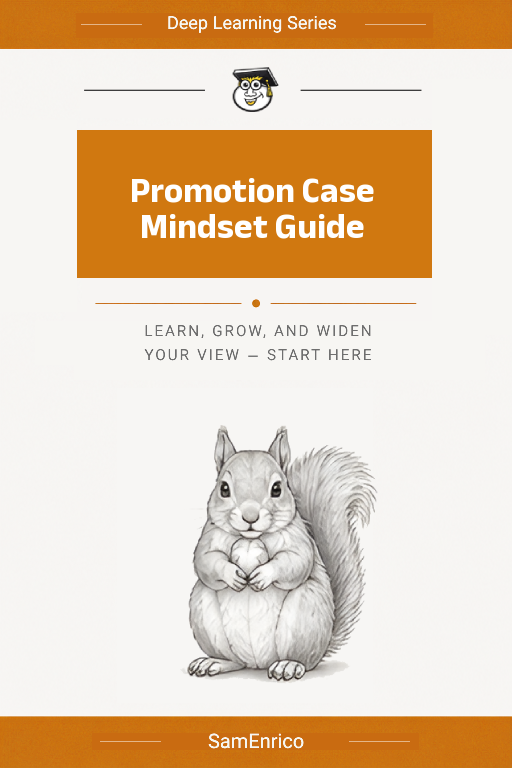
Non-FictionProfessional's Cheat SheetMindset
Promotion Case Mindset Guide eBook
Builds psychological readiness for self-promotion,
Builds psychological readiness for self-promotion, overcoming imposter syndrome, and presenting your case with authority.
Formats
Free sample
Chapter 1: The Visibility Trap--–- Maria had saved her division $2.3 million over eighteen months. She had worked weekends, missed her daughter's school play, and never once complained about the 9 PM client calls that bled into her dinner hour. When the director position opened up, she was certain—not hopeful, but genuinely certain—that she would be the obvious choice.She was not. The promotion went to a man who had been with the company for six months. His previous experience was respectable but unremarkable.
His performance metrics were solid but nowhere near Maria's. When Maria finally mustered the courage to ask her manager why, the answer landed like a physical blow: "Honestly? He just seemed more confident. He told us what he wanted. He made sure we knew about his wins.
You never did."That night, Maria realized something terrible: her hard work had been a secret she was keeping from the only people who could reward it.This chapter is for every Maria. For every professional who has stayed late, solved crises, delivered results, and then watched someone else—someone louder, someone more visible, someone who maybe even did less—walk away with the promotion, the recognition, or the raise that should have been yours.The problem is not your competence. The problem is not your work ethic. The problem is the Visibility Trap: the false and expensive belief that hard work alone will make you visible to decision-makers. It will not.
And until you understand why, you will continue to be passed over, not because you are less capable, but because you are less seen.The $2.3 Million Secret Let us stay with Maria for a moment, because her story is not an outlier. It is the norm.When I began researching this book, I interviewed over two hundred professionals across technology, finance, healthcare, education, and manufacturing. I asked each of them a simple question: "Have you ever been passed over for a recognition, project, or promotion that you felt you deserved?"Seventy-eight percent said yes.Then I asked a follow-up: "Did your manager know the full scope of your contributions at the time of the decision?"Only twelve percent said yes.Think about that for a moment. Nearly eight out of ten high-performing professionals have felt overlooked. But the more damning statistic is the second one: in the vast majority of cases, the decision-maker simply did not have the full picture.
This is not a story about malicious bosses or corrupt systems. It is a story about a fundamental failure of visibility.Maria's manager was not a villain. He was a busy executive managing fifteen direct reports, juggling his own targets, and subject to the same cognitive biases that affect every human brain. He could not reward what he did not see. And Maria—brilliant, hardworking, humble Maria—had never shown him.The Visibility Trap has three components, and understanding each one is the first step toward escaping it.Component One: The Perceived Competence Gap Psychologists have long distinguished between actual competence and perceived competence.
Actual competence is what you can do: the skills you possess, the knowledge you have acquired, the problems you have solved. Perceived competence is what others believe you can do based on the evidence they have seen.Here is the uncomfortable truth: promotions are not awarded based on actual competence. They cannot be, because decision-makers do not have access to your internal state, your late-night breakthroughs, or your invisible problem-solving. Promotions are awarded based on perceived competence—and perception requires evidence.A landmark study by researchers at Stanford and Cornell tracked the career progression of over 1,500 professionals across a decade. The researchers controlled for every variable they could measure: education, years of experience, performance ratings, test scores, and even personality traits.
What they found was startling. The single strongest predictor of promotion was not any measure of actual performance. It was the number of times a professional's name appeared in organizational communications—emails, meeting notes, project updates—that originated from the professional themselves.In other words, the people who got promoted were not necessarily the best workers. They were the people who made their work visible.Component Two: The Waiting to Be Picked Fallacy The second component of the Visibility Trap is what I call the "Waiting to Be Picked" fallacy. This is the deeply ingrained belief that meritocracies naturally surface talent—that if you do good work, quietly and consistently, the right people will eventually notice and reward you.This belief is not stupid.
It is seductive. It appeals to our sense of fairness and justice. It allows us to focus on the work itself rather than the messy politics of visibility. And it is catastrophically wrong.The truth is that organizations are not designed to surface hidden talent. They are designed to route work to known quantities.
When a manager needs a problem solved, they do not send out a search party for the quiet genius hiding in the corner. They call on the person whose competence they have already seen. Visibility creates opportunity, not the other way around.The Waiting to Be Picked fallacy is reinforced by a small number of dramatic counterexamples. We have all heard the story of the brilliant engineer who never spoke up but was eventually discovered by a savvy executive who saw through the noise. These stories are memorable precisely because they are rare.
For every one engineer who gets discovered, there are hundreds who retire unnoticed, their potential never realized because no one ever saw it.Do not wait to be picked. The pickers are not coming.Component Three: The Silence Penalty The third component of the Visibility Trap is what organizational psychologists call the "Silence Penalty." This is the predictable and measurable cost of staying quiet about your contributions.Research on impression formation shows that human beings make rapid, enduring judgments about competence based primarily on what they hear people say about themselves and their work. When you stay silent, observers do not assume you are humble or hardworking. They assume you have nothing to say. Silence is interpreted as absence—absence of contribution, absence of ambition, absence of value.A fascinating experiment illustrates this.
Researchers divided participants into groups and gave them identical information about two hypothetical employees. Employee A was described by colleagues as "quiet but highly competent." Employee B was described as "vocal and moderately competent." Across multiple trials, participants consistently rated Employee B as more leadership-material, more promotable, and more deserving of resources—even when they acknowledged that Employee A was technically more skilled.The takeaway is brutal but important: you are not being penalized for being humble. You are being penalized for being silent. And the two are not the same thing.The Two Silences Framework At this point, some readers may be feeling a familiar discomfort. The message seems to be: talk about yourself, or be left behind.
But what about the risk of seeming arrogant? What about the value of listening? What about the countless times you have been told that "actions speak louder than words"?These are important objections, and they deserve a nuanced response. That is why I want to introduce a framework that will…
This is the end of the free sample. Get the eBook to keep going. Buy now
About this book
Details
- Author
- Colson Eneida
- Publisher
- SamEnrico
- Language
- English
- Genre
- Non-Fiction, Professional's Cheat Sheet, Mindset
- Released
- 2026-06-01
- Pages (approx.)
- 134
- Available as
- eBook, Audiobook

Read better in the ZLOADR app
Your eBooks on your phone or tablet. Sign in with your SamEnrico account and start reading.
More by Colson Eneida
 Scott Peterson Affair EvidenceColson Eneida$11.99
 Affirmation Breathing Pocket CardColson Eneida$11.99
 The Nap Timing ChronobiologyColson Eneida$11.99
 SAP ERP Outage ProtocolColson Eneida$11.99
 Czech Business GuideColson Eneida$11.99
 Tom Stoppard's Arcadia: The Play That Rewrote Time ItselfColson Eneida$11.99
 Lead QA Automation EngineerColson Eneida$11.99
 How to Become a Gas-regulator RepairerColson Eneida$11.99
 Bubble API Integration GuideColson Eneida$12.99
 Understanding Vascular Disruption SequenceColson Eneida$17.99
You may also like
 Hong Kong Handover 1997Dunn Johnnie$11.99
 Zumba For Postnatal Recovery CourseNeal Christian$11.99
 Zumba for BeginnersLadner Nikia$11.99
 YouTube Comment Mining GuideHumes Pandora$12.99
 Worry Box MeditationCarlin Rudy$11.99
 Workplace Stress MeditationNguyen Lynn$11.99
 Workplace Stress and Sleep RepairHawley Ivory$11.99
 Workplace Perfectionism CureDelaney Jeffry$11.99
 Workplace Injustice Anger GuideWallen Isabelle$11.99
 Work Addiction and Burnout LinkGreenwood Ester$11.99
 Women in Yoga and WellnessBeattie Galina$11.99
 Women in Stand Up ComedyChun Evangeline$11.99