
Non-FictionSelf-HelpProject ManagementTasks
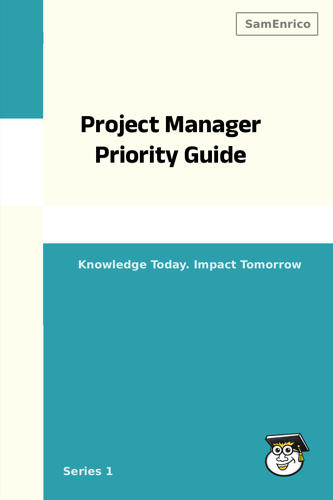
Project Manager Priority Guide eBook
Sort project tasks, risks, and issues using Eisenh
by Vick Asha
Sort project tasks, risks, and issues using Eisenhower matrix categories.
Formats
Free sample
Chapter 1: The Four Boxes--–- The email arrived at 9:14 AM. The subject line was in all caps: “URGENT – NEED IMMEDIATE RESPONSE.” It was from a stakeholder Maya barely knew, requesting data that would take three hours to compile. The deadline was “COB today.”Maya had been a project manager for eleven years. She held a PMP, an Agile certification, and a black belt in Six Sigma. Her resume was a wall of impressive acronyms.
And yet, at 3:47 that same afternoon, she found herself crying in a supply closet.The cause was not the email. The email was just a symptom. The real cause was death by a thousand paper cuts. Her engineering lead had just quit via Slack. Her sponsor was demanding a different “urgent” report that no one would actually read.
Her risk register hadn’t been updated in three weeks. And somewhere in the chaos, she had completely forgotten to approve a critical path purchase order—now threatening to delay the entire project by ten days.Maya was good at her job. Everyone said so. But “good” had started to feel like drowning in slow motion.She had become a master of urgency. A virtuoso of firefighting.
But somewhere along the way, she had lost the ability to distinguish between what was important and what was merely loud.This chapter is for Maya. And for every project manager who has ever stared at a to-do list with forty-seven items and felt their soul leave their body.The problem is not your work ethic. The problem is not your team. The problem is that you are using the wrong map.The Hidden Algorithm That Is Destroying Your Focus Most project managers believe they prioritize rationally. They believe they assess each task, risk, or issue on its merits and allocate time accordingly.They are wrong.What actually happens is something far less deliberate.
Your brain runs a hidden algorithm, developed over millions of years of evolution, that prioritizes threats and rewards in the present moment over those in the future. A sabertooth tiger in front of you gets your attention. A sabertooth tiger that might appear next week does not.This algorithm worked beautifully on the savanna. It works disastrously in project management.The result is the Mere-Urgency Effect—a cognitive bias that makes us favor tasks with tight deadlines regardless of their actual importance. A low-value email due in one hour feels more pressing than a high-value strategic plan due in two weeks.
A stakeholder who demands an immediate answer hijacks your attention more effectively than a silent risk that could derail the entire project next month.Every project manager suffers from this bias. The ones who succeed are not the ones who resist it through willpower alone. Willpower is finite and exhaustible. The ones who succeed are the ones who build external systems that compensate for the limitations of their own brains.This book is that system.The Map You Need (But Probably Don't Use)In 1954, President Dwight D. Eisenhower made an observation about his own decision-making.
He noted that not all urgent tasks were important, and not all important tasks were urgent. From this simple insight, a framework was born that has appeared in countless productivity books, time management seminars, and leadership training programs.The Eisenhower Matrix sorts everything that demands your attention into four boxes based on two questions:Is this important?Is this urgent?The four combinations create four distinct zones:Box 1: Important and Urgent → Do immediately Box 2: Important but Not Urgent → Schedule for later Box 3: Not Important but Urgent → Delegate or train Box 4: Not Important and Not Urgent → Delete This matrix is simple enough to draw on a napkin and powerful enough to run a presidency. But most project managers use it only for their to-do lists. They apply it to tasks and stop there.This is a mistake.A project manager does not manage only tasks. A project manager manages three fundamentally different types of work: tasks, risks, and issues.
Each has its own behavior, timing, and consequences. And all three can be prioritized using the same four boxes.Redefining the Four Boxes for Project Managers Let us rebuild the Eisenhower Matrix from the ground up—not for general productivity, but specifically for the work of managing projects.What “Important” Actually Means In the context of project management, “important” is not a feeling. It is not how much pressure you feel. It is not how loudly a stakeholder is yelling. It is a specific, measurable quality.A task, risk, or issue is important if it affects one or more of these five things:Return on investment (ROI).
Does this change the financial outcome of the project? A task that increases cost without adding value is important to avoid. A risk that threatens budget is important to mitigate.Strategic business goals. Does this align with what the organization has said matters most? A feature that customers are demanding is important.
A report the executive team uses to make decisions is important.The critical path. Does this affect the sequence of tasks that determines the earliest possible completion date? A delay on the critical path delays the entire project. Work that is not on the critical path has buffer time.Stakeholder value. Does this affect the satisfaction or trust of people who have power over project outcomes?
This includes customers, executives, regulators, and key team members.Legal or regulatory compliance. Is this required by law or regulation? If yes, it is important. There is no gray area.If an item touches none of these five things, it is not important. This is a ruthlessly practical definition.
It gives you permission to say “no” to work that does not move the needle.What “Urgent” Actually Means Urgency means time sensitivity. Specifically, an item is urgent if it requires attention within a time window that, if missed, would cause negative consequences.But here is where most project managers get into trouble: not all urgency is real.Real urgency comes from external, objective constraints. A legal filing deadline tomorrow is real. A server outage that is losing revenue is real. A supplier who will cancel at 5 PM is real.Manufactured urgency comes from someone else’s impatience, anxiety, or poor planning.
A stakeholder who wants an answer by end of day because they are behind schedule is manufactured. An email labeled “URGENT” that contains nothing time-sensitive is manufactured. A request for a meeting “as soon as possible” that has no actual deadline is manufactured.Distinguishing between real and manufactured urgency is one of the most important skills you will develop in this book. Chapter 6 will give you the exact tools and scripts for doing this in real time.The Four Boxes, Redefined for PMs With these definitions in place, let us walk through each box and fill it with project-relevant examples.Box 1: DO NOW (Important AND Urgent)These are the true emergencies of project management. They demand your immediate attention and they actually matter.Examples include:A critical path activity that is blocked and delaying the entire project A compliance deadline that will incur fines or legal risk if missed A major scope violation discovered during testing An active production outage affecting…
This is the end of the free sample. Get the eBook to keep going. Buy now
About this book
Details
- Author
- Vick Asha
- Publisher
- SamEnrico
- Language
- English
- Genre
- Non-Fiction, Self-Help, Project Management, Tasks
- Released
- 2026-06-07
- Pages (approx.)
- 154
- Available as
- eBook, Audiobook

Read better in the ZLOADR app
Your eBooks on your phone or tablet. Sign in with your SamEnrico account and start reading.
More by Vick Asha
 HGH and Insulin Like EffectsVick Asha$11.99
 Immigrant Beauty Brand FoundersVick Asha$11.99
 DoorDash Delivery Time OptimizationVick Asha$11.99
 AI Cross Curricular PlannerVick Asha$11.99
 Anansi Weaves the Sky: The Spider Who Outwitted the GodsVick Asha$11.99
 Understanding Meier–rotschild SyndromeVick Asha$17.99
 How to Start a Hobby in RabbitsVick Asha$11.99
 Asana Vs Trello Decision GuideVick Asha$12.99
 Data Engineering Skills GuideVick Asha$12.99
 Pyroxene (Group of Silicate Minerals) MiningVick Asha$11.99
You may also like
 Hong Kong Handover 1997Dunn Johnnie$11.99
 Zumba For Postnatal Recovery CourseNeal Christian$11.99
 Zumba for BeginnersLadner Nikia$11.99
 YouTube Comment Mining GuideHumes Pandora$12.99
 Worry Box MeditationCarlin Rudy$11.99
 Workplace Stress MeditationNguyen Lynn$11.99
 Workplace Stress and Sleep RepairHawley Ivory$11.99
 Workplace Perfectionism CureDelaney Jeffry$11.99
 Workplace Injustice Anger GuideWallen Isabelle$11.99
 Work Addiction and Burnout LinkGreenwood Ester$11.99
 Women in Yoga and WellnessBeattie Galina$11.99
 Women in Stand Up ComedyChun Evangeline$11.99