
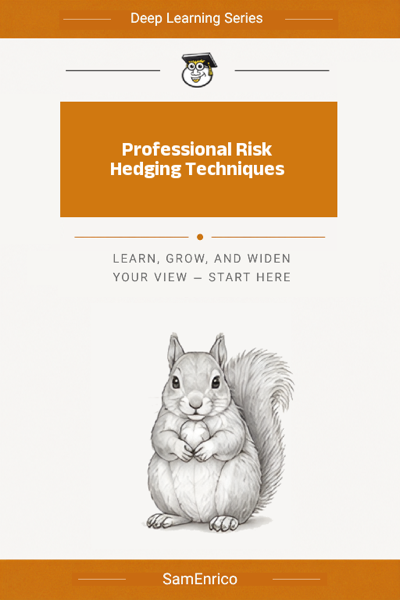
Professional Risk Hedging Techniques eBook
A Coursebook on Professional Risk Hedging Techniqu
A Coursebook on Professional Risk Hedging Techniques
Formats
Free sample
Chapter 1: The Day Risk Woke Up...--Let me tell you about August 15, 1971. On that day, President Richard Nixon announced that the United States would suspend the convertibility of the dollar into gold. The Bretton Woods system, which had anchored global exchange rates since the end of World War II, collapsed in a single speech. Currencies that had been fixed against the dollar for decades suddenly began floating. The Japanese yen appreciated 15 percent in six months.
The British pound fell 10 percent. The German Deutsche mark soared. Corporate treasurers who had never thought about currency risk woke up one morning to find that their European profits could vanish overnight. Hedging departments that did not exist on August 14 were created by September. Companies that did not adapt went bankrupt.That was the day risk woke up.
Not the day risk was invented—risk has always existed. But August 15, 1971, was the day that professional risk hedging became a necessity rather than an academic curiosity. Before that day, most multinational corporations could ignore currency fluctuations. After that day, ignoring currency risk was a form of slow suicide.This chapter is about understanding what risk really is—far beyond the simple definition of volatility that appears in introductory finance textbooks. You will learn the complete taxonomy of risks that professional hedgers face every day.
You will understand why hedging does not eliminate risk but transforms it from catastrophic uncertainty into manageable, budgetable cost. You will see real-world case studies of companies that destroyed themselves by failing to hedge, and companies that saved themselves by hedging correctly. And you will learn the critical distinction between hedging and speculation—a line that is far easier to cross than most professionals realize.The Bank That Forgot to Look at Its Trades Let us start with a cautionary tale. Barings Bank was the oldest merchant bank in England. It had financed the Louisiana Purchase and the Napoleonic Wars.
In 1995, it was brought down by a single trader in Singapore—Nick Leeson—who lost $1.4 billion speculating on the Japanese stock market. Leeson was not supposed to be speculating. He was supposed to be arbitraging between the Singapore and Osaka futures exchanges, a hedged position that theoretically could not lose money. But he took his eyes off the hedge. He started taking proprietary positions without authorization.
He hid his losses in error account 88888. And when the Kobe earthquake hit Japan in January 1995, the market moved against him so violently that he could not hide the losses any longer. Barings collapsed. A 233-year-old institution was destroyed by one man who forgot the difference between hedging and speculation.Here is the distinction that Leeson blurred: A hedge is a position that reduces or eliminates an existing risk. You own a portfolio of Japanese stocks?
You sell Nikkei futures. You have a receivable in British pounds? You sell pound futures. The hedge is directly tied to an exposure. If the exposure changes, the hedge changes.
They are two sides of the same coin.Speculation is a position taken without an offsetting exposure. You have no Japanese stocks, but you sell Nikkei futures because you think the market will fall. That is a bet, not a hedge. There is nothing inherently wrong with speculation—it provides liquidity to markets and profit opportunities to risk-takers. But speculation and hedging must be kept in separate accounts, with separate risk limits, separate reporting lines, and separate mental compartments.
Barings collapsed because those barriers were breached.The Six Faces of Risk Professional risk managers recognize at least six distinct categories of risk. Understanding them is the first step toward hedging them.Market risk is the risk that prices move against you. This is the risk most people think of when they hear the word "risk." It includes equity risk (stock prices falling), interest rate risk (bond prices falling when rates rise), currency risk (exchange rates moving against an overseas receivable or payable), and commodity risk (oil prices rising for an airline, corn prices falling for a farmer). Market risk is measurable, hedgeable, and the primary focus of this book.Credit risk is the risk that your counterparty defaults. You have a derivatives contract with a bank, and the bank goes bankrupt.
You have sold goods to a customer on 90-day terms, and the customer files for bankruptcy on day 89. You have invested in corporate bonds, and the issuer defaults. Credit risk can be hedged through credit default swaps (CDS) or simply through diversification, but it cannot be eliminated entirely because counterparty risk is embedded in almost every financial transaction.Liquidity risk is the risk that you cannot execute a transaction without moving the price against yourself. You own a large block of an illiquid stock. You want to sell it, but the market is thin.
Every share you sell pushes the price lower. You need to hedge a currency exposure, but the forward market for that currency evaporates during a crisis. Liquidity risk is the silent killer—it is invisible in normal markets but becomes catastrophic during stress events.Operational risk is the risk of internal failure. Your trade capture system breaks down, and you do not know your actual exposure. Your confirmation process is slow, and a trade goes unconfirmed for weeks, leaving you with uncollateralized counterparty risk.
Your employee makes an unauthorized trade—like Nick Leeson. Your settlement system fails, and you miss a margin call. Operational risk is often underestimated because it does not show up in market price data, but it causes more losses than market risk in many organizations.Legal risk is the risk that your contracts are not enforceable. You have a swap with a counterparty, but the ISDA Master Agreement was poorly drafted. You have a hedge that qualifies for hedge accounting under IFRS 9, but your documentation is incomplete.
You are transacting across jurisdictions, and close-out netting is not enforceable in certain countries. Legal risk is the domain of lawyers and documentation specialists—but it is your responsibility to ensure that the legal infrastructure is in place before you trade.Systemic risk is the risk that the entire system fails. In 2008, Lehman Brothers failed, and the entire credit default swap market froze. Counterparties did not know who owed what to whom. Liquidity evaporated.
The system fed on itself. You cannot hedge systemic risk through derivatives because there is no counterparty when the system fails. You can only manage it through capital buffers, diversification across uncorrelated strategies, and avoiding excessive leverage.Climate risk is an emerging category that deserves attention. Physical risk includes damage to assets from extreme weather events—hurricanes, floods, wildfires, droughts. Transition risk includes regulatory changes as economies decarbonize—carbon taxes, fossil fuel bans, new disclosure requirements.
Climate risk is difficult to hedge because the timing and magnitude are highly uncertain, but some instruments exist: catastrophe bonds for physical risk, carbon credits and emissions allowances for transition risk.The Cost of Doing Nothing Why bother hedging? Because the cost of being unhedged can be devastating. Consider the airline industry. Jet fuel is typically an airline's second-largest expense after labor. Airlines that hedge fuel costs lock in their operating costs and protect their earnings.
Airlines that do not hedge expose themselves to oil price volatility.In 2008, oil prices spiked to 147perbarrel.Southwest Airlineshadhedgedaggressively,lockinginfuelattheequivalentof147 per barrel.…
This is the end of the free sample. Get the eBook to keep going. Buy now
About this book
Details
- Author
- Helton Beckie
- Publisher
- SamEnrico
- Language
- English
- Genre
- Non-Fiction, Informative, Educational
- Released
- 2026-05-11
- Pages (approx.)
- 154
- Available as
- eBook, Audiobook

Read better in the ZLOADR app
Your eBooks on your phone or tablet. Sign in with your SamEnrico account and start reading.
More by Helton Beckie
 Potassium Blood Pressure Control GuideHelton Beckie$11.99
 OCD Meditation GuideHelton Beckie$11.99
 Baby Tech Capital GuideHelton Beckie$11.99
 Winter Cabin Cozy VisualizationHelton Beckie$11.99
 MBSR for PostpartumHelton Beckie$11.99
 Parts Negotiation ScriptingHelton Beckie$11.99
 Time Blocking For ProcrastinatorsHelton Beckie$11.99
 The Social Worker Stress HandbookHelton Beckie$11.99
 Soft Start Up PracticeHelton Beckie$11.99
 The Dark Money Mirage: How a Shadowy Donor Reshaped an ElectionHelton Beckie$11.99
 The Medieval Star Chart: How a Forgotten Monk Mapped the CosmosHelton Beckie$11.99
 The Maroon Navigators: How Enslaved Africans Charted Freedom Across the CaribbeanHelton Beckie$11.99