
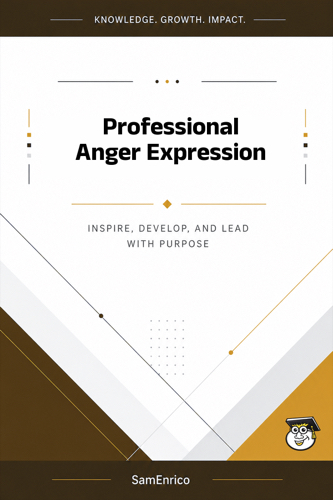
Non-FictionSelf-HelpAssertivenessCommunication
Professional Anger Expression eBook
Communicate frustration assertively without aggres
by Ojeda Lenard
Communicate frustration assertively without aggression, sarcasm, or shutdown.
Formats
Free sample
Chapter 1: The Iceberg Lies--You have been angry at work this week. Not the hot, cinematic anger of a movie meltdown—no standing on desks or throwing coffee mugs. Something quieter. Something worse. A knot in your stomach during a meeting where your idea was stolen.
A sharp text you deleted before sending. A sarcastic comment that landed like a paper cut—small, but it stung for hours. Or perhaps nothing at all. Perhaps you swallowed it. Smiled.
Said “no worries” while your jaw stayed clenched for the rest of the afternoon.That is the anger this book is about. Not the rare, explosive rage that makes the news. The daily, grinding, professional anger that you have been taught to hide, reframe, or apologize for. And here is the first lie this chapter will dismantle: that anger does not belong at work.The corporate world has sold you a dangerous fantasy—that professionalism means emotional flatlining. That good employees are never frustrated.
That great leaders have transcended irritation. This fantasy has a name: toxic positivity. And it is making you sick, quiet, and less effective than you could be.This chapter will do three things. First, it will redefine anger entirely—from a problem to be managed into a signal to be read. Second, it will expose the hidden costs of swallowing your anger, costs that go far beyond a bad mood.
Third, it will give you a new framework for deciding when to speak and when to stay silent, because not all anger deserves expression. Some anger is data. Some anger is noise. This chapter will teach you the difference.Let us start with the iceberg.The Iceberg Principle: What You See Is Not What You Feel Imagine an iceberg floating in cold water. The tip, visible above the surface, is what everyone sees: a raised voice, a terse email, a slammed laptop, or the opposite—a frozen smile and a tight “I’m fine.” That visible tip is what we call anger.
But below the waterline, hidden from view, lies the massive structure that supports it. That is where the real story lives.Below the surface of most workplace anger, you will find one or more of these deeper emotions:Hurt. Someone dismissed your contribution in a meeting. The anger you feel is actually hurt—you wanted to be seen, and you were not.Fear. A deadline changed unexpectedly.
The anger is fear—you are afraid of failing, of looking incompetent, of letting your team down.Frustration. You have explained the same process three times, and the other person still does not get it. The anger is frustration—your effort is not producing results.Boundary violation. A colleague took credit for your work. A manager assigned a task outside your role without asking.
The anger is clean—someone crossed a line, and your system is sounding an alarm.Powerlessness. You have been excluded from decisions that affect your work. The anger is powerlessness—you care about the outcome but have no control over it.Here is the crucial insight: the visible anger is not the enemy. It is the messenger. When you suppress anger without reading the message, you are shooting the messenger and ignoring the invasion.
The PAE model—Professional Anger Expression—begins with this simple shift in perspective: anger is data, not disaster.A project manager named Elena learned this the hard way. For two years, she swallowed her frustration with a vendor who consistently delivered late. She told herself she was being professional. She told herself it was not worth the conflict. Then one day, during a routine status call, the vendor made a joke about “Elena’s famous last-minute panics.” She exploded.
She did not yell, but her voice went cold and sharp. The call ended awkwardly. The relationship never recovered. Later, in reflection, she realized her anger was not about the joke. It was about two years of violated boundaries—missed deadlines, broken promises, unreturned emails.
The joke was just the iceberg tip. The real issue had been underwater the entire time.Elena’s story is not unusual. It is the default pattern for most professionals: suppress, suppress, suppress, then explode over something small. The PAE model replaces that pattern with a new one: notice, investigate, choose.When anger arises, you will learn to ask two questions, and two questions only:What boundary is being crossed?What goal is being blocked?These two questions are the PAE Shift. They transform anger from a reaction into an investigation.
Not “Why is this person so terrible?” Not “Why does this always happen to me?” Those questions lead nowhere. The PAE Shift leads to clarity. A boundary is being crossed. A goal is being blocked. Those are solvable problems.The Hidden Costs of Suppression: What Swallowing Anger Costs You You have been told that keeping your anger inside is the mature choice.
The professional choice. The safe choice. This is wrong. Suppression has measurable, documented costs that accumulate like compound interest on a very bad loan.Physical Costs Chronic anger suppression is not an emotional problem. It is a medical problem.
Studies have linked long-term suppression to hypertension, insomnia, weakened immune response, chronic fatigue, and even cardiovascular disease. When you swallow anger, your body does not forget. Your nervous system stays in a low-grade fight-or-flight state. Cortisol and adrenaline continue to circulate. Over months and years, this wears down your body the way a dripping faucet wears down stone.Consider the physical symptoms you may have normalized: tension headaches by mid-afternoon, a tight chest during certain meetings, grinding your teeth at night, digestive issues before performance reviews, exhaustion after days when you “held it together.” These are not unrelated health quirks.
They are the body’s ledger of unpaid emotional debt.Relational Costs When you suppress anger, you do not become neutral. You become unpredictable. The person who says “I’m fine” while clearly not fine erodes trust faster than someone who simply says “I’m frustrated.” Why? Because the other person knows something is wrong but cannot read your mind. They fill the gap with their own stories: “They are angry at me.” “They are passive-aggressive.” “They are going to explode later.”Suppression also leaks.
It comes out sideways as sarcasm, as pointed silence, as “forgetting” to copy someone on an email, as agreeing to a deadline and then quietly missing it. These behaviors are often called passive-aggressive. That term is not quite right. A better term is suppressed aggression—anger that has nowhere to go, so it dribbles out in ways that damage relationships without the satisfaction of direct expression.Professional Costs The person who never expresses anger is not seen as serene. They are seen as a pushover.
Research on workplace perceptions shows that professionals who never push back are given more work, fewer resources, and less credit. They are promoted less often, not because they lack competence, but because they lack presence. Leadership is not just about getting things right. It is about setting boundaries, protecting your team, and saying no when necessary. You cannot do any of those things if you cannot express frustration cleanly.The suppressed professional is also passed over for…
This is the end of the free sample. Get the eBook to keep going. Buy now
About this book
Details
- Author
- Ojeda Lenard
- Publisher
- SamEnrico
- Language
- English
- Genre
- Non-Fiction, Self-Help, Assertiveness, Communication
- Released
- 2026-06-09
- Pages (approx.)
- 147
- Available as
- eBook, Audiobook

Read better in the ZLOADR app
Your eBooks on your phone or tablet. Sign in with your SamEnrico account and start reading.
More by Ojeda Lenard
 Building Self Esteem in GirlsOjeda Lenard$11.99
 Ayurvedic Sanskrit Glossary GuideOjeda Lenard$11.99
 The Dutch Tech Talent Attraction ForecastOjeda Lenard$11.99
 Teen Self Esteem and DramaOjeda Lenard$11.99
 The Clown Killer of California: The DNA Breakthrough That Changed ForensicsOjeda Lenard$11.99
 Workflow Optimization AI GuideOjeda Lenard$12.99
 Brazil Dropshipping Abandoned Cart RecoveryOjeda Lenard$12.99
 How to Start a Building Materials (commission Agent) Business (Beginners Guide)Ojeda Lenard$11.99
 Warehouse Manager (systems)Ojeda Lenard$11.99
 Understanding Microcephaly CardiomyopathyOjeda Lenard$17.99
You may also like
 Hong Kong Handover 1997Dunn Johnnie$11.99
 Zumba For Postnatal Recovery CourseNeal Christian$11.99
 Zumba for BeginnersLadner Nikia$11.99
 YouTube Comment Mining GuideHumes Pandora$12.99
 Worry Box MeditationCarlin Rudy$11.99
 Workplace Stress MeditationNguyen Lynn$11.99
 Workplace Stress and Sleep RepairHawley Ivory$11.99
 Workplace Perfectionism CureDelaney Jeffry$11.99
 Workplace Injustice Anger GuideWallen Isabelle$11.99
 Work Addiction and Burnout LinkGreenwood Ester$11.99
 Women in Yoga and WellnessBeattie Galina$11.99
 Women in Stand Up ComedyChun Evangeline$11.99