
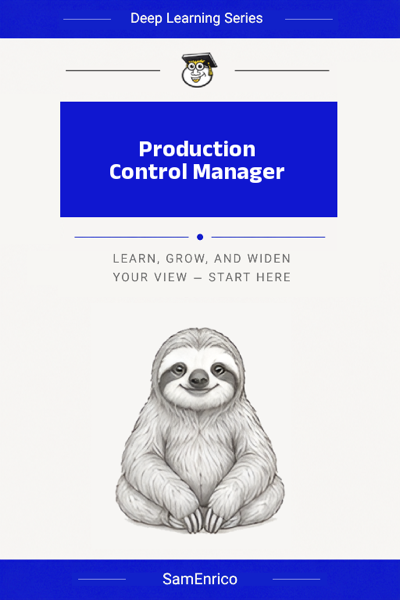
Non-FictionInformativeEducational
Production Control Manager eBook
A Coursebook on Production Control Manager
A Coursebook on Production Control Manager
Formats
Free sample
Chapter 1: The Monday Morning Massacre...--The conference room smelled of stale coffee and desperation. It was 7:45 AM on a Monday, and thirty-seven rush orders had already landed in the production control inbox since midnight. The CEO wanted answers. The sales VP wanted blood. And the production control manager—a thirty-year veteran named Diane who had seen three recessions and six ERP implementations—sat at the end of the table, staring at a printout that said, in red capital letters, that 42 percent of last week’s shipments would be late.This is not a hypothetical scene.
It plays out in factories across the world every single Monday morning. The details change—the industry, the product, the names on the org chart—but the underlying dynamic is always the same. Someone, somewhere, promised customers something the factory could not deliver. The production control manager is the one left holding the broken schedule.If you are reading this book, chances are you have lived that Monday morning. You might be a newly promoted production control manager wondering why your predecessors all looked exhausted.
You might be a plant manager trying to understand why your on-time delivery numbers never improve no matter how many software systems you install. Or you might be an ambitious production planner who has realized that the path to senior leadership runs directly through this misunderstood, underappreciated, and absolutely critical role.This chapter will do three things. First, it will redefine what the production control manager actually does—because most companies, including the one you probably work for, have gotten it wrong. Second, it will introduce the three non-negotiable metrics that separate successful production control managers from the ones who burn out and leave the profession. Third, it will confront the single most difficult reality of the job: you are the adult in the room, the only person whose job it is to say “no” when sales overpromises and executives underinvest.
If you cannot learn to say no—politely, professionally, and with data to back you up—you will fail. Not maybe. Not eventually. You will fail, and your factory will fail with you.The Three Jobs You Didn't Know You Had Ask ten manufacturing executives what a production control manager does, and you will get eleven answers. The role is famously misunderstood, which is why so many companies staff it with well-intentioned but underprepared people and then wonder why their supply chains are chaotic.Let us clear up the confusion right now.
The production control manager performs three distinct functions, and you must master all three. Neglect any one, and the other two will collapse like a three-legged stool with a missing leg.Function One: Production Planning Production planning answers the question: What should we make, and how much, over the next several months?This is a strategic function. It requires looking at sales forecasts, historical demand patterns, seasonal fluctuations, and promotional calendars. It requires understanding your factory’s capacity—not the theoretical capacity printed on the equipment specification sheets, but the real-world capacity after accounting for changeovers, maintenance, breaks, and the inevitable variability that Chapter 2 will explore in mathematical detail.Production planning happens at the aggregate level. You are not planning individual customer orders yet.
You are planning product families, rough volumes, and broad time horizons. The output of production planning is an aggregate plan—a statement that says something like: “In March, we will produce 10,000 units of the A-series product family, using a combination of regular time, overtime, and inventory drawdown.”Most failed production control managers never truly master planning. They jump straight to scheduling—the sexy, urgent, firefighting work—and leave planning as an afterthought. This is a fatal error. Planning without scheduling is useless.
But scheduling without planning is chaos.Function Two: Production Scheduling Production scheduling answers the question: In what sequence should we make these specific customer orders, on which machines, and starting when?This is the tactical function. It takes the aggregate plan from function one and disaggregates it into specific jobs, specific work centers, and specific start and end times. Scheduling is where the rubber meets the road. It is where you decide that Customer A’s order of 500 widgets will run on Press 3 starting at 2:00 PM on Tuesday, followed by Customer B’s order of 300 widgets on the same press after a forty-five-minute changeover.Scheduling is also where most production control systems break down. The reason is simple: scheduling is computationally hard.
If you have ten jobs and three machines, there are millions of possible sequences. If you have one hundred jobs and twenty machines—a modest factory by almost any standard—the number of possible sequences exceeds the number of atoms in the observable universe. No human can optimize that. No current computer can either, at least not in real time.This means scheduling is not about finding the perfect sequence. It is about finding a good enough sequence, fast enough, and then having the discipline to execute it.
Chapter 8 will give you the rules of thumb—the dispatching rules and heuristics—that separate functional schedules from fantasy schedules.Function Three: Production Control Production control answers the question: Are we doing what we said we would do, and if not, what are we going to do about it?This is the operational function. It happens in real time, on the shop floor, often in noise and heat and urgency. Production control is the art of comparing the schedule to reality and making adjustments. A machine breaks. A supplier delivers late.
A quality defect sends a batch back to rework. An operator calls in sick. These are not exceptions. These are the normal conditions of factory life.Production control is the function that keeps the system running despite these disruptions. It is expediting (but done intelligently, not frantically).
It is rescheduling (but with discipline, not panic). It is communicating (but honestly, not hopefully).The production control manager who masters only this function—the firefighter, the expediter, the person who runs around with a red pen and a stressed expression—will never rise above chaos. The production control manager who masters planning and scheduling as well becomes something else entirely. That manager becomes a flow architect.From Order Taker to Flow Architect There is a moment in every production control manager’s career when they realize that their job, as traditionally defined, is impossible. The moment usually comes after a series of rush orders, each marked “HOT” in the ERP system, each demanding to jump to the front of the line.
The manager complies. They push the orders through. They work late. They beg, borrow, and steal capacity. And then, three weeks later, they discover that every order they bumped is now late, every customer is angry, and the on-time delivery metric has collapsed.The manager in this story is an order taker.
They receive requests—from sales, from executives, from customers—and they execute them. They say yes. They push. They react. They are always behind, always catching up, always exhausted.The flow architect does something different.
The flow architect designs the system first. They establish rules. They set WIP caps. They create time fences. They calculate the capacity of the…
This is the end of the free sample. Get the eBook to keep going. Buy now
About this book
Details
- Author
- Gurley Mackenzie
- Publisher
- SamEnrico
- Language
- English
- Genre
- Non-Fiction, Informative, Educational
- Released
- 2026-06-02
- Pages (approx.)
- 146
- Available as
- eBook, Audiobook

Read better in the ZLOADR app
Your eBooks on your phone or tablet. Sign in with your SamEnrico account and start reading.
More by Gurley Mackenzie
 Calisthenics Cool Down GuideGurley Mackenzie$11.99
 Work Addiction Cognitive Behavioral GuideGurley Mackenzie$11.99
 Indian STEM Migration ForecastGurley Mackenzie$11.99
 Gaming Withdrawal SymptomsGurley Mackenzie$11.99
 Physical Sensations Anger ForecasterGurley Mackenzie$11.99
 The Wave Equation: Solving the Pacific's Mathematical MysteryGurley Mackenzie$11.99
 Breaking the Silence: The Unlikely Redemption of Lance ArmstrongGurley Mackenzie$11.99
 Understanding Chromosome 6, Monosomy 6qGurley Mackenzie$17.99
 How to Start a Constructional Engineering Business (Beginners Guide)Gurley Mackenzie$11.99
 Healthcare Buyer IdentificationGurley Mackenzie$12.99
 Phone Call Validation MethodGurley Mackenzie$12.99
You may also like
 Hong Kong Handover 1997Dunn Johnnie$11.99
 Zumba For Postnatal Recovery CourseNeal Christian$11.99
 Zumba for BeginnersLadner Nikia$11.99
 YouTube Comment Mining GuideHumes Pandora$12.99
 Worry Box MeditationCarlin Rudy$11.99
 Workplace Stress MeditationNguyen Lynn$11.99
 Workplace Stress and Sleep RepairHawley Ivory$11.99
 Workplace Perfectionism CureDelaney Jeffry$11.99
 Workplace Injustice Anger GuideWallen Isabelle$11.99
 Work Addiction and Burnout LinkGreenwood Ester$11.99
 Women in Yoga and WellnessBeattie Galina$11.99
 Women in Stand Up ComedyChun Evangeline$11.99