
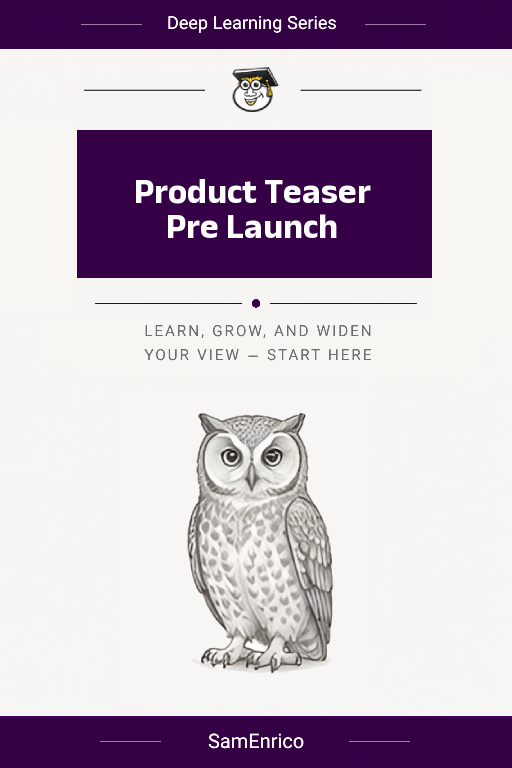
Non-FictionStartup GuideWaitlist Strategy
Product Teaser Pre Launch eBook
Use product teasers to build pre-launch buzz. Snea
Use product teasers to build pre-launch buzz. Sneak peeks and behind-the-scenes content.
Formats
Free sample
Chapter 1: The Before-Moment--–- The email arrived at 11:47 PM on a Tuesday. Sarah, a first-time founder with a prototype that had cost her $47,000 and eighteen months of her life, had finally done it. She had built the perfect product. The website was flawless. The “Buy Now” button was polished.
The launch email was scheduled for 9:00 AM Wednesday.At 9:01 AM, she refreshed her analytics dashboard.Three sales.By 5:00 PM, she had refunded two of them.Her product was excellent. Her price was fair. Her website was beautiful. And she had failed because she had made the same mistake that 99% of creators make: she had shown everything too soon. The “Buy Now” button was not a victory lap.
It was a tombstone.This book exists because Sarah’s story is not an exception. It is the rule. And the rule can be broken.The Most Valuable Moment Does Not Yet Exist Let us conduct a simple mental experiment. Think of the last product you purchased that truly excited you—not a utilitarian buy like trash bags or toothpaste, but something you anticipated, something you tracked via shipping notifications, something you unboxed with genuine pleasure.Now answer honestly: Was the peak of your excitement the moment you held the product in your hands? Or was it the day before it arrived, when you knew it was coming but had not yet seen it?For most people, the answer is the day before.
The anticipation was sweeter than the arrival. The wanting was more powerful than the having.This is not a quirk of human psychology. It is the architecture of the human brain.Neuroscientists have scanned the brains of subjects anticipating a reward—money, food, a desired object—and compared those scans to brain activity during the actual receipt of the reward. The results are unambiguous: the anticipation of a reward lights up the caudate nucleus and the nucleus accumbens, regions dense with dopamine receptors, more intensely and more consistently than the reward itself. Wanting is neurologically distinct from liking.
And wanting is, in many ways, stronger.This is the central argument of this book: The most valuable moment in a product’s lifecycle is the moment before it exists.Once your product is available for purchase, it enters a crowded, noisy, brutal marketplace. It will be compared, discounted, reviewed, criticized, and—if you are lucky—bought. But before it exists, it lives only in the imagination of your audience. And the imagination is where desire burns hottest.The product teaser pre-launch is not a marketing tactic. It is a psychological lever.
It is the art of extending the “before-moment” for days, weeks, or months, turning what could have been a single day of mediocre sales into a sustained crescendo of anticipation that culminates in a launch that feels less like a transaction and more like an event.The $100 Million Mistake: Why Most Launches Fail Before They Start Before we examine what works, we must understand what fails. And what fails, overwhelmingly, is the assumption that a good product sells itself.In 2017, a well-funded consumer electronics startup raised $12 million based on a prototype that had generated significant buzz at trade shows. The product was innovative. The team was stacked with engineers from Apple and Google. The press had written glowing previews.
On launch day, their website crashed from traffic within the first hour—a problem most founders would kill for.Then the crash was resolved. And the orders did not come.Seventy-two hours after launch, they had sold fewer than 1,000 units. The buzz had translated into clicks, not purchases. The company folded eighteen months later, and the post-mortem revealed a devastating truth: they had shown too much, too early. Every feature had been demoed at trade shows.
Every spec had been leaked to journalists. Every use case had been discussed on podcasts. By the time the “Buy Now” button appeared, there was nothing left to discover.This is the Disclosure Death Spiral:You are excited about your product.You share everything because you are proud.Your audience becomes informed but not invested.Launch day arrives with no mystery remaining.Clicks do not convert because there is no emotional gap between “seeing” and “having.”You blame the product, the price, or the market.The product was not the problem. The timing of the reveal was the problem.The Da Vinci Code: A Case Study in Artificial Mystery To understand how to extend the before-moment, we must study the greatest pre-launch campaign in publishing history—a campaign that was not recognized as such until years later.In 2003, Doubleday published Dan Brown’s The Da Vinci Code. The book would go on to sell over 80 million copies, becoming one of the best-selling novels of all time.
But the story of its success does not begin on bookstore shelves. It begins eighteen months earlier, with a mundane decision about advanced reader copies.Most publishers treat Advanced Reader Copies (ARCs) as functional objects: plain covers, basic typesetting, sent to a few hundred reviewers. Doubleday did something different. They printed 10,000 ARCs of The Da Vinci Code with no cover image and no author biography. The front of each ARC was nearly blank.
The back contained only a single sentence: “This is not a final cover. The final book will contain additional material not found in this ARC.”To booksellers and reviewers, these ARCs looked like leaked documents. They looked like secrets. And secrets, by their nature, demand to be shared.The lack of a cover image meant that no two people could describe the book the same way. The lack of an author biography meant that the author remained a mysterious figure.
Reviewers began speculating online: Who was Dan Brown? What was the “additional material”? Had they been given an incomplete manuscript on purpose?They had. The “additional material” was a single page of puzzles and codes—a postscript that had been removed from the ARC and added only to the final printed book. Doubleday had intentionally created a version of the product that was incomplete, then distributed it widely.
The result was not frustration. It was obsession.Booksellers who had received ARCs began calling their customers to pre-order the “real” book. Reviewers who had published early notices updated them with speculation about the missing material. The conversation was not about whether the book was good. It was about what the book was hiding.The Da Vinci Code spent over 150 weeks on the New York Times bestseller list.
And it succeeded not because of its marketing budget—though that helped—but because Doubleday understood a principle that most marketers reject: Incompleteness is a feature, not a bug.The Brown Paper Wrapper: A 19th-Century Lesson in Modern Marketing The Da Vinci Code strategy was not new. It was a digital-era adaptation of a tactic that is nearly two centuries old.In the mid-1800s, books were sold primarily through traveling salesmen who carried sample copies in their wagons. These sample copies were often bound in plain brown paper wrappers with no title, no author name, and no price. The salesman would show the brown paper wrapper to a potential buyer and say, “I am not permitted to show you what is inside yet.”The buyer, of…
This is the end of the free sample. Get the eBook to keep going. Buy now
About this book
Details
- Author
- Rutledge Minh
- Publisher
- SamEnrico
- Language
- English
- Genre
- Non-Fiction, Startup Guide, Waitlist Strategy
- Released
- 2026-05-29
- Pages (approx.)
- 134
- Available as
- eBook, Audiobook

Read better in the ZLOADR app
Your eBooks on your phone or tablet. Sign in with your SamEnrico account and start reading.
More by Rutledge Minh
 Humid Climate Sleep MeditationRutledge Minh$11.99
 Mindful Parenting HandbookRutledge Minh$11.99
 Widowhood Reconnection GuideRutledge Minh$11.99
 Assertive Requests That Get ResultsRutledge Minh$11.99
 The Writer's Daily Ritual GuideRutledge Minh$11.99
 The Marauders of the Atlantic: Portugal’s Golden FleetRutledge Minh$11.99
 Assistant Banquet ManagerRutledge Minh$11.99
 Interview Talking About MOOCsRutledge Minh$12.99
 Learn to Play the ArghulRutledge Minh$11.99
 How to Start a Phonetic Printing Business (Beginners Guide)Rutledge Minh$11.99
You may also like
 Hong Kong Handover 1997Dunn Johnnie$11.99
 Zumba For Postnatal Recovery CourseNeal Christian$11.99
 Zumba for BeginnersLadner Nikia$11.99
 YouTube Comment Mining GuideHumes Pandora$12.99
 Worry Box MeditationCarlin Rudy$11.99
 Workplace Stress MeditationNguyen Lynn$11.99
 Workplace Stress and Sleep RepairHawley Ivory$11.99
 Workplace Perfectionism CureDelaney Jeffry$11.99
 Workplace Injustice Anger GuideWallen Isabelle$11.99
 Work Addiction and Burnout LinkGreenwood Ester$11.99
 Women in Yoga and WellnessBeattie Galina$11.99
 Women in Stand Up ComedyChun Evangeline$11.99