
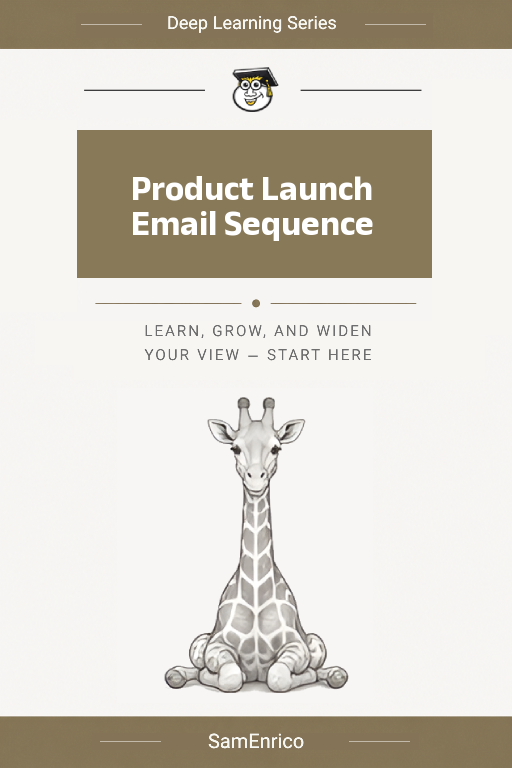
Non-FictionFirst 30 DaysEmail Sequences
Product Launch Email Sequence eBook
Write 5 emails for announcement, teaser, launch, s
Write 5 emails for announcement, teaser, launch, scarcity, and last chance in 2 hours.
Formats
Free sample
Chapter 1: The 0.16% Graveyard--–- The email sent at 9:02 AM on a Tuesday. The founder had spent three months building the product, two weeks crafting the perfect launch page, and one hour writing what she believed was the greatest sales email of her career. She clicked send. Then she waited.The first 10 minutes brought a trickle of opens. By the 30-minute mark, the open rate had climbed to 38%, which seemed promising.
By the end of the day, the stats were final: 847 emails delivered, 321 opened, 12 clicks to the checkout page, and 3 purchases. Total revenue: $147. Total time invested in the product: 3 months. The math was brutal.That founder was not a beginner. She had read the books, attended the webinars, and followed the "gurus." She did exactly what everyone told her to do: build an email list, create a great product, and send a single announcement when it was ready.
And it failed. Not because her product was bad. Not because her list was too small. Not because her price was wrong. It failed because she walked into the 0.16% Graveyard—the vast, silent cemetery where 99.84% of single-email launches go to die.This chapter is the autopsy of that graveyard.
You will learn why a single "We're live!" email is statistically the worst way to launch a product, why even massive email lists fail when sent alone, and why the shift from announcing to orchestrating is the single most important change you will ever make to your business.The Anatomy of a Failed Launch Let us begin with the data, because the data does not lie. Between 2023 and 2025, the major email service providers—Convert Kit, Mailchimp, Klaviyo, and Active Campaign—aggregated anonymized performance metrics from over 47 million commercial launch emails. The sample included everything from solopreneur product launches to enterprise software rollouts. The results were compiled into a benchmark report that should terrify anyone still using the single-email launch model.The median conversion rate for a single "We're live!" email was 0.16%. Not 1.6%.
Not 16%. Zero point one six percent. For every 10,000 subscribers on your list, a single email will generate, on average, 16 sales. For a list of 1,000 subscribers, you can expect 1.6 sales—meaning most launches will produce either 1 or 2 purchases. For a list of 500 subscribers, the expected value is 0.8 sales, meaning more than half of all launches will produce zero revenue.These numbers are not outliers.
They are the median. Half of all single-email launches performed worse than this. Consider what that means for the average entrepreneur spending months developing a product: a coin flip, at best, between a handful of sales and complete silence.The same benchmark report analyzed 5-email sequences using the same products, same prices, same lists, and the same senders. The median conversion rate for the 5-email sequence was 2.11%—a 13.2 times improvement. That is not a small optimization.
That is the difference between bankruptcy and a sustainable business.But raw numbers only tell part of the story. To understand why the single email fails so catastrophically, we must look inside the inbox of your subscriber.The Three Killers of the Single Email Every time you send a single "We're live!" email, you are asking three impossible things of your subscriber. Call them the Three Killers, because they kill conversions before they have a chance to live.Killer Number One: Inbox Distraction The average professional receives 121 emails per day. Not per week. Per day.
That is the global average reported by Radicati Group in their 2024 Email Statistics Report. For executives, founders, and high-output professionals—precisely the people most likely to buy products in the 100to100 to 100to2,000 range—the number exceeds 200 emails daily.When your single email lands in that inbox, it is competing for attention against client requests, team updates, shipping notifications, receipt confirmations, Linked In messages converted to email, newsletters from five other creators, and—if the timing is unlucky—a breaking news alert or a calendar invitation that requires immediate action.Your subscriber does not wake up thinking, "I wonder if [Your Name] launched a product today." They wake up thinking about their deadlines, their meetings, their children, their mortgage, and the 47 unread messages already waiting for them at 7:00 AM.By the time your email arrives, the average subscriber has already made a series of split-second decisions about what deserves attention. Emails from known senders with clear, relevant subject lines survive. Emails with vague subject lines or generic branding get skimmed, archived, or deleted. And here is the cruel reality: even a great subject line in a single-email launch fails because the subscriber has no reason to prioritize it.
They do not know this is the only chance. They assume, reasonably, that if the product matters, you will mention it again.Killer Number Two: Skepticism Let us imagine, for a moment, that your email survives the inbox. The subscriber opens it. They read your subject line, your headline, and the first few sentences. Now they face the second killer: skepticism.Every day, the average consumer is exposed to between 4,000 and 10,000 marketing messages.
Television commercials, social media ads, billboards, sponsored posts, affiliate links, product placements, and—most relevant to your launch—email promotions. After thousands of repetitions, the human brain develops a highly efficient filtering mechanism for marketing claims.When you write, "This product will change your life," the brain hears, "This product might be mildly useful." When you write, "Limited time offer," the brain hears, "We say that to everyone." When you write, "Best decision I ever made" (in a testimonial), the brain hears, "Someone was paid to say this or is exaggerating to be nice."This is not cynicism. It is pattern recognition. Your subscribers have been burned before. They bought the course that sat unopened in their dashboard.
They ordered the gadget that broke after three uses. They signed up for the Saa S tool that had a terrible user interface and impossible cancellation process. Every one of those experiences trained them to doubt your claims.The single email has no room to overcome this skepticism. You get one headline, a few paragraphs, and a call-to-action button. That is not enough time to build trust.
Trust requires evidence, and evidence requires space. You need testimonials, but not just any testimonials—specific, metric-driven testimonials that name the problem, the solution, and the result. You need to address objections, but not just any objections—the actual, specific fears lurking in your subscriber's mind. You need to demonstrate authority, but not by claiming it—by showing the work you have done, the people you have helped, and the results you have generated.All of that takes words. All of that takes time.
All of that takes multiple emails.Killer Number Three: Decision Paralysis Even if your email survives the inbox and even if you overcome skepticism, you still face the third killer: decision paralysis. This is the least understood but most destructive barrier to purchase.Decision paralysis, also known as choice overload, was first documented by psychologists Sheena Iyengar and Mark Lepper in their famous jam study. In a grocery store, researchers set up a tasting booth. Some days, the booth offered 24 varieties of jam. Other days, it offered 6 varieties.
The booth with 24 varieties attracted more attention, but the booth with 6 varieties generated 10 times more purchases. Too…
This is the end of the free sample. Get the eBook to keep going. Buy now
About this book
Details
- Author
- Worley Felton
- Publisher
- SamEnrico
- Language
- English
- Genre
- Non-Fiction, First 30 Days, Email Sequences
- Released
- 2026-05-30
- Pages (approx.)
- 146
- Available as
- eBook, Audiobook

Read better in the ZLOADR app
Your eBooks on your phone or tablet. Sign in with your SamEnrico account and start reading.
More by Worley Felton
 Goal Vision Board GuideWorley Felton$11.99
 The Distraction Proof CommuteWorley Felton$11.99
 HGH Epigenetic RegulationWorley Felton$11.99
 Burnout Prevention For ExecutivesWorley Felton$11.99
 Young Adult Parent LossWorley Felton$11.99
 Weight Loss Affirmations That WorkWorley Felton$11.99
 Benzo Polyaddiction GuideWorley Felton$11.99
 Gig Platform Legal StructureWorley Felton$11.99
 The Symphony of the Sun: Joseph Boulogne, Chevalier de Saint-Georges, and the Birth of the Classical African VirtuosoWorley Felton$11.99
 The Unstoppable Force: Diego Maradona's 1986 World Cup MasterpieceWorley Felton$11.99
 How to Produce a Wonder LoomWorley Felton$11.99
 How to Start a Metal Stockholder (wholesale) Business (Beginners Guide)Worley Felton$11.99
You may also like
 Hong Kong Handover 1997Dunn Johnnie$11.99
 Zumba For Postnatal Recovery CourseNeal Christian$11.99
 Zumba for BeginnersLadner Nikia$11.99
 YouTube Comment Mining GuideHumes Pandora$12.99
 Worry Box MeditationCarlin Rudy$11.99
 Workplace Stress MeditationNguyen Lynn$11.99
 Workplace Stress and Sleep RepairHawley Ivory$11.99
 Workplace Perfectionism CureDelaney Jeffry$11.99
 Workplace Injustice Anger GuideWallen Isabelle$11.99
 Work Addiction and Burnout LinkGreenwood Ester$11.99
 Women in Yoga and WellnessBeattie Galina$11.99
 Women in Stand Up ComedyChun Evangeline$11.99