
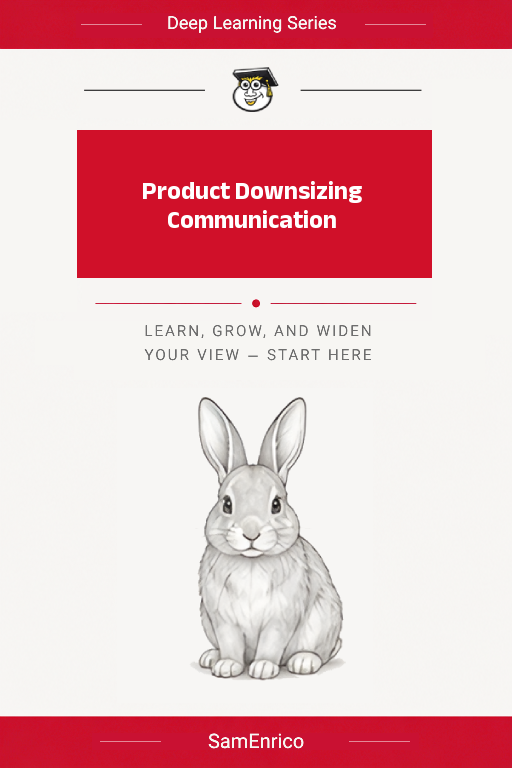
Product Downsizing Communication eBook
Announce net weight reductions as environmental in
by Hatton Noble
Announce net weight reductions as environmental initiatives, framing shrinkflation as sustainability rather than hidden price increase.
Formats
Free sample
Chapter 1: The Vanishing Ounce--–- Every morning, Maria did the same ritual. She poured herself a bowl of her favorite cereal—the one with the blue box and the smiling cartoon bee—added milk, and scrolled through her phone. One Tuesday, she noticed nothing different. The box looked the same. The price was the same.
The bee was still smiling. But when she finished her bowl and reached for a second serving, the box was empty. She had eaten the same number of spoonfuls as always, but the bowl had been less full. Maria did what millions of consumers do every day: she felt a flash of irritation, shrugged, and added cereal to her shopping list. She did not write a angry tweet.
She did not switch brands. But somewhere in her brain, a small, indelible mark was made. That blue box had lost her trust.This is the shrinkflation trap, and it is one of the most dangerous, invisible, and self-inflicted wounds in modern commerce. Every year, thousands of products across dozens of categories reduce their net weight while keeping their price constant. The motivations are obvious: raw material costs rise, supply chains become more expensive, and brands fear the consumer backlash of a visible price increase.
So they take the hidden path. They shave five grams off the chocolate bar. They reduce the diameter of the toilet roll tube. They thin the plastic of the water bottle. And they say nothing.The data on this practice is staggering.
In the European Union alone, consumer protection agencies tracked over 2,300 distinct shrinkflation events between 2021 and 2024, affecting everything from pasta to laundry detergent to coffee. In the United States, the Biden administration made shrinkflation a White House talking point, with the Council of Economic Advisers estimating that hidden weight reductions accounted for nearly 15 percent of perceived inflation in packaged goods during the peak cost-of-living crisis. And yet, despite its prevalence, almost every brand executes shrinkflation poorly. They hide. They hope no one notices.
And when someone does notice—when a Tik Tok user holds up an old package next to a new one and asks "Does this look smaller to you?"—the brand scrambles, issues a jargon-filled non-apology, and watches its reputation crater.This book is about doing the opposite. It is about taking the most sensitive, most risky, most trust-eroding act in consumer goods—reducing the amount of product you sell—and transforming it into a signal of environmental leadership, transparency, and long-term thinking. But before we can build that new framework, we must understand the enemy. And the enemy is not consumer anger. The enemy is loss aversion, temporal discounting, and the thousand small ways that human psychology makes a missing ounce feel like a personal betrayal.The Vanishing Ounce: Why Loss Aversion Rules the Shopping Aisle Let us start with a simple experiment, one that has been replicated in behavioral economics labs around the world for four decades.
Two groups of people are given the same scenario. Group A is told: "You find 10onthestreet.Howhappyareyou?"Group Bistold:"Youhad10 on the street. How happy are you?" Group B is told: "You had 10onthestreet.Howhappyareyou?"Group Bistold:"Youhad10 in your pocket, but you lost it. How upset are you?" The results are always the same, regardless of culture, age, or income. The pain of losing 10isroughlytwiceasintenseasthepleasureoffinding10 is roughly twice as intense as the pleasure of finding 10isroughlytwiceasintenseasthepleasureoffinding10.
This is loss aversion, the foundational insight of Daniel Kahneman and Amos Tversky's prospect theory, and it explains more about consumer behavior than almost any other single psychological principle.Loss aversion is not a bug in human cognition. It is a feature, honed by millions of years of evolution. For our ancestors, losing a food cache or a water source could mean death. Gaining an extra cache was merely a bonus. The brain therefore evolved to treat losses as catastrophic and gains as secondary.
In the modern supermarket, that ancient wiring is still firing. When a consumer opens a package and finds less product than they expected, their brain does not process it as "the brand made a rational supply chain adjustment." It processes it as a loss. A theft. A violation of an implicit contract.Here is what that implicit contract looks like: "I have paid this price for this package size for months or years. The brand and I have an understanding.
The blue box means a certain amount of cereal. The red can means a certain amount of soup. When I reach for it on the shelf, I am not calculating unit prices or reading fine print. I am relying on habit, pattern recognition, and trust." When the brand silently changes the terms of that contract, the consumer feels betrayed. And because loss aversion amplifies the emotional weight of that betrayal, the response is often wildly disproportionate to the actual harm.
A missing fifty grams of cereal can trigger more outrage than a five percent price increase on the same product, even though the economic impact is identical.This is the shrinkflation trap. Brands choose downsizing because they believe it is less visible than a price hike. But loss aversion makes it more emotionally damaging. The price hike is a clear, transparent, upfront loss. The consumer sees the new price tag, makes a deliberate choice, and can attribute the increase to inflation, supply chains, or greedy corporations—but at least they saw it coming.
The silent downsizing, by contrast, is a hidden loss. It violates expectations. It feels like a trick. And as we will see throughout this book, consumers will forgive almost anything except being tricked.The Boredom of Carbon: Why Environmental Metrics Fail to Move Us If loss aversion explains why downsizing triggers rage, another psychological principle explains why environmental messaging so often fails to calm that rage. That principle is temporal discounting, and it is the subject of Chapter 2.
But we must introduce it here because it explains the central failure of most corporate sustainability communication.Imagine two statements. Statement A: "This product now contains 10 percent less volume." Statement B: "This product now has 15 percent lower carbon emissions." Which statement is more emotionally powerful for the average consumer? The data is clear: Statement A triggers anger. Statement B triggers boredom. Not because consumers don't care about the environment—polls consistently show that a majority of consumers say they care about sustainability.
But caring about a thing in the abstract is not the same as feeling that thing in the moment. Carbon emissions are an abstract, delayed, collective problem. A missing ounce of cereal is an immediate, concrete, personal problem.This is the central paradox of downsizing communication. The brand is making a change that, if framed correctly, could be presented as a genuine environmental benefit. Less product means less material extraction, less manufacturing energy, less transportation fuel, less packaging waste, less landfill burden.
But the consumer does not see any of that. They see a smaller box. And because the environmental benefits are abstract and future-oriented—"This change will reduce our carbon footprint by 2030"—while the cost is concrete and immediate—"I have less food to eat today"—the consumer's brain discounts the future benefit almost entirely.Kahneman and Tversky would…
This is the end of the free sample. Get the eBook to keep going. Buy now
About this book
Details
- Author
- Hatton Noble
- Publisher
- SamEnrico
- Language
- English
- Genre
- Non-Fiction, Business Brief
- Released
- 2026-06-02
- Pages (approx.)
- 143
- Available as
- eBook, Audiobook

Read better in the ZLOADR app
Your eBooks on your phone or tablet. Sign in with your SamEnrico account and start reading.
More by Hatton Noble
 Uruguay Remote Tax GuideHatton Noble$11.99
 Patreon Creator ComparisonHatton Noble$11.99
 The Mayor's Homeless DiariesHatton Noble$11.99
 TM for Mornings Energy BoostHatton Noble$11.99
 Headache Sleep Meditation GuideHatton Noble$11.99
 Empathy For Teenagers GuideHatton Noble$11.99
 Sleep Apnea AffirmationsHatton Noble$11.99
 Pomodoro For Video EditingHatton Noble$11.99
 Cameron AvatarHatton Noble$11.99
 The Silk Road Blackmail: How Ross Ulbricht’s Empire FellHatton Noble$11.99
 The Van Gogh Heist: How a Forger Fooled the WorldHatton Noble$11.99
 The Oud Thief of Damascus: How a 18th-Century Musician Stole the Heart of the Middle EastHatton Noble$11.99
You may also like
 Franchising Your Local Brand Across Borders Child Labor LawsWilson Ida$11.99
 Franchising Your Local Brand Across Borders Beneficial OwnershipGordon Debbie$11.99
 Franchising Your Local Brand Across Borders Trade SecretsKeener Tatum$11.99
 Franchising Your Local Brand Across Borders Performance DashboardsCota Lisette$11.99
 Franchising Your Local Brand Across Borders Parallel ImportsBailey Wallace$11.99
 Franchising Your Local Brand Across Borders Packaging RegulationsRandle Adaline$11.99
 Franchising Your Local Brand Across Borders Know Your CustomerMyers Adam$11.99
 Franchising Your Local Brand Across Borders Human TraffickingFranklin Lee$11.99
 Franchising Your Local Brand Across Borders Government IncentivesLogsdon Beckie$11.99
 Franchising Your Local Brand Across Borders Carbon FootprintMcfarlane Margot$11.99
 Franchising Your Local Brand Across Borders Bribery LawsStarr Cortney$11.99
 Franchising Your Local Brand Across Borders Best Practice SharingBryson Vernia$11.99