
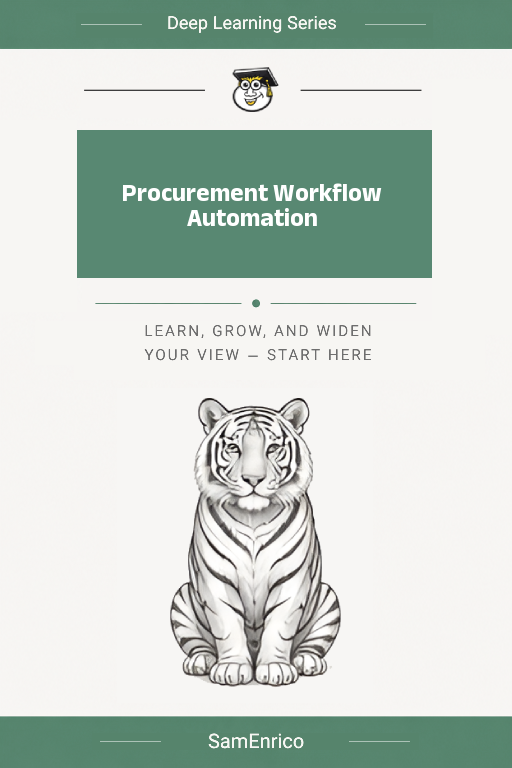
Procurement Workflow Automation eBook
Replaces manual steps with automated triggers for
Replaces manual steps with automated triggers for requisition routing, PO generation, invoice matching, and payment scheduling.
Formats
Free sample
Chapter 1: The Spaghetti Map Revelation--–- The email arrived at 4:47 PM on a Tuesday, which everyone in procurement knows is the worst time for bad news. A global retailer—let's call them Omni Goods—had just finished a $2.3 million implementation of a best-in-class procurement automation suite. The steering committee was scheduled to celebrate with champagne the following morning. Instead, the project lead, a sharp but exhausted CIO named Marcus, stared at a dashboard showing that 63% of purchase orders were still being processed manually. The new system wasn't failing technically.
It was running perfectly. It was processing every request exactly as configured. And that was the problem. Marcus had automated chaos, and chaos, as it turns out, runs very efficiently when you point expensive software at it.The post-mortem took three weeks. Investigators interviewed forty-three employees across purchasing, accounts payable, warehouse operations, and IT.
They mapped workflows, traced approvals, and followed the digital breadcrumbs. What they found was a masterclass in organizational self-deception. The official policy manual, a 147-page document last updated during the Obama administration, described a pristine approval matrix: requisitions routed to department heads, then to finance if over 5,000,thentolegalifover5,000, then to legal if over 5,000,thentolegalifover25,000, then finally to a VP for anything over $100,000. Clean. Logical.
Completely fictional.The real workflow, discovered through forensic process mapping, was a monster of heroic workarounds, silent bypasses, and shadow systems that no one had ever documented because no one wanted to admit they existed. When the investigators drew the actual process on a whiteboard, it looked like a plate of spaghetti—lines crossing, looping back, dead-ending, and occasionally disappearing entirely. Thirty-seven percent of approved POs were actually approved via a secret Slack channel where managers traded screenshots and emoji reactions. Fifteen percent were never formally approved at all—buyers simply called suppliers and said "send it," then backfilled paperwork weeks later. The remaining approved POs that did follow a formal route took an average of twelve days, not because the rules were complex, but because the rules were ambiguous.
Approvers didn't know who was supposed to approve what, so they forwarded requests to each other in endless, polite loops.The new automation software, bless its literal heart, took every ambiguity as an instruction. When it encountered a requisition with two possible approval paths, it didn't guess. It stopped. When it found a missing delegate for an absent approver, it didn't escalate. It waited.
When it saw a GL code that didn't exist in the Chart of Accounts, it rejected the entire request rather than asking for clarification. The software was doing exactly what it was told. The problem was that no one had ever told it the truth.This chapter exists because Marcus's disaster happens every single day in organizations that believe software will save them. It won't. Software cannot fix a broken process.
It can only perform that broken process faster, more consistently, and with better audit trails—which is a terrifying thought when you realize how broken most procurement workflows actually are. Before you buy a single tool, before you write a single line of integration code, before you even schedule a demo with a vendor, you must map your current process in brutal, unflinching detail. This chapter is that process. You will learn how to conduct a Discovery Session that uncovers the real workflow hiding beneath the official one. You will learn to spot value leaks: the approval bypasses, shadow finance spreadsheets, and informal workarounds that drain millions from your bottom line.
And you will create the single most important document in your automation journey: the Approval Hierarchy Matrix, a concrete map of every role, every spend threshold, and every escalation path that will become the bedrock of your new system. By the end of this chapter, you will not be ready to automate. You will be ready to stop automating chaos.The Discovery Session: Asking Questions That Make People Uncomfortable Most process mapping exercises fail because they ask the wrong questions. The typical approach is to gather stakeholders in a conference room, hand out sticky notes, and say something like "let's document how we approve purchases." What follows is a group recitation of the official policy manual—the same fiction that got Marcus into trouble. People do not lie in these sessions, at least not deliberately.
They simply describe the world as they wish it existed, not as it actually exists. The person who bypasses approvals will not raise their hand and say "I ignore the rules every Tuesday." The finance clerk who maintains a secret spreadsheet will not volunteer that information in front of their boss. The manager who approves requests with a thumbs-up emoji in Slack knows that this is not compliant, but also knows that the official system is too slow to run the actual business.The Discovery Session, as defined in this chapter, is not a group exercise. It is a series of private, structured interviews with four distinct stakeholder groups, each asked a different set of questions designed to surface the real workflow. You will interview requestors (the people who need things), approvers (the people who say yes or no), AP clerks (the people who pay the bills), and buyers (the people who place the orders).
You will interview them separately, not because you don't trust them, but because each group experiences a different version of the truth.Interviewing Requestors: The People Who Just Need Stuff Requestors are the least politically invested in the procurement process. They don't care about compliance, audit trails, or preferred supplier programs. They care about getting a laptop, a software license, or a pallet of raw materials before their project fails. This makes them both the most honest witnesses and the most likely to have abandoned the official process entirely.Ask every requestor: "What do you do when the form is confusing or missing a field?" The answer will tell you how many people are abandoning the process at the first hurdle. One financial services firm discovered that 40% of requestors gave up on the requisition form entirely when it asked for a "cost center hierarchy" that no one could explain.
Those 40% either bought on corporate cards (creating maverick spend) or emailed a buyer directly (creating shadow workflows). The form wasn't malicious. It was just poorly designed. But the cost of that poor design was hundreds of thousands of dollars in off-policy spending.Ask: "How often do you use the corporate card for purchases that should go through procurement?" Frame this question without judgment. Say: "I'm not here to get anyone in trouble.
I'm here to understand how the system actually works. If the corporate card is easier, I need to know that." The answers will shock you. A mid-sized manufacturer learned that 60% of its office supplies were purchased on corporate cards because the procurement system required a separate requisition for every pack of pens. Employees weren't being lazy. They were being rational.
The official process was too expensive in terms of their own time.Ask: "When you need something urgently, what is your actual process from start to finish?" This is the question that uncovers the emergency bypass routes. One logistics company discovered that urgent requests were handled by…
This is the end of the free sample. Get the eBook to keep going. Buy now
About this book
Details
- Author
- Rowland Darlena
- Publisher
- SamEnrico
- Language
- English
- Genre
- Non-Fiction, Operational Efficiency Manual, Workflow
- Released
- 2026-05-26
- Pages (approx.)
- 151
- Available as
- eBook, Audiobook

Read better in the ZLOADR app
Your eBooks on your phone or tablet. Sign in with your SamEnrico account and start reading.
More by Rowland Darlena
 Everyday Mindfulness HandbookRowland Darlena$11.99
 Food Intolerance and SIBORowland Darlena$11.99
 The Prolonged Grief WorkbookRowland Darlena$11.99
 Code Creativity for ProgrammersRowland Darlena$11.99
 The Blue Zone Social ConnectionRowland Darlena$11.99
 The Master Forger's Gambit: The 1972 Montreal Art Heist and SiegeRowland Darlena$11.99
 Understanding Stein–leventhal SyndromeRowland Darlena$17.99
 Financial Forecasting AIRowland Darlena$12.99
 Business Relationship ManagerRowland Darlena$11.99
 How to Become a Sheet-metal-worker ApprenticeRowland Darlena$11.99